

Thousands of Skilled Workers came to the UK expecting to apply for Indefinite Leave to Remain (ILR) after five years. Many have built careers, bought homes or settled their children into school on that basis.
The earned settlement reforms announced on 2 November 2026 change that expectation. The Government has confirmed that the new framework will apply to people already in the UK, with only limited exceptions. If you are part-way through your five years, this is what it could mean for you.
Arrived in 2022? Your Settlement Date Could Move to 2032
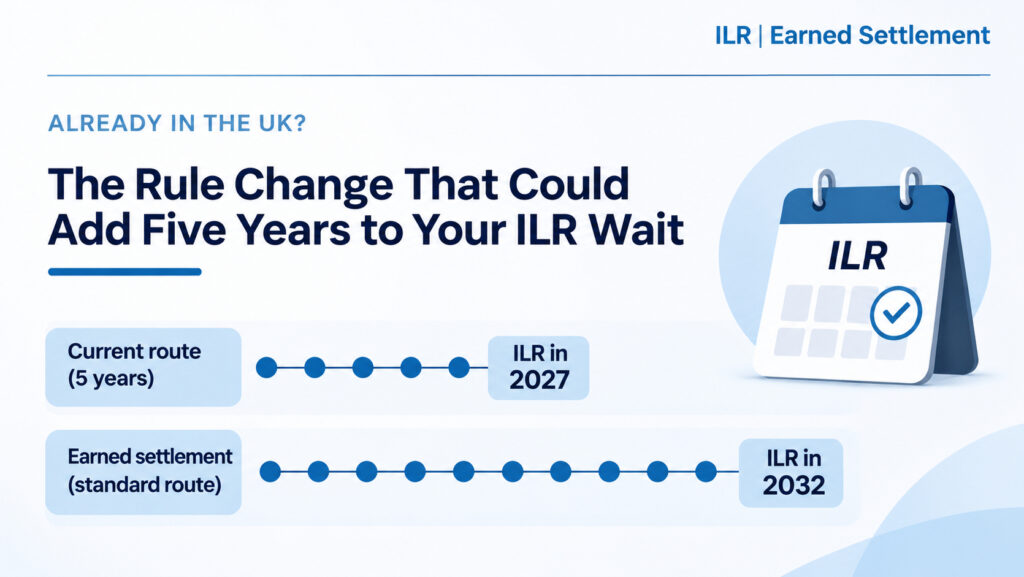
Take a Skilled Worker who arrived in 2022. Under the current rules, they would expect to apply for ILR in 2027.
Under earned settlement, the picture changes. Unless they earn at least £50,271 in three of the five years before applying, work in an eligible public service occupation or fall within one of the named transitional groups, they move to the standard 10-year path. Their earliest settlement date becomes 2032 (Figure 1).
Figure 1: Example timeline for a Skilled Worker who arrived in 2022
| Route | ’22 | ’23 | ’24 | ’25 | ’26 | ’27 | ’28 | ’29 | ’30 | ’31 | ’32 |
|---|---|---|---|---|---|---|---|---|---|---|---|
| Current five-year route | ILR | ||||||||||
| Earned settlement: £50,271+ in 3 of last 5 years | ILR | ||||||||||
| Earned settlement: standard 10-year path | ILR |
Illustrative only. Shaded cells show years of qualifying residence; “ILR” marks the earliest year an application could be made. Assumes all mandatory requirements are met and no transitional arrangement applies.**
For someone already in their fourth or fifth year, that difference affects real decisions: whether to buy a home, change jobs or commit to their children’s schooling here.
Why Your Arrival Date Won’t Protect You
Many migrants assumed that the rules in place when they arrived would apply when they came to settle. The Government’s position is the opposite. Its consultation response states that, unless transitional provisions are made, applications are ordinarily considered under the Immigration Rules in force on the date of the settlement decision. The Home Secretary repeated this in her statement to Parliament.
The transitional provisions that have been made are narrow. They cover care workers, certain lower-paid health and education workers and pre-April 2024 Skilled Workers who arrived before the Immigration White Paper was published in May 2025, and the Government says they “do not create a wider exemption for everyone already living in the UK”.
Flowchart: Which Settlement Path Are You On?
Figure 2 sets out the key questions in order. Work down from the top: the first “yes” shows the pathway that is likely to apply to you.
Figure 2: Which settlement path is likely to apply if you are already in the UK on a work route?
| START: You are in the UK on a work route that leads to settlement | ||
|---|---|---|
| ↓ | ||
| Do you meet the current five-year requirements and receive your ILR decision before the new Immigration Rules take effect? | Yes → | Current rules: settle at 5 years |
| ↓ No | ||
| Have you earned at least £125,141 in 3 of the last 4 years? | Yes → | 3-year pathway |
| ↓ No | ||
| Have you earned at least £50,271 in 3 of the last 5 years? | Yes → | 5-year pathway |
| ↓ No | ||
| Do you work in an eligible health or education public service occupation (for example, doctor, nurse or teacher)? | Yes → | 5-year pathway |
| ↓ No | ||
| Did you enter or switch into care work (earning £25,000+) or a national-pay-scale health or education role below RQF 6 before May 2025, and meet your visa conditions? | Yes → | 5-year route retained (transitional) |
| ↓ No | ||
| Have you committed a qualifying immigration breach or accessed public funds in the last 5 years? | Yes → | 20-year pathway |
| ↓ No | ||
| Standard 10-year pathway (earnings of at least £12,571 in 5 of the last 7 years) |
Simplified guide based on announced policy. It does not cover family, refugee, Hong Kong BN(O), armed forces or other routes, and every pathway also requires the mandatory requirements (criminal record, English at B2, no Government debt, National Insurance record and Life in the UK test).Is Your Pending ILR Application Safe?
If you have already applied, or are about to, timing matters more than ever.
Earned settlement only takes effect once the Immigration Rules are amended. If you meet the current five-year requirements and receive a decision before that date, your application should be assessed under the existing rules.
What the Government has not yet confirmed is how it will treat applications that are still undecided on the day the changes take effect. Until the amended rules and guidance are published, no one should assume that a pending application is either protected or lost. Figure 3 shows where the reforms currently stand.
Figure 3: Where the reforms stand – from White Paper to new Immigration Rules
| May 2025 | 20 Nov 2025 | 12 Feb 2026 | 2 Nov 2026 | Next | Then |
|---|---|---|---|---|---|
| Immigration White Paper proposes 10-year standard path | Earned settlement consultation opens | Consultation closes (204,667 responses) | Government response and statement to Parliament | Technical guidance published | Immigration Rules amended; new rules apply to decisions |
| Done | Done | Done | Done | Awaited | Awaited |
Source: GOV.UK, Earned settlement consultation page and Government response. No implementation date had been published at the time of writing.Close to Five Years? Why You Should Act Now
If you are approaching your five-year date, check now that you meet every requirement of your current route, including continuous residence, English language and the Life in the UK test. Applying as soon as you are eligible, rather than waiting, could be the difference between the five-year and the 10-year path.
How Morgan Smith Immigration Can Help
We are reviewing clients’ settlement timelines against the announced pathways, so that anyone who can still qualify under the current five-year rules does not miss the window.
Our ILR Eligibility Calculator gives an initial estimate of when you may qualify under the current Immigration Rules: https://morgansmithimmigration.com/ilr-calculator/#ilr-latest-changes
For advice on your own circumstances, contact Morgan Smith Immigration on 0203 959 3335 or email [email protected].