

Month: July 2026

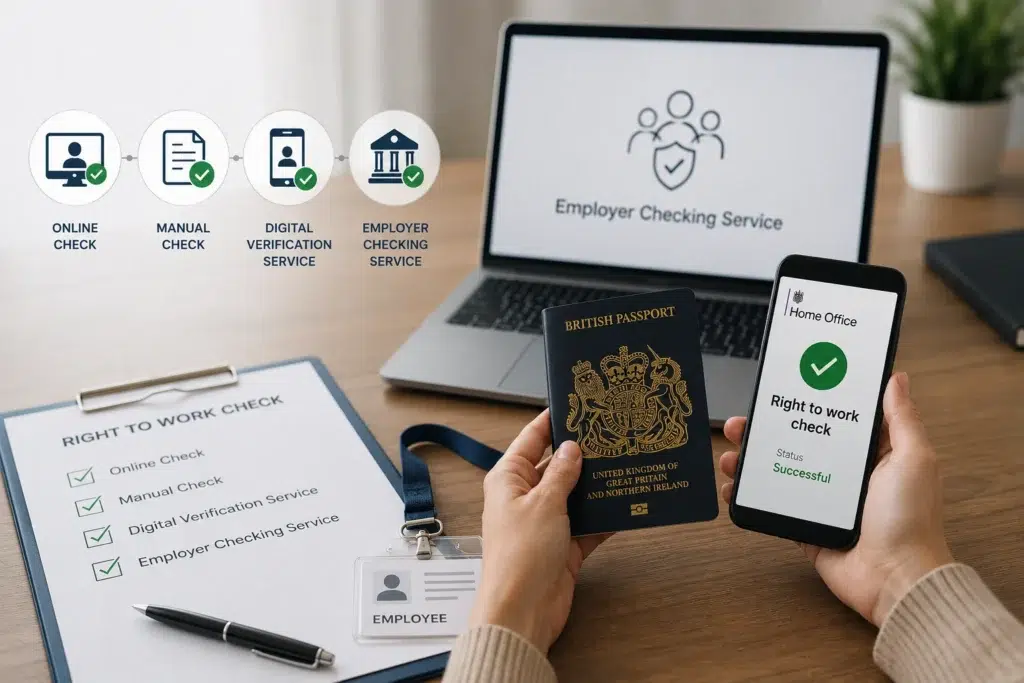
When Should Employers Use the Employer Checking Service?

Completing a compliant Right to Work check is a legal requirement for every UK employer. In most cases, this is straightforward. Employers can verify an individual’s Right to Work by carrying out an online Right to Work check using a share code, a manual Right to Work check or, where appropriate, a Right to Work Digital Verification Service Provider (RtW DVSP) check.

When Should Employers Use the Employer Checking Service? Read More »

Temporary Shortage List Stage 2 Report illustration showing construction, engineering and digital professionals representing the MAC's latest recommendations for UK overseas recruitment and workforce planning.

Temporary Shortage List Stage 2 Report: What the MAC’s Latest Recommendations Mean for UK Employers

The Migration Advisory Committee (MAC) has published its Temporary Shortage List (TSL) Stage 2 Report, setting out its final recommendations on which occupations should receive temporary access to overseas recruitment under the Government’s new immigration framework.

Temporary Shortage List Stage 2 Report: What the MAC’s Latest Recommendations Mean for UK Employers Read More »

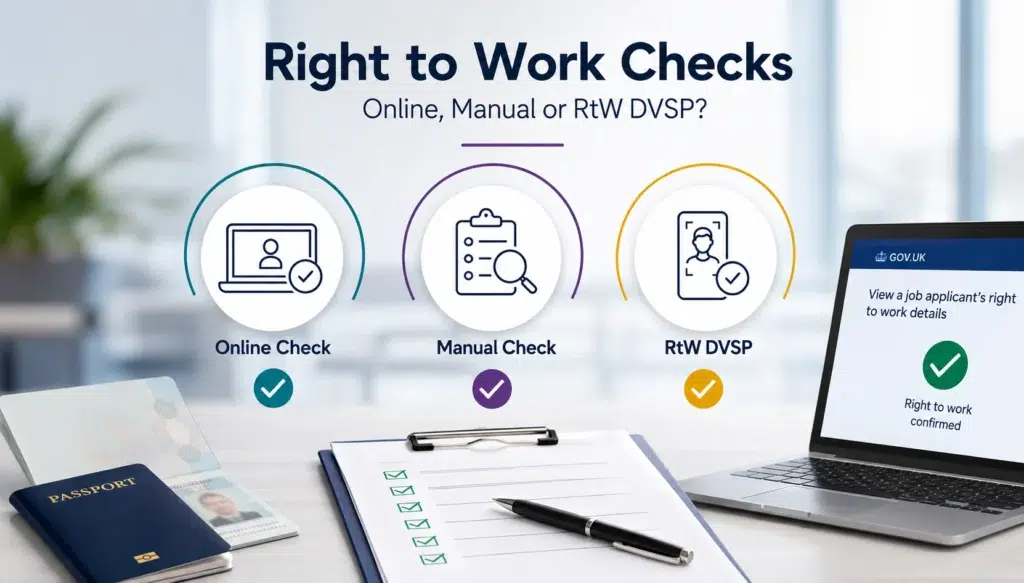
Professional illustration comparing the three Right to Work Check methods in the UK, showing online, manual and RtW DVSP checks with digital verification, documents and employer compliance elements.

Online Right to Work Check vs Manual Check vs RtW DVSP: A Guide for UK Employers

Carrying out a Right to Work check is one of the most important legal responsibilities for UK employers. A correctly completed check helps establish a statutory excuse against a civil penalty if it later emerges that an individual did not have the right to work in the UK. Conversely, failing to carry out the prescribed check, or using the wrong checking method, may expose an employer to significant penalties and potential criminal liability where illegal working is knowingly facilitated.

Online Right to Work Check vs Manual Check vs RtW DVSP: A Guide for UK Employers Read More »

India Young Professionals Scheme graphic featuring an Indian passport, aircraft, travel documents and UK destination concept representing the final 2026 ballot and visa opportunity.

India Young Professionals Scheme Ballot Opens on 21 July 2026: Final Opportunity to Apply This Year

UK Home Office has confirmed the dates for India Young Professionals Scheme ballot for 2026. The ballot will open at 1:30pm India Standard Time (IST) on 21 July 2026 and will close at 1:30pm IST on 23 July 2026, giving eligible applicants a 48-hour window to submit their entry.

India Young Professionals Scheme Ballot Opens on 21 July 2026: Final Opportunity to Apply This Year Read More »

Could Salary Transparency Signal the Return of Labour Market Testing in UK Recruitment? 

Labour Market Testing could once again become a key consideration for UK employers as the Government proposes significant changes to recruitment practices. Under new plans to strengthen anti-discrimination laws, employers may soon be required to include salary information in job advertisements and provide greater transparency about pay before recruitment decisions are made.

Could Salary Transparency Signal the Return of Labour Market Testing in UK Recruitment?  Read More »

Statement of Changes to the Immigration Rules Introduces Updates to the Graduate Route, Appendix FM and Family Provisions

On 9 July 2026, the Home Office published a new Statement of Changes to the Immigration Rules (HC 259), introducing a number of amendments affecting family migration, the Graduate route, the EU Settlement Scheme, diplomatic visas and other immigration provisions.

Statement of Changes to the Immigration Rules Introduces Updates to the Graduate Route, Appendix FM and Family Provisions Read More »

Statement of Changes HC 259 and the 14-day overstaying rule from 3 August 2026 — calendar with day 14 circled next to a UK passport

Statement of Changes HC 259: The 14-Day Overstaying Rule Now Matters More Than Ever from 3 August 2026

The Home Office published Statement of Changes HC 259 on 9 July 2026. From 3 August 2026, more immigration routes are aligned with Part Suitability, making the 14-day overstaying rule under SUI 13.1 more important than ever. If your UK visa has expired, you must act quickly.

Statement of Changes HC 259: The 14-Day Overstaying Rule Now Matters More Than Ever from 3 August 2026 Read More »

Settlement Reforms illustration featuring the Home Office, UK Parliament, scales of justice and migrant families, highlighting proposed changes to UK immigration and Indefinite Leave to Remain (ILR).

Home Office May Soften Proposed Settlement Reforms for Existing Migrants

UK Government is reportedly considering changes to its proposed settlement reforms that could reduce the impact on many migrants already living and working in the UK. According to recent reports, ministers are exploring whether individuals who arrived in the UK from 2021 onwards could continue to qualify for Indefinite Leave to Remain (ILR) after five

Home Office May Soften Proposed Settlement Reforms for Existing Migrants Read More »

UK passport and legal papers near Westminster representing section 7 Immigration Act 1971 deportation law

Section 7 Immigration Act 1971 Deportation: Shabir Ahmed, Citizenship and Serious Crime

Section 7 of the Immigration Act 1971 can still protect some pre-1973 Commonwealth and Irish residents from deportation, even after British citizenship deprivation. We explain the Shabir Ahmed controversy, the current law, possible reform and what this means for British citizenship applicants.

Section 7 Immigration Act 1971 Deportation: Shabir Ahmed, Citizenship and Serious Crime Read More »

Scroll to Top