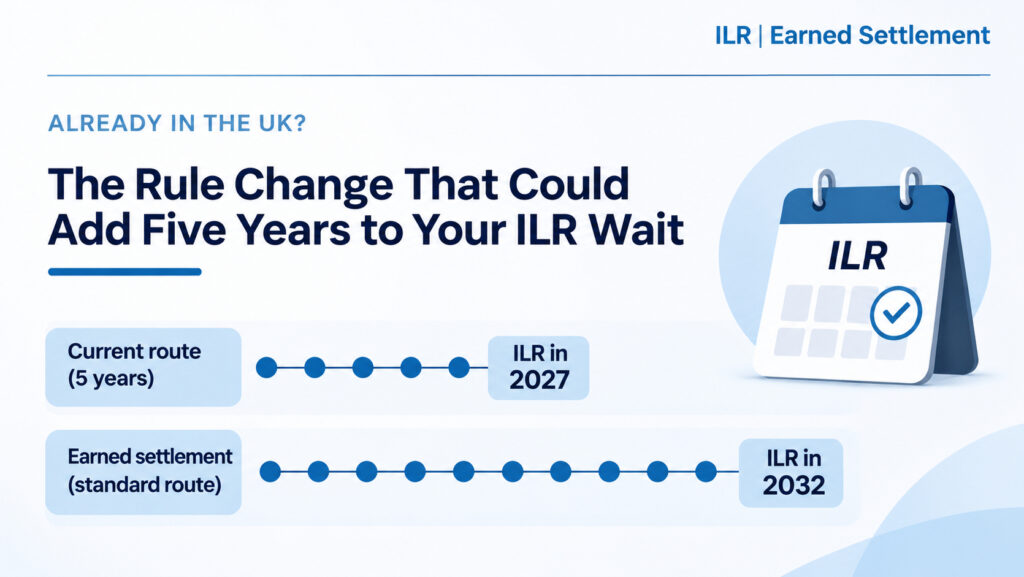


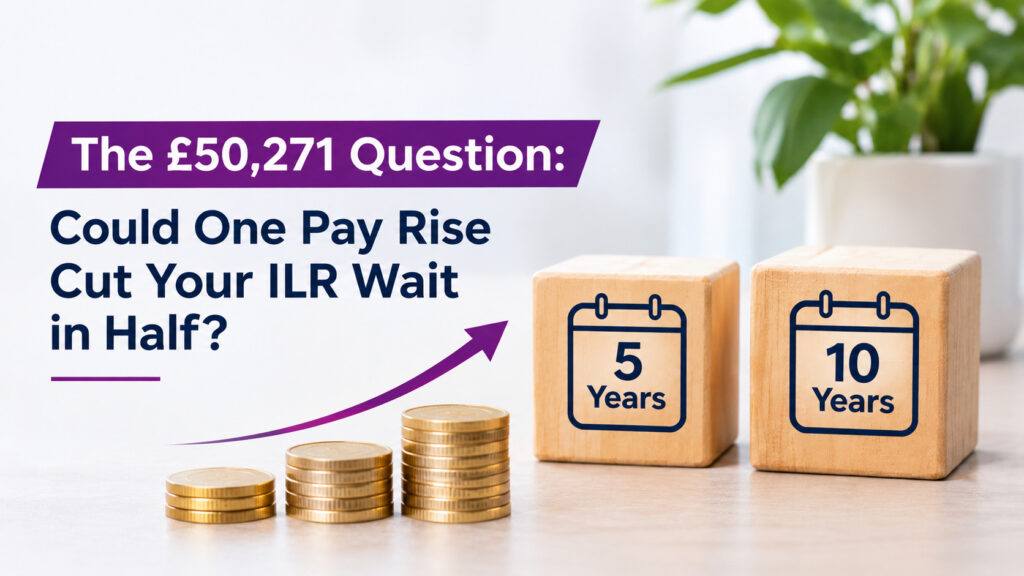
Under the UK’s new earned settlement model, your salary could decide whether you wait five years or 10 for Indefinite Leave to Remain (ILR).
That makes pay one of the most important conversations a sponsored worker will have with their employer, and it brings new costs for families facing a longer stay on temporary visas. Here is what the numbers mean for employees and for the businesses that sponsor them.
The Salary Lines That Now Decide Your Wait
The Home Office’s announcement refers to earnings of more than £50,271, while the Home Secretary’s statement to Parliament rounded this to £50,000. The Government response sets the precise tests. They are tied to income tax thresholds and will move if those thresholds change (Figure 1).
Figure 1: How earnings decide your qualifying period
| Earnings test | Years that must meet it | Qualifying period |
|---|---|---|
| £125,141 or more (additional rate) | 3 of the last 4 years | 3 years |
| £50,271 or more (higher rate) | 3 of the last 5 years | 5 years |
| £12,571 or more (basic rate) | 5 of the last 7 years | 10 years |
| Couples: £25,142 combined household income | Counts towards the minimum contribution requirement | Settle together on the applicable path |
Source: Home Office, A Fairer Pathway to Settlement: Government Response, Chapter 2 (Contribution). Children, people aged 65 and over and those unable to work because of a physical or mental condition are exempt from the minimum income requirement.**
The “best years” approach matters. Because only three of the last five years need to meet the £50,271 line, a period of parental leave, caring or illness does not automatically push someone onto the longer path.
Will Your Employees Start Asking for Pay Rises?
For most people on work routes, salary now decides whether the wait is five years or 10. That puts pay at the centre of conversations between sponsored workers and their employers.
A sponsored employee earning £42,000 now has a clear reason to push for a substantial rise. To reach the five-year route, they would need to earn at least £50,271 in three of the five years before applying.
Employers cannot always say yes. Salary decisions depend on business finances, market rates, internal pay structures and the responsibilities of each role. A business with several sponsored workers could receive a cluster of salary review requests in a short space of time, and an increase for one sponsored employee is likely to be noticed by colleagues in the same role.
The Home Office expects some of this. Its fiscal analysis notes that people on the 10-year path may try to change occupation or employer in order to settle sooner.
When Good Work Isn’t Enough: The Salary Gap
A worker can perform well, meet every sponsorship condition and still miss the shorter route because their salary sits below the line.
The Government accepts that “salary alone does not capture every form of contribution”, which is why the final framework also recognises public service, household income and British connections. Doctors, nurses and teachers in eligible roles can settle after five years whatever their salary. For a chef earning £30,000, or a care assistant who arrived after May 2025, the practical result is still a 10-year wait. Figure 2 shows the quick check.
Figure 2: Five or 10 years? A quick salary check
| START: You meet all the mandatory settlement requirements | ||
|---|---|---|
| ↓ | ||
| Have you earned at least £125,141 in 3 of the last 4 years? | Yes → | 3-year pathway |
| ↓ No | ||
| Have you earned at least £50,271 in 3 of the last 5 years? | Yes → | 5-year pathway |
| ↓ No | ||
| Do you work in an eligible health or education public service occupation? | Yes → | 5-year pathway |
| ↓ No | ||
| Standard 10-year pathway: earnings of at least £12,571 in 5 of the last 7 years (or £25,142 combined as a couple) |
Simplified guide. Transitional arrangements for some existing care, health and education workers, and longer paths for immigration breaches or use of public funds, are not shown.The Hidden Bill: What a 10-Year Wait Could Cost Your Family
Five extra years on a temporary visa means more applications. The Home Secretary has confirmed that people on the 10-year path will be able to renew their existing temporary visas until they qualify, but each renewal brings an application fee and an Immigration Health Surcharge payment.
For a household of two adults and two children, every family member needs each extension. A longer path is therefore not one extra application but a series of renewals, repeated for every person.
There is one concession for families. Couples will be able to combine their earnings to meet a household threshold of £25,142, so a partner who works fewer hours to care for children is not automatically held back.
What Employers Should Do Now
-
Identify which sponsored employees earn close to £50,271, and which are likely to need sponsorship for up to 10 years.
-
Budget for longer sponsorship periods and repeat visa extensions.
-
Handle settlement-driven pay requests through your normal pay review process, and record the reasons for each decision so that employees in similar roles are treated consistently.
How Morgan Smith Immigration Can Help
Our immigration specialists advise employees on their settlement timeline and employers on their sponsorship obligations under the new framework.
Our ILR Eligibility Calculator gives an initial estimate of when you may qualify under the current Immigration Rules: https://morgansmithimmigration.com/ilr-calculator/#ilr-latest-changes
For advice on your own circumstances, contact Morgan Smith Immigration on 0203 959 3335 or email [email protected].