

On 2 November 2026, Home Secretary Shabana Mahmood confirmed the biggest change to UK settlement in decades. Indefinite Leave to Remain (ILR) will no longer follow almost automatically after five years. Under the new “earned settlement” model, how long you wait will depend on what you earn, the work you do and your immigration record.
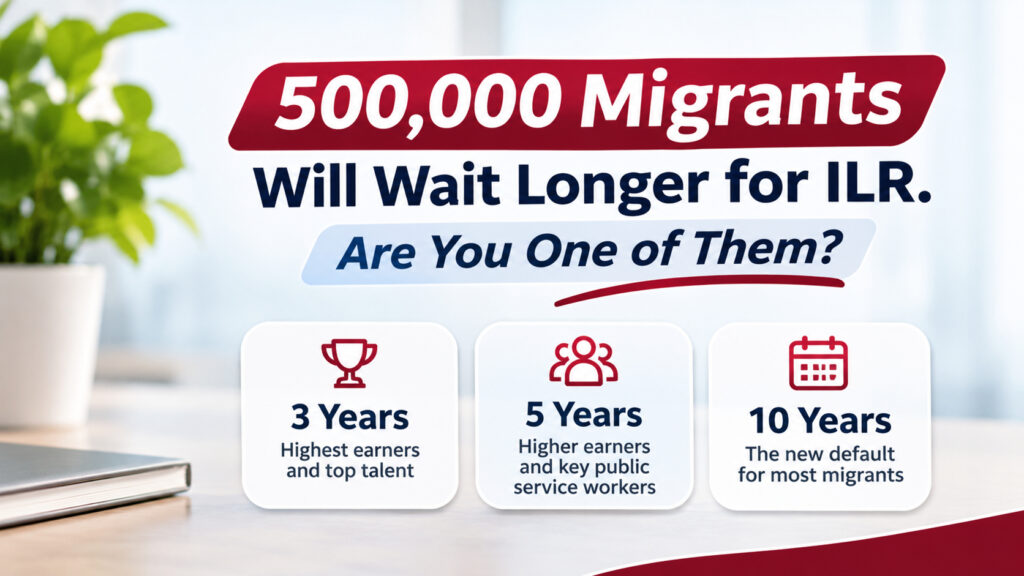
The Home Office’s own estimate is that over 500,000 people will now wait longer than five years to settle. If you hold a work visa today, this article explains the new pathways, who is protected and where you are likely to sit.
The End of Automatic Five-Year Settlement
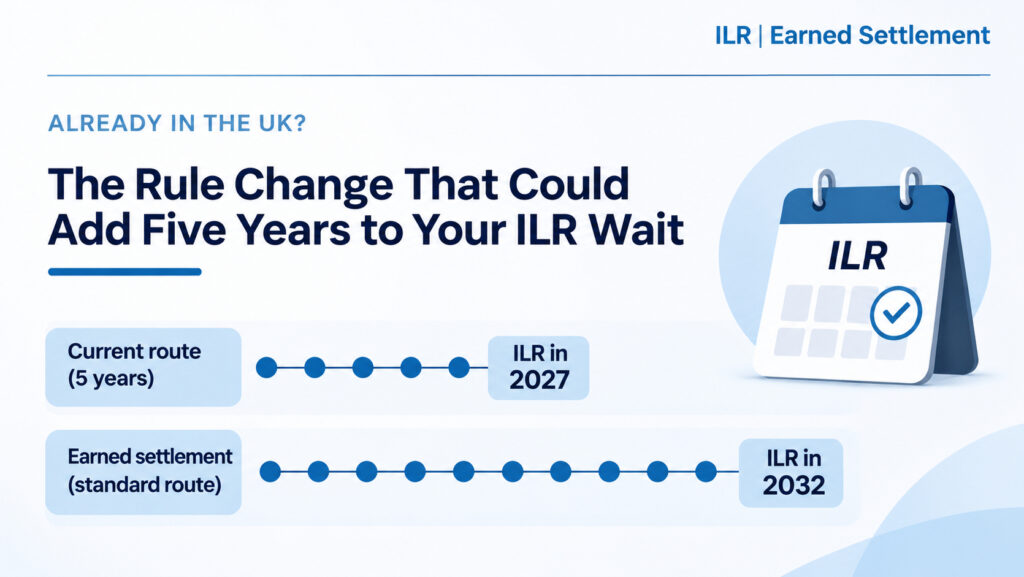
Under the framework confirmed in the Government’s consultation response, A Fairer Pathway to Settlement, the standard qualifying period for ILR rises from five to 10 years. Faster routes of three and five years remain for higher earners and certain public service workers. People who breach immigration rules face a path of at least 20 years.
Earnings are not the only test. Every applicant must also meet a set of mandatory requirements, which the Government says higher earnings cannot offset. Figure 1 sets out the full picture.
Figure 1: Earned settlement pathways at a glance
| Qualifying period | Who it is for | Main contribution test |
|---|---|---|
| 3 years | Highest earners and the Highest Talent Group (for example, Global Talent and Innovator Founder) | Earned at least £125,141 in 3 of the last 4 years |
| 5 years | Higher earners, eligible health and education public service workers (for example, doctors, nurses and teachers) and people with a British connection | Earned at least £50,271 in 3 of the last 5 years, or 5 years in an eligible public service occupation, or a British connection |
| 10 years | The new default for everyone else | Earned at least £12,571 in 5 of the last 7 years (couples may combine earnings to meet £25,142) |
| 20 years | People with a qualifying immigration breach or who have accessed public funds in the last 5 years | Earned at least £12,571 in 5 of the last 7 years |
| All pathways | Mandatory requirements that higher earnings cannot offset | Clean criminal record, no debt owed to Government, English at B2, Life in the UK test, sustained National Insurance contributions |
Source: Home Office, A Fairer Pathway to Settlement: Government Response to the Consultation (Table 1) and GOV.UK announcement of 2 November 2026.The Non-Negotiables: Requirements No Salary Can Offset
Whichever pathway applies to you, the Government has said you will first need:
-
a clean criminal record, a stricter standard than today’s threshold of a 12-month suspended sentence
-
English at B2 level, which the Home Office describes as equivalent to A-Level English as a foreign language
-
no outstanding debt owed to the Government
-
a sustained record of National Insurance contributions (the Home Secretary referred to three years)
-
a pass in the Life in the UK test
How Many People Will Wait Longer?
The Home Office forecasts that, without these reforms, around 1.9 million people would have settled in the UK between 2026 and 2030. With earned settlement, its central estimate falls to 1.4 million (Figure 2).
Figure 2: Forecast settlement grants, 2026 to 2030 (central estimate)
| Scenario | Settlement grants |
|---|---|
| Without earned settlement | ██████████████████████████████████████1.9 million |
| With earned settlement | ████████████████████████████1.4 million |
| Difference | Over 500,000 people settle later than under current arrangements |
Source: Home Office, A Fairer Pathway to Settlement: Government Response, Annex A (forecast excludes EUSS and EEA Family Permit grants).**
Work routes account for much of the change. The Home Office expects around 146,000 Skilled Workers and 85,000 of their dependants to move onto the 10-year path. By contrast, people on a family route sponsored by a British citizen who meet the core requirements keep their five-year route.
Who Still Gets the Five-Year Route?
The Home Office has confirmed that family members of British citizens, Hong Kong British Nationals (Overseas) and members of the armed forces will keep their current pathways.
It has also made targeted transitional arrangements for people who arrived before the Immigration White Paper was published in May 2025:
-
Care workers who earned at least £25,000 a year and met their sponsorship and employment conditions keep the five-year route. Those who did not, which the Home Office puts at around a quarter of the cohort, will be offered a further five-year Health and Care visa before applying again.
-
Workers in health and education roles below RQF 6 that are paid on a national pay scale, such as nursing auxiliaries and teaching assistants, keep the five-year route if they meet their visa requirements.
Skilled Workers who joined the route before April 2024 will be able to extend their visas on their current terms until 2035.
The Government response is clear that these arrangements “do not create a wider exemption for everyone already living in the UK”. On the current plans, a Skilled Worker in a mid-salary role who does not fit one of these groups will be assessed under the new framework.
Not Law Yet: What Happens Next
Earned settlement is announced policy. It will only apply once the Immigration Rules are amended and no implementation date has been published. The Government has also confirmed that it will publish further technical guidance before implementing the reforms. In addition, the Home Secretary has stated that the Government will publish a full impact assessment as it introduces the changes.
Settled status will not be removed from anyone who already holds it, and the Home Office has said no one will be forced to leave.
How Morgan Smith Immigration Can Help
If you are working towards ILR, the most useful step you can take now is to find out which pathway you are likely to fall into and whether you can still qualify under the current five-year rules before the changes take effect.
Our ILR Eligibility Calculator gives an initial estimate of when you may qualify under the current Immigration Rules: https://morgansmithimmigration.com/ilr-calculator/#ilr-latest-changes
For advice on your own circumstances, contact Morgan Smith Immigration on 0203 959 3335 or email [email protected].