

Urgent warning: If your UK visa has expired, or is about to expire, you may only have a very short window to fix the problem. In many cases, that window is just 14 days.
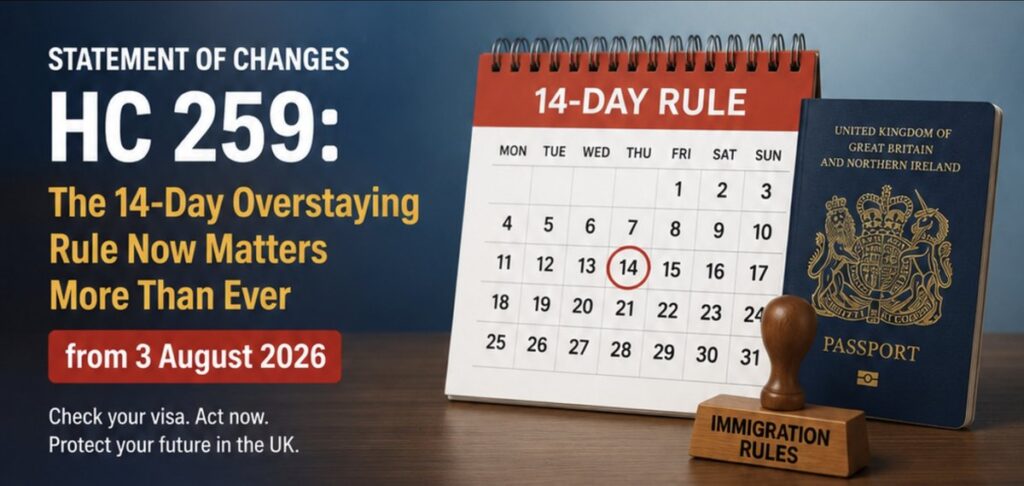
The Home Office published a new Statement of Changes to the Immigration Rules: HC 259 on 9 July 2026. For many applicants, the most important practical message is simple: check your visa expiry date now. If your visa has expired, act urgently.
From 3 August 2026, more immigration routes will be aligned with Part Suitability. This means the Home Office will look closely at whether an applicant is in breach of immigration laws, including whether they have overstayed. This is where paragraph SUI 13.1, known as the Exceptions for overstayers rule, becomes extremely important.
What is the 14-day overstaying rule?
If your UK visa or immigration permission expires, you are generally expected to either:
- leave the UK before your permission expires; or
- apply for further permission before your permission expires.
If you stay in the UK after your permission expires, this is usually called overstaying.
The Immigration Rules contain a limited exception under paragraph SUI 13.1. This rule can allow the Home Office to disregard a short period of overstaying in specific circumstances. However, this is not automatic. You must fall within the rule, act quickly, and provide the correct evidence.
Does the 14-day rule apply to you?
Use this table as a simple guide.
| Your situation | Could the 14-day rule help? | What you should do |
|---|---|---|
| Your visa has not expired yet | Not needed yet | Apply before your visa expires |
| Your visa expired less than 14 days ago | Possibly | Act immediately and prepare evidence |
| Your visa expired more than 14 days ago | Much harder | Get urgent legal advice before applying |
| You forgot the deadline | Usually no | Forgetting alone is unlikely to qualify |
| You were seriously ill or hospitalised | Possibly | Obtain medical evidence urgently |
| Your previous application was made in time but refused | Possibly | Check the refusal date and any appeal or administrative review deadline |
| Your previous application was made in time but rejected as invalid | Possibly | A fresh application may need to be made within 14 days |
| You left the UK after overstaying | Different rules apply | You may face a re-entry ban |
When can SUI 13.1 apply?
For most applicants today, SUI 13.1 is relevant in two main situations.
1. You apply within 14 days of your visa expiring
This may apply if:
- your visa or permission has expired;
- you submit a new application within 14 days of expiry;
- you provide a good reason with the application;
- the reason was beyond your control or your representative’s control; and
- the Home Office accepts the explanation.
Examples of reasons that may be considered include a serious medical emergency, hospitalisation, bereavement, or another exceptional event that genuinely prevented you from applying on time. But weak explanations are unlikely to succeed. For example, saying “I forgot”, “I was busy”, or “I did not check my eVisa” will usually not be enough.
2. You previously applied before your visa expired, but your application was refused or rejected
This may apply if:
- you made your previous application before your visa expired;
- that application was later refused or rejected;
- you still act within the correct 14-day period; and
- the new application is submitted properly.
This can be complicated because the 14 days may run from different dates depending on the case. For example, it may depend on:
- the date of refusal;
- the date of rejection;
- whether section 3C leave applied;
- whether you had a right of appeal;
- whether you had administrative review rights;
- when an appeal or administrative review ended, was withdrawn, or lapsed.
If you have received a refusal or rejection, do not guess the deadline. Get advice urgently.
What changed under HC 259?
HC 259 does not create a brand-new 14-day rule. The 14-day overstayer exception already exists under Part Suitability, paragraph SUI 13.1.
The important change is that HC 259 continues to align more immigration routes with Part Suitability. This means more routes now use the same suitability wording, including whether a person is in breach of immigration laws unless the Exceptions for overstayers section applies.
A key example: from 3 August 2026, the relevant routes are amended so that being on immigration bail does not, by itself, block an application where the SUI 13.1 exception applies. This fix has been replicated across work, study, family and settlement routes, so that an application made within the 14-day window can be considered on its merits rather than refused on a technicality.
In practical terms, this makes the 14-day rule more important because applicants in more routes may now need to show that any overstaying is covered by SUI 13.1. Many of the relevant HC 259 changes take effect from 3 August 2026.
Why is this urgent?
Overstaying is not a minor issue. If the Home Office does not accept that SUI 13.1 applies, your application may be refused. If you leave the UK after overstaying and later apply to return, you may also face a mandatory refusal period, often called a re-entry ban. Depending on the circumstances, this can be:
| Situation | Possible consequence |
|---|---|
| You leave voluntarily at your own expense after overstaying | 12-month refusal period may apply |
| You leave at public expense | 2-year or 5-year refusal period may apply |
| You are removed from the UK at public expense | 10-year refusal period may apply |
| Deception was used in an application | 10-year refusal period may apply |
Every case depends on the facts, including how long you overstayed, how you left the UK, and whether an exception applies.
Practical examples
Example 1: Student visa expired 7 days ago because of a medical emergency
A student’s visa expired on 1 September. They were unexpectedly admitted to hospital before the expiry date and could not deal with the application in time. They contact an adviser on 6 September and submit a valid application on 8 September with hospital records and a clear explanation.
This may fall within SUI 13.1 because the application was made within 14 days and the reason may have been beyond the student’s control. The key point is evidence. The Home Office will need to see documents supporting the explanation.
Example 2: Skilled Worker forgot the visa expiry date
A Skilled Worker’s visa expired on 1 September. They submit an application on 10 September and explain that they forgot because they were busy at work. Although the application was made within 14 days, this may still fail. Why? Because forgetting the deadline or being busy is unlikely to be accepted as a good reason beyond the applicant’s control.
Example 3: Previous application was submitted in time but rejected as invalid
A person’s visa expired on 10 May. They submitted an application on 4 May, before the visa expired. The Home Office later rejected the application as invalid because there was a payment issue. The person then submits a fresh application within 14 days of receiving the rejection.
This may fall within SUI 13.1 because the earlier application was made in time and the fresh application was made within the relevant 14-day period.
Example 4: Application refused after being submitted in time
A person applied before their visa expired. The Home Office later refused the application. They may still have appeal rights or administrative review rights. Their section 3C leave position may also need to be checked. If they want to submit a fresh application, the 14-day deadline must be calculated carefully. This is not a situation where an applicant should guess. A wrong calculation could put the new application at risk.
Example 5: Visa expired yesterday
A person checks their eVisa and realises their permission expired yesterday. They should act immediately. Even if they are within 14 days, they still need to show that the late application falls within SUI 13.1. If there is no good reason for missing the deadline, the case may still be difficult.
Example 6: Visa expired 25 days ago
A person’s visa expired 25 days ago and they now want to apply from inside the UK. This is much more serious. The main 14-day exception may no longer be available unless another specific exception applies. The person may be treated as being in breach of immigration laws, and the application may be at risk of refusal. Urgent legal advice should be obtained before submitting anything.
What should you do now?
If you are in the UK on a visa, check your expiry date immediately. You should check:
- your eVisa;
- your BRP;
- your Home Office decision letter;
- your online immigration status;
- your previous application history;
- any refusal;
- any rejection;
- any appeal deadline; and
- any administrative review deadline.
If your visa has expired, do not wait. A few days can make a major difference.
How Morgan Smith Immigration can help
If your visa has expired, if you are close to your expiry date, or if you have received a refusal or rejection, you should act urgently. Morgan Smith Immigration has over 20 years of experience helping clients with complex UK immigration matters. We can help you:
- check whether the 14-day rule may apply;
- calculate the correct deadline;
- prepare legal representations under SUI 13.1;
- gather the right evidence;
- advise on section 3C leave and previous refusals;
- assess the risk of refusal or re-entry ban; and
- prepare the strongest possible application strategy.
If you are worried about overstaying, contact Morgan Smith Immigration today. A short delay can make a difficult case even harder.
Contact Morgan Smith Immigration
Morgan Smith Immigration
Interchange Building, 1st Floor
81–85 Station Road
Croydon
CR0 2GH
Telephone: 0203 959 3335
Email: [email protected]
Morgan Smith Immigration is authorised and regulated by the Immigration Advice Authority. IAA authorisation number: F201700049.
Common questions
No. The Home Office must accept that the rule applies. You need to meet the timing requirement and, where relevant, provide a good reason supported by evidence.
Usually, no. The Home Office expects applicants to know when their permission expires and apply in time.
Potentially, yes. If your previous application was made in time and was later rejected, a fresh application may fall within SUI 13.1 if it is submitted within the correct 14-day period.
Potentially, yes. But the deadline must be calculated carefully, especially if section 3C leave, appeal rights or administrative review rights are involved.
No. Part Suitability applies to many routes, but not all. Some routes, including Appendix EU and certain protection routes, have different rules.
Immigration law changes frequently. This article is for general information only and should not be treated as legal advice on your individual case.