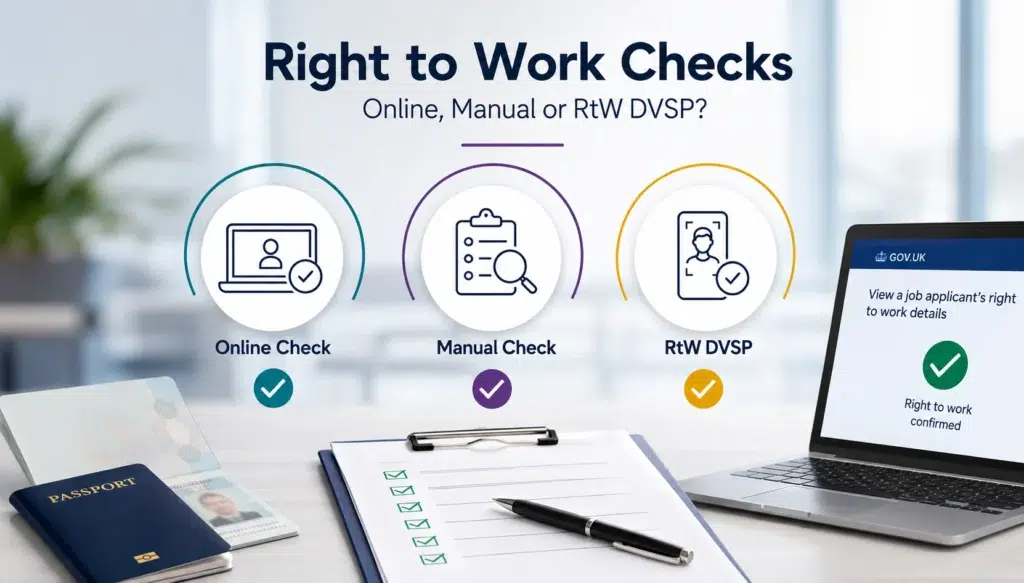


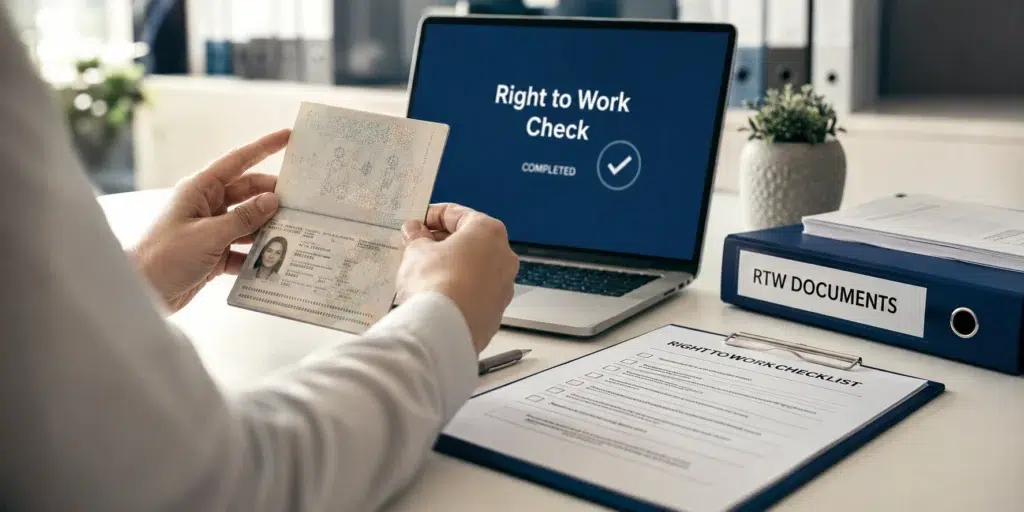
Carrying out a compliant Right to Work check is one of the most important legal responsibilities for UK employers. A properly completed check helps establish a statutory excuse against a civil penalty if it is later discovered that an individual is working illegally.
Although many employers now rely on digital checks where available, manual document-based checks continue to play an important role. However, employers must follow the prescribed Home Office process carefully. Missing a step, failing to examine documents correctly or keeping inadequate records may prevent an employer from establishing a statutory excuse.
This guide explains how to conduct a manual Right to Work check in accordance with current Home Office guidance.
What Is a Manual Right to Work Check?
A manual Right to Work check involves examining an individual’s original documents to confirm that they have permission to work in the UK.
To establish a statutory excuse, employers must complete every stage of the prescribed checking process before employment begins.
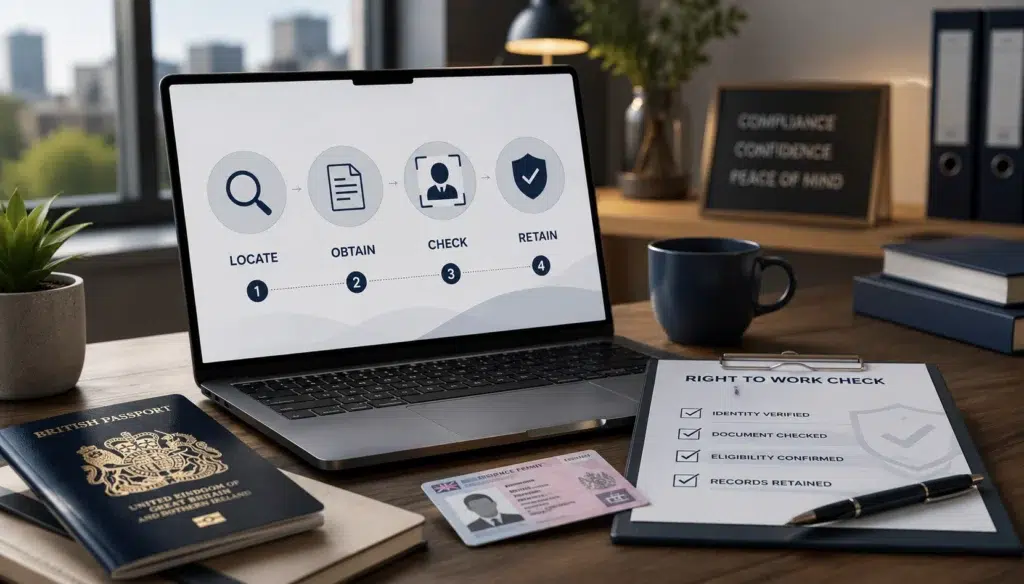
The Home Office sets out four essential steps:
- Obtain
- Check
- Copy
- Record and retain
Each step is equally important.
Step 1: Obtain the Original Documents
The first stage is obtaining the appropriate original documents from the worker.
These documents must come from either List A or List B of the Home Office’s acceptable documents.
Where official evidence of an individual’s name and permanent National Insurance number has been issued by or on behalf of a government department, employers may accept a digital version of that document. However, it must always be presented alongside the appropriate document from the acceptable document lists.
Step 2: Carefully Check the Documents
Once the employer has the original documents in their possession, they must carefully examine them.
This stage goes far beyond simply looking at a passport or identity document.
Employers must be satisfied that:
- the documents are genuine
- they have not been altered or tampered with
- the person presenting them is the rightful holder
Employers should also compare all photographs and dates of birth across the documents to ensure they are consistent and match the individual.
The purpose of these checks is to help identify impersonation or fraudulent use of genuine documents.
Checking Digital National Insurance Documents
Some workers may provide official evidence of their name and National Insurance number in a digital format.
This may be presented as:
- a screenshot
- an email confirmation
- another electronic submission
The Home Office explains that the most secure method of checking these documents is through a registered Right to Work Digital Verification Service Provider (RtW DVSP), as these providers have systems capable of verifying authenticity.
However, employers may carry out these checks themselves where they are confident that:
- the information belongs to the individual
- the document appears genuine
- it originates from an official government digital service or account
Employers must not ask workers for passwords or access credentials to view information on their personal devices.
Checking Photographs and Preventing Impersonation
Identity verification is an important part of every Right to Work check.
Employers should ensure that:
- photographs match the individual
- dates of birth are consistent across all documents
- the individual presenting the documents is the person who will undertake the work
Where facial recognition technology is used, this must be carried out by a registered RtW DVSP.
If the technology cannot verify the individual’s identity, the worker must be given a reasonable opportunity to verify their identity through other means.
Check Immigration Permission and Work Restrictions
Employers must confirm that any permission to stay in the UK remains valid.
They must also check whether any restrictions apply to the individual’s employment.
For example, an individual may be restricted by:
- the type of work they may undertake
- the job role they may perform
- the number of hours they are permitted to work
Employers must ensure that the proposed employment complies with those restrictions before work begins.
Where relevant, employers should also consider the specific rules applying to students with limited permission to work during term time.
Resolve Differences in Names
Sometimes an individual’s documents may contain different names.
Where this happens, employers should ensure the differences can be explained through supporting evidence such as:
- a marriage certificate
- a decree absolute
- a deed poll
Employers may choose to retain copies of these supporting documents as evidence that they have completed the required checks.
Do Not Rely on Copies or Screenshots
A manual Right to Work check requires the employer to examine the original documents.
Employers must not rely solely on:
- scanned copies
- photographs
- screenshots
- documents viewed only during a video call
The only exception relates to official digital evidence of an individual’s name and National Insurance number where this is permitted under the Home Office guidance.
Step 3: Copy the Documents
After completing the checks, employers must make clear copies of every document examined.
These copies must be stored in a format that cannot be manually altered.
This may include:
- electronic files
- PDF documents
- HTML records
- hard copies
Where facial recognition technology has been used through a RtW DVSP, employers must also retain the comparison produced alongside a copy of the document.
Copying Passports Correctly
When copying a passport, employers should retain copies of all relevant pages, including those showing:
- the holder’s nationality
- date of birth
- signature
- photograph
- biometric details
- immigration permission
- expiry dates
- visas or entry stamps confirming permission to enter or remain in the UK
- information confirming permission to undertake the work
The Home Office no longer requires employers to copy the passport’s front cover.
Step 4: Record and Retain the Check
Employers must also keep an accurate record of when the Right to Work check was completed.
The Home Office requires employers to record the date by making a dated declaration on the copied documents or by maintaining a separate record confirming when the check took place.
Simply writing a date on a copied document is not sufficient, as it does not confirm that this was the date the Right to Work check was actually completed.
The Home Office recommends wording such as:
“The date on which this right to work check was made: [insert date]”
How Long Should Employers Keep the Documents?
Copies of Right to Work documents must be kept securely:
- throughout the worker’s employment
- for two years after employment ends
After that period, the records should be securely destroyed.
Employers should also be able to produce these records promptly if requested by the Home Office.
Checking Documents During a Video Call
Employers may conduct the checking process while speaking to the individual via a live video link.
However, they must still be in physical possession of the original documents.
For example, a worker may send their documents by post before the video meeting.
Viewing documents only on screen does not satisfy the requirements for a manual Right to Work check.
Who Is Responsible for Carrying Out the Check?
An employer may delegate the practical task of carrying out Right to Work checks to members of staff or other authorised individuals acting on its behalf.
However, responsibility for compliance remains with the employer.
Even where third-party support is used for technical services or identity verification, the employer remains responsible for ensuring the check has been carried out correctly in accordance with Home Office requirements.
False Documents and Employer Liability
If an employer is presented with a false document, liability depends on the circumstances.
The Home Office explains that an employer may be liable for a civil penalty where it is reasonably apparent that the document is false.
An employer will not establish a statutory excuse where:
- it is reasonably apparent that the individual presenting the document is not the rightful holder
- the employer knows the individual does not have permission to undertake the work
- the employer knows the documents are false or belong to someone else
Where an individual provides a false document, or a genuine document that does not belong to them, employers should report this in accordance with the Home Office guidance.
National Insurance Numbers and Immigration Applications
Some migrants automatically receive a National Insurance number as part of their immigration application.
This currently applies to most migrants and dependants granted permission in a skilled worker category, as well as refugees who have been granted settled status through a protection route.
Where a National Insurance number appears on an individual’s eVisa profile, neither the worker nor the employer needs to make a separate application to the Department for Work and Pensions to obtain one.
Preventing Impersonation
Every Right to Work check should confirm that the individual who presented the documents is the same person who will carry out the work.
The Home Office explains that employers should take reasonable and proportionate steps to reduce the risk of impersonation.
Depending on the nature of the business, employers may choose to implement additional controls, such as:
- retaining a photograph of the individual
- using facial recognition technology through a registered RtW DVSP
- introducing proportionate identity verification procedures
Where an employer has carried out a prescribed Right to Work check correctly but later becomes the victim of fraud or deliberate deception despite appropriate controls being in place, the Home Office states that these circumstances will be considered on the individual facts of the case.
Final Thoughts
Manual Right to Work checks remain an important part of an employer’s compliance obligations. Following each stage of the prescribed process obtaining the correct documents, checking them carefully, making compliant copies and retaining accurate records helps employers establish a statutory excuse and demonstrate compliance with Home Office requirements.
Employers should ensure that everyone responsible for recruitment understands the prescribed checking process and follows the Home Office guidance consistently before employment begins.
Conducting compliant Right to Work checks is only one part of maintaining effective immigration compliance. Regular mock Right to Work audits can help employers identify gaps in their processes, ensure records are complete and up to date and reduce the risk of costly compliance issues before a Home Office inspection.
Follow Morgan Smith Immigration for the latest UK immigration law, policy updates and employer compliance guidance. With over 20 years of experience, we help businesses strengthen their Right to Work procedures through mock audits and practical legal advice. If you require assistance with Right to Work checks or any UK immigration matter, contact us on us at 0203 959 3335 or email [email protected].