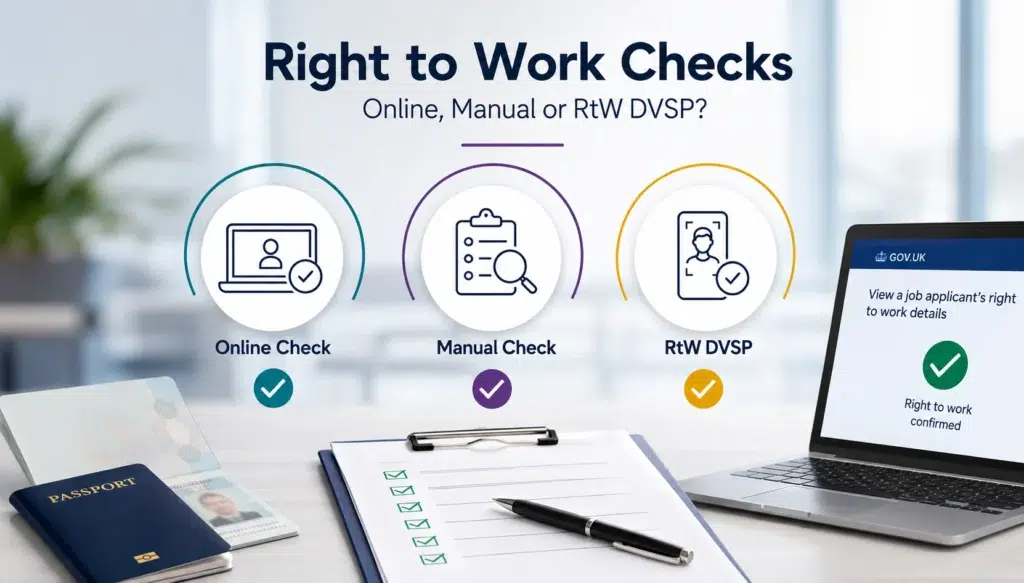



Changes to Right to Work Checks from 1 October 2026 will make it important for businesses to look beyond their usual employee onboarding procedures.
From that date, the Scheme will extend to certain individuals engaged under a worker’s contract, individual sub-contractors and arrangements involving online matching services.
For businesses, the priority now is to understand how people carry out work for the organisation, who is responsible for them and whether existing right to work procedures remain suitable.
We previously explained the wider changes in our article on the UK Right to Work Scheme changes coming into force on 1 October 2026. Here, we look at the practical areas businesses should review before the new rules take effect.
Review How People Carry Out Work for Your Business
A contractual label will not, by itself, determine whether a working arrangement falls within the Right to Work Scheme.
UK Home Office guidance states that whether an arrangement is within scope will depend on the particular facts of the case. It also states that these arrangements should operate effectively in practice. Businesses should take reasonable and proportionate steps to confirm that right to work requirements are being met.
Businesses should review arrangements involving individuals who are not conventional employees. They should also establish whether these arrangements fall within the expanded Right to Work Scheme.
For employment under a worker’s contract, the expanded rules apply from 1 October 2026. This also applies to individual sub-contractors and relevant online matching services. Therefore, a civil penalty may only be imposed where the employment commenced on or after this date.
Identify Contracts That Could Create Extended Liability
Separate extended liability provisions will apply from 1 October 2026.
Extended liability may arise when a business uses another employer’s workers to fulfil a contract for work or services that it has with a third party. It may also arise through certain online matching arrangements or where a contract permits an individual to substitute another person to carry out the work or services.
The employer who has the direct contractual relationship with the worker remains responsible for carrying out the right to work check and establishing a statutory excuse. Extended liability does not automatically transfer responsibility for carrying out that check to another person in the contractual chain.
However, where the extended liability provisions apply, a person or online matching service seeking to establish a statutory excuse against a civil penalty must comply with the prescribed requirements relevant to the contractual arrangements.
These requirements may include appropriate contractual terms, substitution controls and identity verification measures, depending on how the work or services are provided.
Review Contractual Controls
Where the prescribed contractual requirements apply, a written statement must be in place before the work or service commences.
The written terms must require prescribed right to work checks. In addition, they must restrict further subcontracting without prior written consent. They must also permit compliance audits. Furthermore, they should provide for enforcement action where illegal working is identified without a statutory excuse. Finally, they must require cooperation with any Home Office investigation into illegal working.
Written terms alone are not sufficient. UK Home Office guidance states that these arrangements should operate effectively in practice. Therefore, businesses should take reasonable and proportionate steps to confirm that right to work requirements are being met.
Check Any Substitution Arrangements
Businesses should review contractual arrangements that permit a worker to provide a substitute.
Where substitution is permitted, employers must have the required processes in place before the work or service begins. In particular, a prescribed right to work check must be completed for any substitute. Additionally, the substitute must not start work until their right to work has been verified.
Employers must also have appropriate identity verification systems in place to ensure that the individual carrying out the work or services is the same individual whose right to work has been checked.
Review Digital Right to Work Checks
Businesses using a digital verification service should confirm that the provider they use is a registered Right to Work Digital Verification Service Provider (RtW DVSP).
Using a provider does not transfer responsibility for compliance. The employer remains responsible for ensuring that the prescribed requirements of the right to work check are satisfied.
What Should Businesses Do Before October?
From October, businesses must examine how people carry out work across their organisation. They should identify who performs the work and how they engage each individual. They should also check whether they subcontract any work or use other working arrangements.
Businesses should review relevant working arrangements and contractual chains. In addition, they should identify contracts that permit substitution. They should also check their digital verification arrangements. Finally, recruitment, contracting and compliance teams should understand the new Right to Work Checks requirements.
For advice on preparing your organisation for the changes to the Right to Work Scheme, or to arrange a mock audit to assess your compliance with Home Office requirements, contact Morgan Smith Immigration on 0203 959 3335 or email [email protected].