


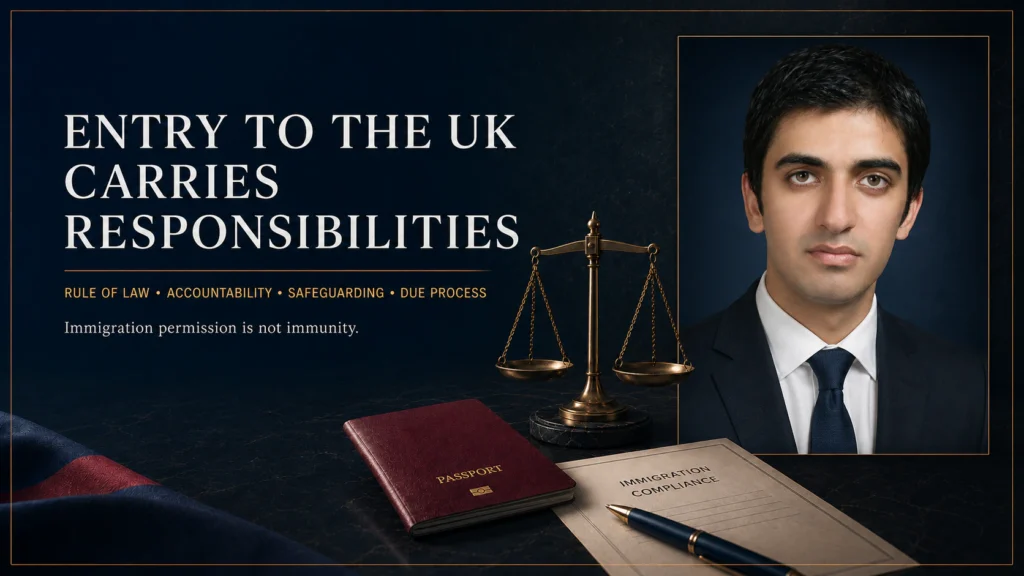
The removal of Dr Jawad Ahmad from the UK medical register raises questions extending beyond professional misconduct. It exposes possible gaps between immigration control, employer sponsorship, criminal investigations and public protection.
The Medical Practitioners Tribunal Service found that Ahmad sexually harassed a junior colleague while working at Royal Stoke University Hospital in 2020. His behaviour was described by the tribunal as “predatory and premeditated.” He was also found to have dishonestly failed to inform his employer that he had been arrested on suspicion of sexually assaulting a teenage girl.
Ahmad subsequently left Britain and is now believed to be in Pakistan. Although the professional regulator has erased his name from the medical register, serious questions remain. How was a regulated professional facing such concerns able to leave the country? Were the risks of departure properly assessed? Was information shared promptly between the police, his employer, the GMC and immigration authorities? And could stronger controls have ensured that the allegations were resolved through the criminal-justice system?
An arrest cannot produce an immediate sentence
An arrest is not a conviction and Ahmad could not have been sentenced without a criminal charge, fair proceedings and a finding of guilt. However, his departure raises legitimate questions about whether the risk of him leaving the UK was properly assessed and whether proportionate bail or travel restrictions were considered.
People working with patients or other vulnerable individuals may be subject to criminal-record checks. Certain overseas Skilled Worker applicants in health, education and social-care roles must also provide criminal-record certificates. Employers should conduct the required pre-employment checks and maintain effective safeguarding procedures when serious concerns emerge.
The available reports do not establish that the hospital failed to complete the required criminal-record checks when Ahmad was recruited, particularly as the reported arrest occurred during his employment. It is also important to recognise that an arrest or detention does not automatically appear on every criminal-record certificate. Basic and standard DBS checks mainly disclose qualifying convictions and cautions, while an enhanced check may include relevant information held by local police. Overseas certificates may record pending arrests or prosecutions, but disclosure practices vary between countries.
The case therefore raises a broader question about continuing oversight after a sponsored healthcare worker has entered the UK. Initial screening provides only a snapshot of the information available at that time. Effective public protection also requires clear disclosure duties and prompt communication between employers, the police, professional regulators and UKVI when serious concerns arise later. The issue is not simply whether Ahmad was checked when recruited, but whether his subsequent arrest was identified, reported and acted upon before he left the country.
Sponsored migration must come with enforceable responsibilities
Britain depends heavily on overseas doctors and other sponsored workers. Most make an indispensable contribution and follow both the law and the professional standards required of them. But sponsorship is not simply a route into the UK. It is a position of trust involving responsibilities for the worker, the employer and the Home Office.
Where sponsored professionals are arrested for an alleged serious sexual or violent offence, there should be a clear and lawful process for assessing:
- Whether the employer and professional regulator must be notified.
- Whether the individual remains suitable for the sponsored role.
- Whether professional registration remains valid.
- Whether employment or sponsorship has ended.
- Whether immigration permission should be reviewed.
- Whether there is an evidenced risk of the individual leaving the jurisdiction.
An allegation should not automatically result in dismissal, detention or visa cancellation. At the same time, institutions should not ignore serious safeguarding concerns merely because a worker is filling an important vacancy.
Ahmad’s reported failure to disclose his arrest is especially concerning. If a person deliberately hides material information to obtain or retain employment, that dishonesty may be relevant not only to professional regulation but also to future immigration applications. The Home Office requires applicants to answer relevant criminality and conduct questions truthfully, and deliberate non-disclosure may itself lead to refusal.
Is migration responsible for increasing sexual offences?
Public anxiety about sexual crime is real. ONS figures for the year ending March 2026 show that police recorded 217,567 sexual offences, an increase of 4% from the previous year. Recorded rape offences also increased by 4%. The Crime Survey estimated that approximately 3.9% of adults experienced some form of sexual harassment during the year.
However, these figures do not establish that immigration caused the increases. More importantly, the ONS has confirmed that it does not hold comprehensive crime statistics broken down by asylum-seeker or migrant status.
The government should therefore be challenged for the absence of adequate evidence. If ministers expect the public to have confidence in immigration policy, they should publish reliable, anonymised and population-adjusted conviction data showing immigration category, offence type and case outcome. Without that evidence, neither the government nor its critics can responsibly determine whether particular immigration routes are associated with disproportionate offending.
Entry to the UK Is Conditional, Not a Licence to Disregard the Rules
Whether someone enters the United Kingdom as a visitor, sponsored worker, student or under another immigration route, their permission carries conditions and responsibilities
No one should believe that UK immigration permission places them above the law. Misconduct can lead to serious legal and immigration consequences. Criminal offending, dishonesty, visa breaches or non-disclosure may affect employment and professional registration. They may also damage future applications or lead to cancellation of permission.
When Misuse Leads to Stricter Visa Controls
The Government’s decision to reintroduce visa requirements for Colombian nationals and other nationalities demonstrates how immigration privileges can be withdrawn when a route is being used for purposes beyond those permitted.
UK removed the visitor visa requirement for Colombians in November 2022. According to the Home Office, this was followed by a “significant and sustained increase” in Colombian nationals travelling to the UK for purposes not permitted under the Visitor Rules, including living, working and claiming asylum.
Official figures show that Colombian asylum claims increased. Border refusals involving Colombian passengers also increased. Consequently, the Government restored the visit-visa requirement in November 2024, allowing applicants to be assessed before travelling to Britain.
It demonstrates something different but important: where visa-free access is repeatedly used for purposes outside the Visitor Rules, the Home Office can impose advance scrutiny to protect the integrity of the immigration system.
The Government adopted a similar approach to Nicaragua. From 5 March 2026, Nicaraguan nationals were required to obtain visit visas. The Home Office said that almost 90% of asylum claims by Nicaraguan nationals in 2025 were made upon arrival at a UK port. The Government described this pattern as continued exploitation of visa-free entry and an unsustainable pressure on the border system.
These developments support a wider principle: access to the UK is governed by rules, not personal entitlement. Genuine visitors, workers and refugees must be treated fairly, but deliberate abuse of an immigration route should produce timely and proportionate consequences.
The same principle is relevant to sponsored professionals. A sponsored doctor is admitted to undertake a particular role and is expected to comply with immigration conditions, employment obligations, criminal law and professional standards. Where serious misconduct is established or mandatory professional registration is removed, the sponsor and UKVI should act promptly.
Human Rights Must Not Be Used to Frustrate Legitimate Immigration Control
Human rights protections are an essential safeguard against unlawful removal, but they should not become an automatic means of remaining in the UK after someone has breached immigration rules or committed a serious offence. The Government must examine such claims rigorously and distinguish genuine protection needs from attempts to delay or frustrate lawful enforcement.
Every claim must be assessed individually. However, unsupported claims should not outweigh evidence of criminality, deception, unlawful residence or other relevant immigration history. The Home Office should decide clearly unfounded protection or human-rights claims promptly. It should take lawful enforcement action and prevent repeat applications intended solely to delay removal.
Protecting fundamental rights must remain compatible with maintaining an effective immigration system, preventing abuse and protecting the public.
What the government should change
UK Government should strengthen cooperation between the police, UKVI, sponsors and professional regulators. Serious charges, disciplinary findings and loss of professional registration should be reported promptly. Authorities should document flight-risk assessments when credible evidence suggests someone may leave the UK. Proportionate travel restrictions should be considered when legally justified.
Healthcare sponsors should regularly verify professional registration, report the end of sponsored employment and protect staff who report misconduct. UKVI should also review a sponsored worker’s permission when they can no longer perform the sponsored role.
Fifth, the government should publish reliable statistics on convictions involving different immigration categories. The figures must distinguish arrests from convictions and asylum seekers from refugees, sponsored workers, settled migrants and people without permission. They must also use per-capita rates rather than politically inflammatory raw totals.
Public safety and fairness must operate together
Britain can expect everyone entering the country to respect its criminal law. This applies to sponsored professionals, students, family members, asylum seekers and visitors. Those granted the privilege of working in positions of professional trust carry an additional obligation to protect colleagues, patients and the public.
But public protection will not be strengthened by declaring entire migrant communities dangerous or assuming that an arrested person is guilty. It requires effective investigations, proper bail decisions, honest sponsorship, information-sharing, timely immigration action and firm sentencing after conviction.
The Ahmad case should prompt scrutiny of whether those systems communicated effectively and whether more could have been done to prevent an unresolved case from crossing international borders. The government must ensure that migration policy serves the national interest, that serious offenders face lawful consequences, and that nobody in Britain is made less safe because institutions failed to act when credible warning signs emerged.
Follow us to stay updated on changes to UK immigration law, policy developments and guidance affecting migrants, employers and families.
With over 20 years of experience and a commitment to excellence, Morgan Smith Immigration is your trusted partner for all your immigration needs. Contact us today to learn more about how we can assist you with UK visa applications. For enquiries or assistance, call us at 0203 959 3335 or email [email protected].