

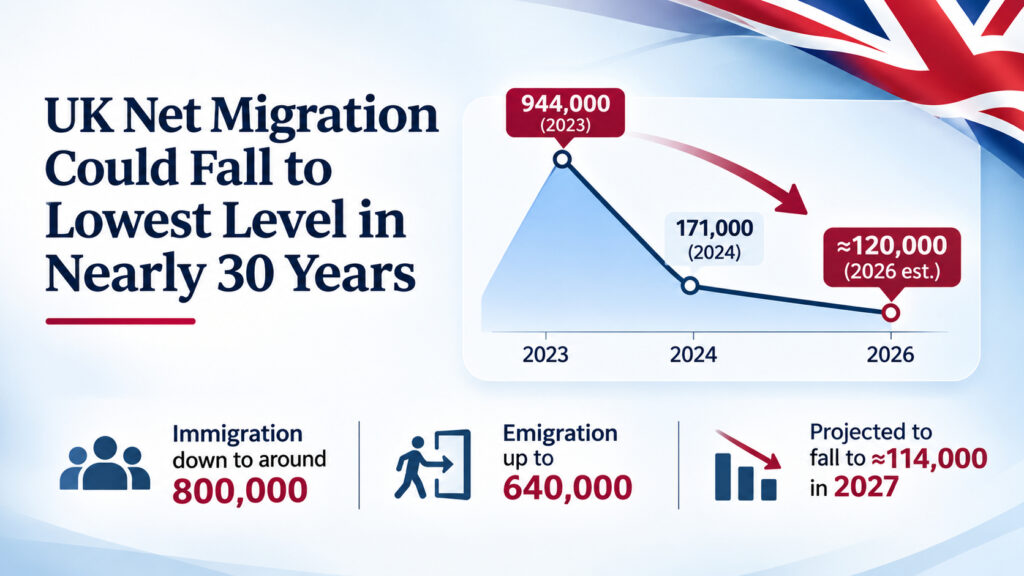
UK net migration is expected to fall to its lowest level in almost three decades, with estimates suggesting that the figure could drop to approximately 120,000 in the year ending June 2026.
If confirmed by the Office for National Statistics (ONS) later this month, this would represent the lowest level of net migration recorded outside the COVID-19 pandemic since 1997.
Immigration experts have also suggested that net migration could potentially fall below 100,000, reflecting the combined impact of tighter immigration rules and increasing numbers of people leaving the UK.
Net Migration Falls Sharply from Record Levels
Net migration measures the difference between the number of people moving to the UK and those leaving the country.
In 2023, net migration reached a record high of approximately 944,000, with immigration peaking at around 1.45 million.
However, the latest estimates suggest a substantial reversal of this trend.
Annual immigration has fallen to approximately 800,000, while emigration has increased from just over 500,000 to more than 640,000.
The Office for Budget Responsibility (OBR) forecasts that net migration could decline further to approximately 114,000 in 2027.
These projections indicate that the UK may experience an extended period of relatively low net migration following several years of exceptionally high arrivals.
Why Is UK Net Migration Declining?
The reduction in net migration reflects two significant developments: fewer people arriving in the UK and more previous migrants leaving.
Changes to immigration policy have contributed to the decline in arrivals, particularly through restrictions on work visas and dependant applications.
Measures introduced in recent years include higher salary thresholds for sponsored workers, restrictions on dependants and tighter eligibility requirements for certain occupations.
The health and social care sector has experienced some of the most substantial changes.
According to the figures reported, annual visa numbers for social care workers have fallen from a peak of approximately 108,000 to just 1,400.
Other immigration categories have also recorded considerable reductions:
- Work visas declined by 17% year on year to March 2026.
- Sponsored study visas fell by 37% compared with their 2023 peak.
- Skilled Worker visa numbers declined by 76% from their 2023 peak.
- Family visa numbers decreased by 17%.
These figures reflect the effects of immigration restrictions introduced by successive governments.
Rising Emigration Is Also Driving the Decline
While immigration restrictions have reduced arrivals, increasing emigration has played an equally important role.
Many migrants who arrived during the period of exceptionally high immigration between 2021 and 2023 are now leaving the UK after completing their employment contracts, studies or temporary visa arrangements.
Dr Madeleine Sumption, Director of the University of Oxford’s Migration Observatory, described the current situation as a temporary adjustment following a period of unusually high immigration.
She explained that many people who leave the UK are previous migrants rather than British citizens, with departures commonly occurring within five years of arrival.
According to Dr Sumption, if existing immigration policies remain unchanged and no major international crises occur, the UK could experience unusually low net migration over the next few years.
However, this pattern may not continue indefinitely as the number of migrants leaving after earlier periods of high immigration gradually declines.
Could Net Migration Increase Again?
Despite the expected decline, longer-term forecasts suggest that net migration may begin rising again towards the end of the decade.
The OBR projects that net migration could start increasing in 2028, reaching approximately 230,000 annually by 2031 and 2032.
However, these forecasts do not account for potential future immigration restrictions or further policy changes.
The Home Office has maintained that reducing migration remains a government priority.
A Home Office spokesperson stated:
“Net migration has already fallen sharply from its peak, but we are clear there is further to go.”
The spokesperson also attributed the decline partly to fewer non-EU nationals arriving for employment, alongside tighter requirements for work visas and settlement.
What Does This Mean for UK Immigration?
The anticipated reduction in net migration comes as the Government continues to introduce significant changes to the UK’s immigration system.
Higher sponsorship requirements, restrictions on overseas recruitment and proposed changes to settlement eligibility could affect individuals planning to work, study or settle permanently in the UK.
For employers, these developments reinforce the importance of reviewing recruitment strategies and ensuring compliance with sponsorship obligations.
For migrants, changes to visa eligibility and settlement requirements may influence decisions about employment, family arrangements and long-term residence.
However, the projected figure of 120,000 remains an estimate. The actual level of net migration will become clearer when the ONS publishes its official statistics later this month.
How Morgan Smith Immigration Can Help
With UK immigration policies continuing to change, individuals and employers must understand how new requirements may affect their applications and sponsorship arrangements.
At Morgan Smith Immigration, we assist individuals, families and businesses with visa applications, sponsor licence matters and settlement applications.
For professional immigration advice, contact our team on 0203 959 3335 or email [email protected].
Follow Morgan Smith Immigration for the latest updates on UK immigration policies and regulations.