

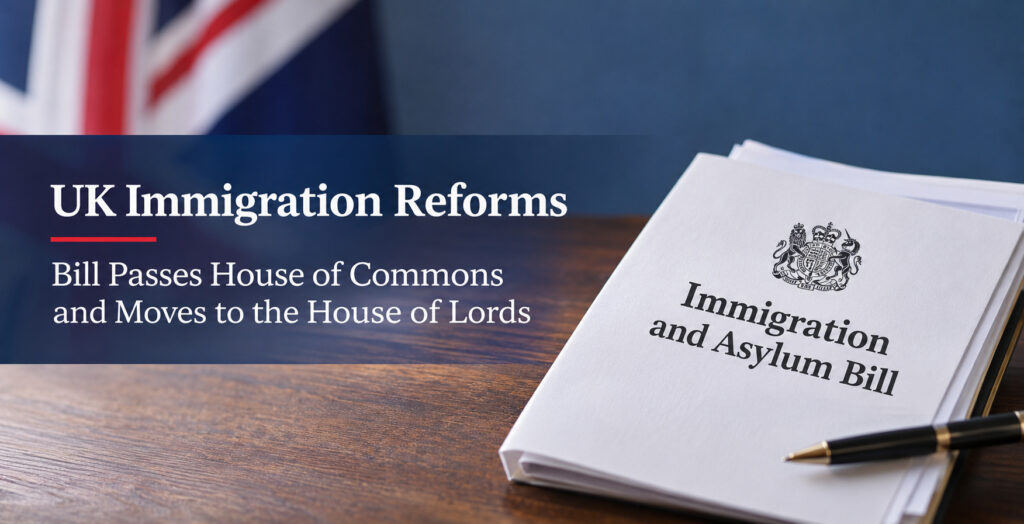
The UK Government’s proposed immigration and asylum reforms have moved a step closer to becoming law after the Immigration and Asylum Bill passed its Third Reading in the House of Commons on 18 November 2026.
MPs voted 290 to 94 in favour of the Bill, securing a majority of 196. The legislation will now proceed to the House of Lords for further parliamentary scrutiny.
The Bill introduces significant changes to immigration appeals, the removal of unsuccessful asylum applicants, modern slavery protections and the application of human rights legislation.
Five-Day Notice Period for Removals Could Be Abolished
One of the most significant amendments concerns the removal of individuals whose asylum or immigration appeals have been unsuccessful.
Under the current arrangements, Immigration Enforcement must generally provide at least five working days’ notice before carrying out an enforced removal.
The Government proposes removing this additional notice period for individuals who have exhausted their appeal rights through the new Independent Immigration Appeals Authority.
Instead, Immigration Enforcement officers would have a six-month period in which to carry out removals without issuing a further notice.
The Home Office argues that the existing notice period can lead to last-minute claims that delay removals.
If implemented, the amendment would allow removals to proceed more quickly once the relevant appeal process has concluded.
Changes to Modern Slavery Protections
The Bill also proposes changes to how modern slavery claims are assessed.
A new legal definition of a ‘bad faith’ modern slavery claim would be introduced.
Under the proposed provisions, individuals who knowingly submit dishonest claims or raise modern slavery information after receiving notice of removal could be disqualified from certain protections.
The Government maintains that these measures are intended to prevent misuse of the system while preserving support for genuine victims.
According to Home Office figures, nearly 80% of referrals to the National Referral Mechanism (NRM) last year involved individuals subject to immigration controls.
Of these referrals, 4,526 were made by individuals in detention. The Home Office also reported that nearly 80% of people referred while detained were not ultimately identified as modern slavery victims.
These figures form part of the Government’s justification for introducing stricter procedures.
New Independent Immigration Appeals Authority
Another important proposal is the establishment of an Independent Immigration Appeals Authority (IIAA).
The new authority is intended to improve the handling of immigration and asylum appeals, particularly where individuals have received an unsuccessful decision.
The Government wants to reduce delays and ensure that cases can proceed more efficiently through the appeals process.
Recruitment for the authority’s chair is expected to begin shortly, with an appointment anticipated by spring 2027.
The chair will be responsible for helping establish the new body independently of the Home Office.
Further Changes to Human Rights and Asylum Support
The legislation also includes several measures previously announced by the Government.
Article 8 of the European Convention on Human Rights
The Bill seeks to clarify how the right to respect for private and family life should be considered in immigration decisions.
The Government intends to reduce inconsistent interpretations and ensure that the public interest receives appropriate consideration.
Financial Contributions Towards Asylum Support
Asylum seekers receiving taxpayer-funded accommodation or other support could be required to contribute towards these costs where they have sufficient financial resources.
A Single Definition of Protection Claims
The Government also proposes combining refugee status and humanitarian protection within a single definition of a protection claim.
This is intended to simplify decision-making and the appeals process.
What Has the Home Secretary Said?
Commenting on the Bill’s progress, Home Secretary Shabana Mahmood stated:
“But we must go further. This Bill is a crucial next step, enabling us to speed up asylum decisions, close loopholes that have been exploited and remove people with no right to be here.”
The Home Secretary also highlighted the Government’s reported progress in reducing small boat arrivals, increasing returns and cutting taxpayer costs by £1 billion.
What Happens Next?
Although the Bill has passed the House of Commons, the proposed measures are not yet law.
The legislation must now undergo scrutiny in the House of Lords, where further amendments may be considered.
The final provisions and their implementation will depend on the remaining parliamentary stages.
For individuals involved in asylum or immigration proceedings, the proposed changes could have important consequences, particularly regarding appeal procedures, removal notices and human rights claims.
Those potentially affected should therefore follow the Bill’s progress and seek professional advice where necessary.
At Morgan Smith Immigration, we provide professional advice on UK immigration matters, including complex applications and immigration appeals.
For assistance with your immigration circumstances, contact our team on 0203 959 3335 or email [email protected].