

The UK Government has provided further clarification on when the proposed changes to Indefinite Leave to Remain (ILR) are expected to be introduced.
Following the Home Secretary’s announcement on 2 November 2026, the Government has confirmed that amendments to the Immigration Rules are expected to begin appearing in December 2026, with implementation taking place in stages throughout 2027.
Important: The exact date on which the proposed standard 10-year qualifying period will take effect has not yet been confirmed. The current Immigration Rules remain applicable until the relevant changes commence.
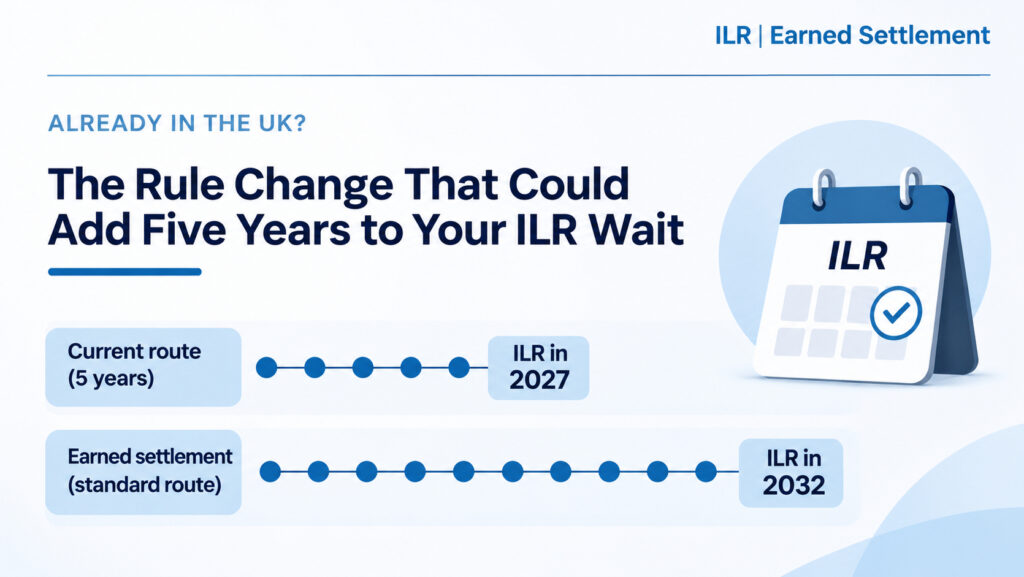
This distinction is particularly important for individuals already living and working in the UK who are approaching their five-year settlement eligibility.
At Morgan Smith Immigration, we believe applicants should understand what has been confirmed, what remains subject to implementation and how the proposed reforms could affect their settlement plans.
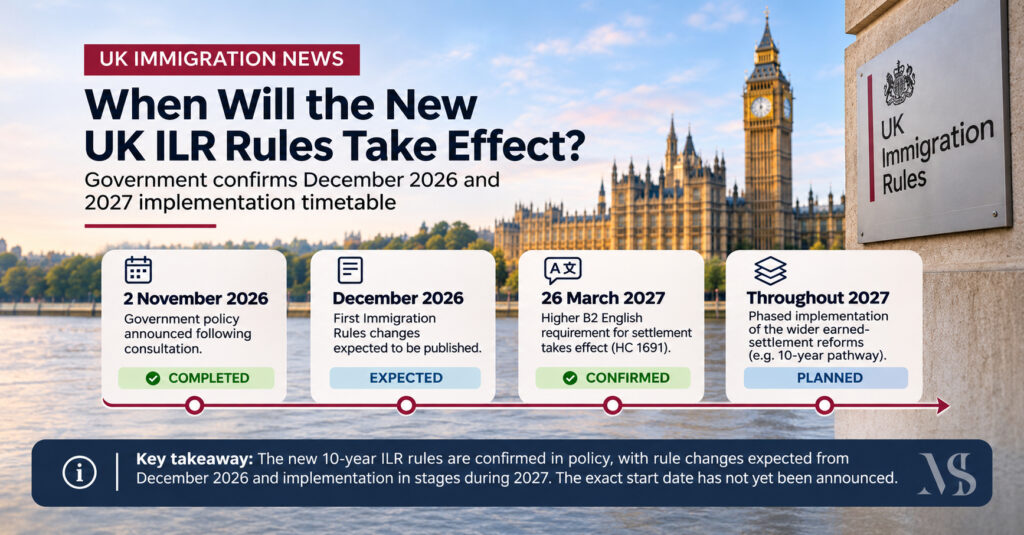
Key Dates at a Glance
- 2 November 2026 – Government announcement: The earned-settlement policy approach was announced.
- 17 November 2026 – Parliamentary clarification: The Government addressed previously accumulated qualifying residence and limited transitional protection.
- December 2026 – Expected publication: The first amendments to the Immigration Rules are expected to be published. This is not a confirmed start date for the 10-year settlement period.
- 26 March 2027 – Confirmed change: The higher B2 English-language requirement takes effect for relevant settlement applications, subject to exemptions.
- During 2027 – Planned implementation: The wider earned-settlement reforms are intended to be introduced in phases. Individual commencement dates have not been confirmed.
When Are the New ILR Rules Expected to Start?
The Home Secretary confirmed the Government’s intended timetable during a statement to Parliament on 2 November 2026.
December 2026: Expected Publication of Immigration Rules
The Government expects to begin publishing amendments to the Immigration Rules in December 2026. The House of Commons Library subsequently reported the timetable.
Throughout 2027: Planned Phased Implementation
The changes are intended to come into force in stages during 2027, rather than necessarily on a single date.
Publication Is Not the Same as Commencement
The publication of an Immigration Rules amendment does not necessarily mean that every provision takes effect immediately. Each change must be read alongside its commencement provisions and any applicable transitional arrangements.
Until the relevant provisions commence, the existing Immigration Rules continue to apply.
Will the Standard ILR Qualifying Period Increase from Five to Ten Years?
Under the Government’s announced earned-settlement framework, the standard qualifying period for settlement is intended to increase to ten years for many applicants. However, ten years will not apply to everybody.
The Government’s earned-settlement policy response sets out different qualifying periods according to an individual’s immigration route, contribution and circumstances.
For further information about how these changes could affect existing visa holders, see Morgan Smith Immigration’s analysis of the Skilled Worker settlement reforms.
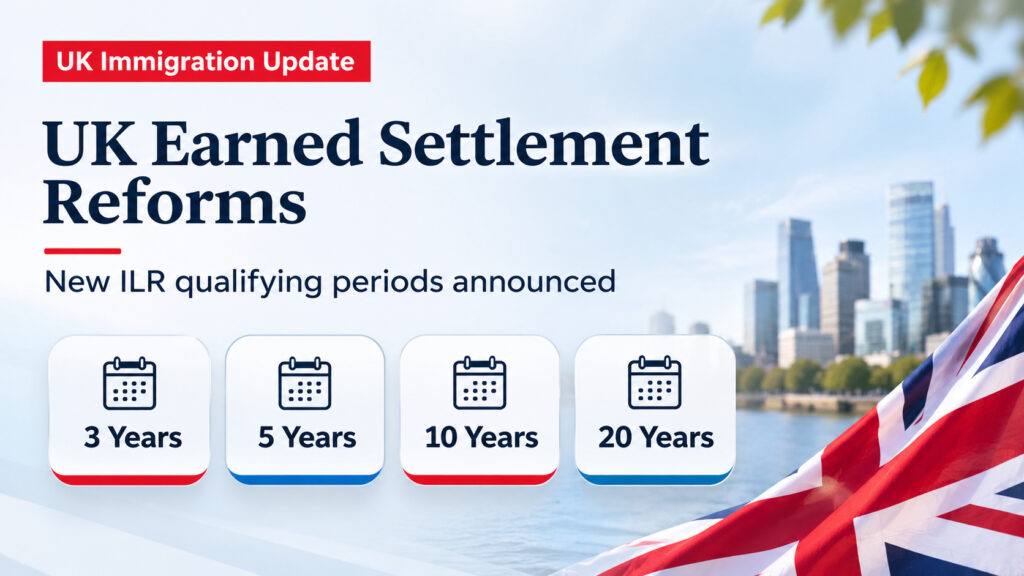
Proposed Settlement Pathways
- Three years: A proposed accelerated route for qualifying high earners and individuals within specified high-talent categories.
- Five years: A pathway retained for certain higher earners, eligible healthcare and education professionals, people with recognised British connections and specified transitional groups.
- Ten years: The proposed standard pathway for many other eligible applicants who meet the relevant contribution and mandatory requirements.
- Twenty years: A longer pathway for certain applicants affected by specified immigration breaches or public-funds conditions.
Examples of Proposed Shorter Pathways
The announced framework provides a five-year pathway for qualifying higher earners meeting the £50,271 annual earnings threshold in three of the five years immediately before settlement.
The Government has also retained a five-year pathway for eligible partners of British citizens, subject to the relevant requirements.
Legal status: These periods form part of the Government’s announced policy. They should not be presented as legally operative across all routes before the detailed Immigration Rules and commencement provisions take effect.
What Happens to People Who Are Already in the UK?
One of the biggest concerns relates to individuals who entered the UK under the existing five-year settlement arrangements.
Many Skilled Worker visa holders have already completed several years of lawful residence and expected to qualify for ILR after five years.
On 17 November 2026, the Government provided further clarification in a written parliamentary answer.
Will Existing Qualifying Residence Still Count?
The Government indicated that the earned-settlement framework is intended to apply generally to people already living in the UK who have not yet obtained settlement. However, it also confirmed that lawful, continuous residence already accumulated on a qualifying route will be recognised.
This means that an individual’s qualifying residence will not simply restart from zero because they move to the proposed standard 10-year pathway.
Nevertheless, having accumulated five years under the existing system will not necessarily guarantee eligibility under future rules.
Will Existing Visa Holders Receive Transitional Protection?
The Government has confirmed that transitional protections will be limited to specified groups. These include certain existing care workers and workers in designated healthcare and education occupations who meet the relevant conditions.
Key point for Skilled Workers: There is currently no general exemption protecting every Skilled Worker who entered the UK before the reforms were announced.
The precise effect on individual applicants will depend on their immigration route, accumulated residence, applicable settlement requirements and the final transitional provisions.
One Change Already Has a Confirmed Date: 26 March 2027
While the commencement date for the wider earned-settlement reforms remains unconfirmed, one important change has already been introduced through the Immigration Rules.
Under Statement of Changes HC 1691, published on 5 March 2026, the English-language requirement for settlement will increase from B1 to B2 under the Common European Framework of Reference for Languages (CEFR) for specified immigration routes.
Who Needs to Prepare for B2 English?
The new B2 requirement will apply to relevant settlement applications made on or after 26 March 2027, subject to the applicable exemptions and alternative ways of meeting the requirement.
This includes routes covered by Appendix Knowledge of Language and Life in the UK and several other settlement categories. Applicants approaching settlement should therefore check whether they will need to demonstrate English at the higher level.
Do not confuse these dates: 26 March 2027 is the confirmed commencement date for the relevant B2 English-language amendment. It is not a confirmed commencement date for the proposed 10-year settlement period.
What About the Existing 10-Year Long Residence Route?
The Government has confirmed its intention to close the separate 10-year Long Residence route under the earned-settlement framework.
Under the existing system, eligible applicants may qualify for settlement after ten years of continuous lawful residence, including qualifying time spent on certain temporary immigration routes.
The announced reforms would replace this arrangement with a framework that places greater emphasis on residence accumulated under routes intended to lead to settlement.
Who Could Be Affected?
This could particularly affect individuals who have spent substantial periods in the UK on Student, Graduate or other temporary immigration routes.
However, the closure has not yet been implemented. Until the relevant Immigration Rules change, applicants should continue to assess their eligibility under the existing Long Residence provisions.
What Should Applicants Do Before the New Rules Take Effect?
For individuals approaching settlement, we recommend reviewing their immigration circumstances as early as possible.
If You Already Qualify for ILR
- Confirm your current eligibility and qualifying residence.
- Check applicable salary, employment, absences, English-language and other route-specific requirements.
- Consider preparing your application without unnecessary delay.
If You Are Not Yet Eligible for ILR
- Maintain lawful immigration status and comply with your visa conditions.
- Calculate your likely settlement eligibility date under the rules currently in force.
- Review how the announced reforms could affect your future qualifying period.
- Monitor the published Immigration Rules and transitional arrangements rather than relying on an assumed commencement date.
Important: Applications Submitted Before Future Rule Changes
Applicants should not assume that submitting an application before a future commencement date will automatically protect them from subsequent amendments.
The Government has emphasised the importance of the rules applicable when settlement decisions are made. The precise treatment of applications pending when the new rules commence will require careful consideration of the published amendments and transitional provisions.
There is no justification for making premature applications or taking unnecessary steps based on an implementation date that has not been officially confirmed.
Our Advice: Plan Ahead, but Rely on the Law Currently in Force
The Government’s direction is now clearer. The announced earned-settlement policy establishes a proposed standard 10-year pathway, retains shorter routes for specified applicants and introduces stricter requirements for settlement.
The Government intends to begin publishing changes to the Immigration Rules in December 2026 and implement them progressively during 2027.
What remains outstanding is the exact commencement date for each change and the detailed legal provisions governing affected applicants.
At Morgan Smith Immigration, our position is straightforward: immigration decisions must be based on the Immigration Rules in force and the individual circumstances of each applicant, not assumptions about future legislation.
We encourage anyone approaching ILR eligibility, particularly Skilled Worker visa holders and those relying on the existing Long Residence route, to review their circumstances and obtain appropriate advice before making decisions about their immigration future.
Speak to Morgan Smith Immigration
If you are concerned about how the forthcoming settlement changes could affect you, contact Morgan Smith Immigration for a personalised assessment of your eligibility and available options.
Telephone: 0203 959 3335
Check your eligibility: Use our ILR Eligibility Calculator for an initial assessment of your settlement timeline.
This article reflects the published policy position and Immigration Rules information discussed as at 18 November 2026. Announced policy is distinguished from legally effective rules. This article provides general information and is not a substitute for advice based on individual circumstances.