

UK Home Office presents the eVisa as a safer and more convenient way to prove immigration status. More than 10 million people now use digital status. For many, the system works as intended. However, digitalisation has also placed a considerable practical burden on migrants.
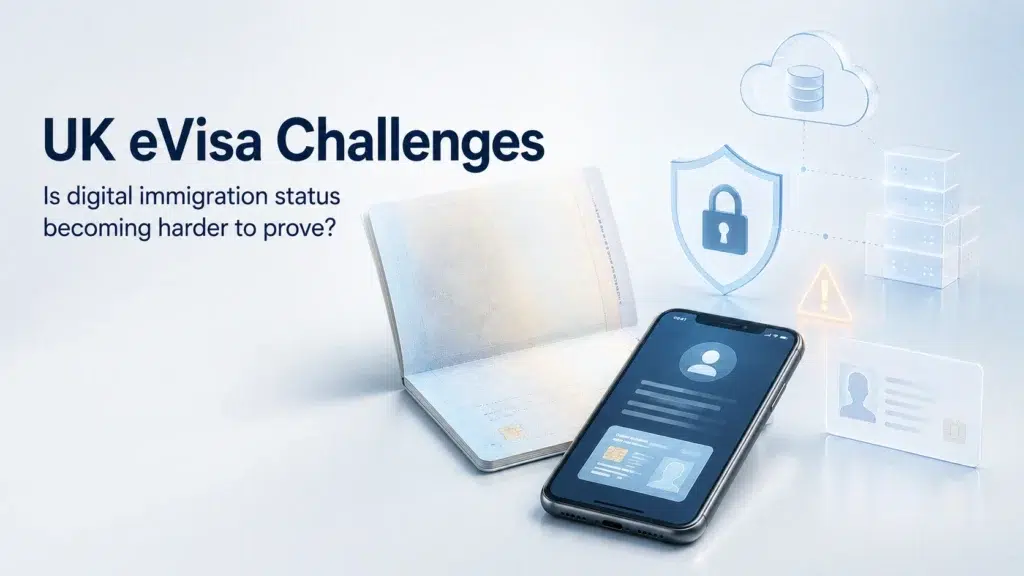
An eVisa is a digital record of a person’s identity, immigration status and the conditions attached to their permission in the UK, including whether they can work or study. Individuals must access a UK Visas and Immigration (UKVI) account to view it. They may also need a share code to prove their rights.
This process assumes reliable internet access, digital confidence and continued access to the registered email address or telephone number. It also assumes the Home Office record is accurate. Those assumptions do not reflect everyone’s circumstances.
When lawful status becomes difficult to prove
Biometric residence permits, passport vignettes and endorsements provided visible evidence of immigration status. Under the digital system, individuals generally see only what the online service displays.
If someone cannot access their account, their passport is not correctly linked or their record contains an error, their lawful status can become difficult to prove. Their immigration permission may remain valid, but an employer, landlord or airline may be unable to verify it.
UK Home Office recorded 64,778 eVisa errors corrected between September 2025 and May 2026. These included errors involving identity details, immigration status, validity dates and share codes.
UK Home Office states that corrected errors represent less than one per cent of live eVisas. Nevertheless, a low overall error rate offers little reassurance to someone who misses a flight or loses an employment opportunity.
Travel has exposed the system’s weaknesses
Before travelling, eVisa holders must ensure their personal details and current passport are correctly linked to their UKVI account. Government guidance warns that a carrier may refuse travel if these details are incorrect.
In August 2026, The Guardian reported that a settled UK resident was stranded at a Spanish airport. Her digital immigration status had become linked to her identical twin sister’s details. She was initially prevented from boarding and spent hours trying to correct the problem.
The case exposes a fundamental weakness. An error within a central database can outweigh the traveller’s actual legal position when proof matters most. Responsibility may then become divided between the passenger, airline and Home Office.
Digital exclusion remains a serious concern
Research reported by The Guardian in December 2025 found that migrants experienced technical failures, language barriers and difficulties generating share codes.
These are not minor inconveniences. An inability to access or prove immigration status can prevent someone from securing employment, renting a home and travelling.
The risks are particularly serious for older people, individuals with disabilities, those who lack digital skills or reliable internet access. A system designed to simplify immigration checks may instead exclude those who need the greatest support.
Digital assistance is available, but assisted access is not equal to independent access. People should not have to depend on relatives, community organisations or professional advisers whenever they need to prove their lawful status.
When digital proof becomes the only accepted proof, technical access is no longer simply a matter of convenience. It becomes the gateway through which individuals must exercise their fundamental rights.
Expiry dates and renewal responsibility
An eVisa displays the immigration permission held and, where relevant, its expiry date. However, placing this information online does not remove the individual’s responsibility to monitor that date and submit any required application in time.
The system should provide clear, repeated and accessible expiry notifications. Until a dependable reminder system exists for every visa holder, individuals should not assume the Home Office will alert them.
They should regularly check their eVisa, retain their decision correspondence and record their relevant application deadline independently.
Is digital immigration making life easier?
Digital status can be updated without replacing a physical card. It can also be shared quickly when the system works properly. These benefits are genuine.
However, convenience for the Home Office must not create insecurity for the individual.
A reliable digital immigration system requires accurate records, effective human support, proactive expiry reminders and a secure alternative when online verification fails. Without these safeguards, the eVisa risks making immigration status easier for the Home Office to administer but harder for some people to understand, monitor and prove.
Anyone unable to access their eVisa, concerned about an incorrect record or approaching an expiry date should seek assistance promptly. Early action may prevent disruption to their employment, housing, travel or future immigration application.
Follow us for updates on the UK eVisa system, digital immigration status and Home Office guidance affecting visa holders.
With over 20 years of experience and a commitment to excellence, Morgan Smith Immigration is your trusted partner for all your immigration needs. Contact us today to learn more about how we can assist you with UK visa applications. For enquiries or assistance, call us at 0203 959 3335 or email [email protected].