

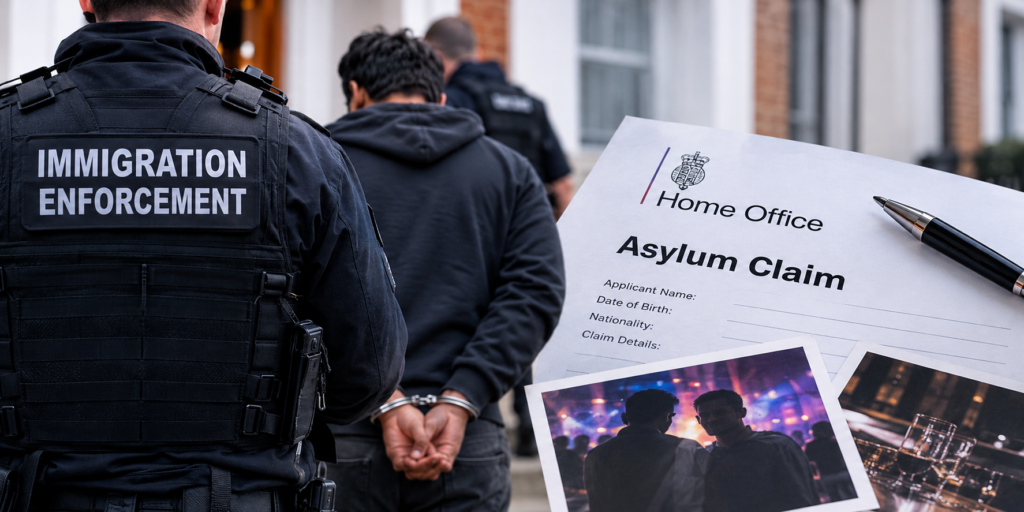
Three people have been arrested in London following a Home Office investigation into a suspected criminal network accused of helping migrants submit fraudulent asylum claims based on fabricated evidence of their sexual orientation.
The arrests follow allegations that individuals were charged up to £4,500 for false documents, staged photographs and supporting statements intended to establish that they faced persecution because of their sexual orientation.
The Home Office is now reviewing more than 100 asylum claims believed to be connected to the suspected network.
Three Arrested Following Immigration Enforcement Raids
Home Office Immigration Enforcement officers conducted raids at addresses in London as part of an investigation into suspected asylum fraud.
Two individuals were arrested on suspicion of fraud and immigration offences. A third person was arrested on suspicion of being in the UK illegally.
Officers also seized mobile phones, jewellery and thousands of pounds in cash.
According to the BBC, the investigation concerns a suspected network accused of assisting dozens of Bangladeshi men in making asylum claims based on alleged persecution because of their sexual orientation.
Investigators suspect the individuals charged between £1,000 and £4,500 to produce false supporting evidence. This allegedly included fabricated letters, staged photographs and statements claiming same-sex relationships.
The allegations remain under investigation.
More Than 100 Asylum Claims Under Review
The investigation centres on alleged activities connected to Apanjon, a Bangladeshi community LGBT organisation based in Whitechapel, east London.
Chris Foster, a regional lead for criminal investigations at the Home Office, said asylum caseworkers had identified similarities between several applications, prompting concerns about the authenticity of the supporting evidence.
Immigration Enforcement officers subsequently began investigating the suspected network.
The Home Office is reviewing more than 100 asylum claims associated with the investigation.
According to the BBC, immigration judges had previously questioned the reliability of evidence connected to Apanjon. In one case, photographs submitted by an asylum applicant were found to have been staged.
The Home Office also reported instances where individuals raised claims concerning their sexual orientation after earlier asylum applications based on political persecution had been refused.
In one reported case, an applicant did not raise their sexual orientation until nine years after their original claim.
However, a person raising additional grounds for asylum at a later stage does not, by itself, establish that the claim is fraudulent. Each application must be assessed on its individual circumstances and evidence.
Earlier BBC Investigation Exposed Alleged Asylum Fraud
The latest arrests follow a BBC undercover investigation published in April 2026.
That investigation reported allegations that certain immigration advisers and intermediaries were helping migrants construct false asylum claims.
Undercover reporters were allegedly offered assistance in obtaining fabricated evidence, including photographs taken at LGBT events, false relationship statements and medical documentation.
The BBC also identified allegations involving fictitious medical conditions and fabricated online news reports intended to support asylum applications.
The investigation led to two arrests in May 2026.
The Home Office has confirmed that its review of asylum claims associated with the earlier reporting remains ongoing.
What Are the Consequences of Submitting a Fraudulent Asylum Claim?
Providing deliberately false information or fabricated evidence in an asylum application can have serious legal consequences.
Where the Home Office establishes that an applicant has deliberately misrepresented material facts, this may affect the credibility and outcome of their asylum claim.
Depending on the circumstances, the consequences may include refusal of the application, criminal investigation, prosecution or immigration enforcement action.
Individuals who knowingly organise or facilitate immigration fraud may also face criminal charges.
Certain immigration fraud offences carry a maximum prison sentence of 10 years, depending on the offence and circumstances.
However, allegations of dishonesty must be distinguished from genuine asylum claims where evidence may be limited, inconsistent or difficult to obtain.
People seeking protection because of their sexual orientation may face genuine risks of persecution in their home countries. Their claims must be considered fairly and in accordance with the UK’s international protection obligations.
Home Secretary Responds to Alleged Asylum Fraud
Home Secretary Shabana Mahmood condemned the alleged activities and warned that those involved in organising fraudulent claims could face prosecution and financial penalties.
She also stated that individuals found to have deliberately abused the asylum system could face refusal of their claims and removal from the UK, where legally permitted.
The Home Office’s investigation remains ongoing, with further scrutiny of asylum applications linked to the suspected network.
What Does This Mean for Asylum Applicants?
The investigation demonstrates the importance of submitting accurate information and genuine supporting evidence when seeking asylum in the UK.
An asylum application must be based on the applicant’s individual circumstances and the risks they may face if returned to their country of origin.
Applicants should not rely on fabricated documents, misleading statements or evidence obtained through individuals offering to manufacture grounds for asylum.
Those who have genuine protection needs should seek advice from appropriately regulated immigration professionals.
For further information about the consequences of dishonesty in immigration applications, read our related article, False Information and Deception in UK Visa Applications: What Applicants Should Know.
Morgan Smith Immigration has over 20 years of combined experience in UK immigration law. For professional immigration advice, contact Morgan Smith Immigration on 0203 959 3335 or email [email protected].
Follow Morgan Smith Immigration for the latest UK immigration news, policy changes and legal developments.