


Conducting a compliant Right to Work check is one of the most important legal responsibilities for UK employers. A Right to Work Digital Verification Service Provider (RtW DVSP) enables employers to carry out digital identity verification for certain Right to Work checks using technology that meets the Home Office requirements.
However, using a RtW DVSP does not remove an employer’s legal responsibilities. Employers must still complete the prescribed Right to Work check themselves and retain the required records to establish a statutory excuse against a civil penalty.
This guide explains what a RtW DVSP can verify, how employers should conduct a Right to Work check using a RtW DVSP and the records that must be retained to remain compliant with Home Office requirements.
Key Points
Before using a RtW DVSP, employers should remember that:
- A RtW DVSP can carry out digital identity verification for eligible documents.
- Employers remain responsible for completing the prescribed Right to Work check.
- Facial recognition technology is optional and may be used to confirm a worker’s identity.
- Workers who cannot or do not wish to use a RtW DVSP should be offered an alternative method of proving their right to work where appropriate.
- Employers must retain the required records throughout employment and for two years after it ends.
What Is a RtW DVSP?
A Right to Work Digital Verification Service Provider (RtW DVSP) is a provider registered with the Office for Digital Identities and Attributes (OfDIA) that can carry out digital identity verification as part of a Right to Work check.
Employers may choose to use a registered RtW DVSP to verify eligible identity documents digitally. However, responsibility for complying with the Home Office Right to Work guidance always remains with the employer.
A statutory excuse is only established where both the employer and the RtW DVSP complete the prescribed Right to Work check correctly.
What Documents Can a RtW DVSP Verify?
A registered RtW DVSP may carry out digital Right to Work checks for:
- holders of valid British passports;
- holders of valid Irish passports or Irish passport cards;
- British and Irish passports (or Irish passport cards) that expired within the previous six months, provided the embedded chip can be verified through passive authentication; and
- documents contained within List A and List B of Annex A where those documents are available digitally from the issuing authority.
RtW DVSPs may also provide facial recognition technology to help employers confirm that the individual presenting for work is the same person whose identity has been verified.
The services available will vary between providers, so employers should check what technology and identity verification services their chosen RtW DVSP offers.
Expired British and Irish Passports
Where a British or Irish passport, or an Irish passport card, expired within the previous six months is presented, a RtW DVSP may verify the document using passive authentication technology.
However, this may not always be possible. A RtW DVSP may decide not to offer verification for expired documents, or the embedded chip within the document may be damaged or corrupted, preventing verification.
Employers should also be aware that a clipped passport is a cancelled document and cannot be accepted as evidence of the right to work.
Employers Must Provide an Alternative
Not every worker will hold an eligible passport or wish to complete a digital identity check.
Employers must not treat these individuals less favourably.
Where an individual does not wish to use a RtW DVSP, or cannot complete the digital verification process, employers should provide an alternative way for them to prove their right to work by carrying out a compliant manual document-based Right to Work check where appropriate.
How to Conduct a Right to Work Check Using a RtW DVSP
To establish a statutory excuse, employers must complete the following steps before employment begins.
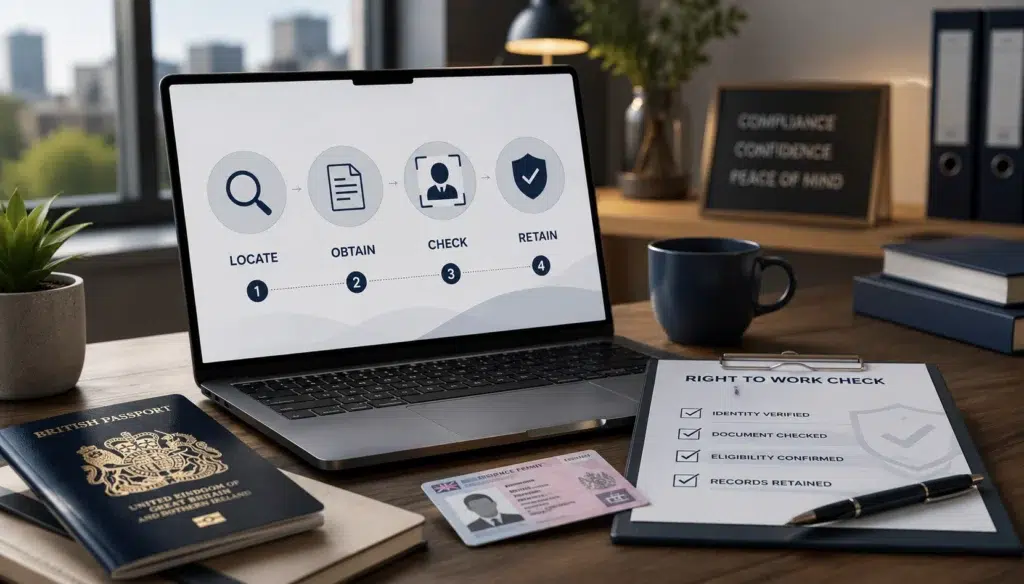
Step 1: Locate
Choose a RtW DVSP that is registered with the Office for Digital Identities and Attributes (OfDIA).
Using a registered provider helps ensure that the identity verification process is carried out in accordance with the Home Office requirements.
Step 2: Obtain
Obtain the verification output produced by the RtW DVSP.
This document forms part of the employer’s Right to Work records and should be retained as evidence that the digital verification has been completed.
Step 3: Check
The employer must be satisfied that:
- the photograph relates to the individual presenting for work;
- the biographical information, such as the date of birth, relates to that individual; and
- the person presenting themselves for work is not an imposter.
This confirmation may be completed:
- in person;
- during a video call; or
- by using facial recognition technology provided by the RtW DVSP.
Where facial recognition technology is used, employers should retain the comparison provided by the RtW DVSP alongside the Right to Work records.
Step 4: Retain
Employers must retain a clear copy of the RtW DVSP output throughout the worker’s employment and for two years after employment ends.
The records should then be securely destroyed.
What Information Must Employers Keep?
The information provided by the RtW DVSP should include:
- the worker’s forename and surname;
- any middle names, where applicable;
- date of birth;
- an image of the identity document used for the check;
- a photograph of the individual;
- confirmation that the RtW DVSP is registered;
- confirmation that the RtW DVSP conducted the check in accordance with the supplementary code;
- the date the identity check was completed;
- the name of the RtW DVSP; and
- confirmation of whether the worker’s identity was successfully verified.
Keeping complete and accurate records is an important part of demonstrating compliance during any Home Office audit or investigation.
Using Facial Recognition Technology
Employers may choose to use facial recognition technology to confirm a worker’s identity as part of a Right to Work check.
The technology compares the facial image contained within the identity document against an image of the individual and confirms whether the images match.
Facial recognition technology is optional. Employers may instead confirm the worker’s identity in person.
Where facial recognition technology is used, it must be provided by a registered RtW DVSP.
If a worker is unable to complete the digital facial recognition process, employers should provide another suitable method of verifying their identity as part of the Right to Work check.
The RtW DVSP will also provide a record of the facial comparison, including the relevant images, confirmation of registration, the date of the check, the name of the provider and confirmation of whether the identity was successfully verified. These records must also be retained for the required retention period.
Holder Services
Some organisations use holder services, such as digital wallets or similar identity storage services, to allow individuals to collect, store and share identity information across multiple organisations.
These services may help businesses, particularly where work is delivered through a chain of contracts, by providing greater confidence that the individual undertaking the work is the same person whose identity has already been verified.
However, holder services do not replace the requirement to carry out a Right to Work check.
Where employers choose to use holder services, the Home Office recommends using a registered RtW DVSP to help ensure that the systems meet the required standards for security and data protection.
Final Thoughts
Using a RtW DVSP can help employers complete digital identity verification efficiently, but it does not remove their legal responsibilities under the Home Office Right to Work guidance.
Employers should ensure they choose a RtW DVSP registered with OfDIA, complete each prescribed step before employment begins and retain the required records throughout the prescribed retention period. Following the correct process is essential to establishing and maintaining a statutory excuse against a civil penalty.
Follow Morgan Smith Immigration for the latest UK immigration law, policy updates and employer compliance guidance. With over 20 years of experience, we help businesses strengthen their Right to Work procedures through mock audits and practical legal advice. If you require assistance with Right to Work checks or any UK immigration matter, contact us on us at 0203 959 3335 or email [email protected].
Frequently Asked Questions
No. RtW DVSPs can only carry out digital verification for the documents and circumstances permitted under the Home Office guidance. Where an individual cannot or does not wish to use a RtW DVSP, employers should provide an alternative method of completing the Right to Work check where appropriate.
No. A statutory excuse is only established where both the employer and the RtW DVSP complete the prescribed Right to Work check in accordance with the Home Office requirements.
Employers must retain the required records throughout the worker’s employment and for two years after employment ends before securely destroying them.