


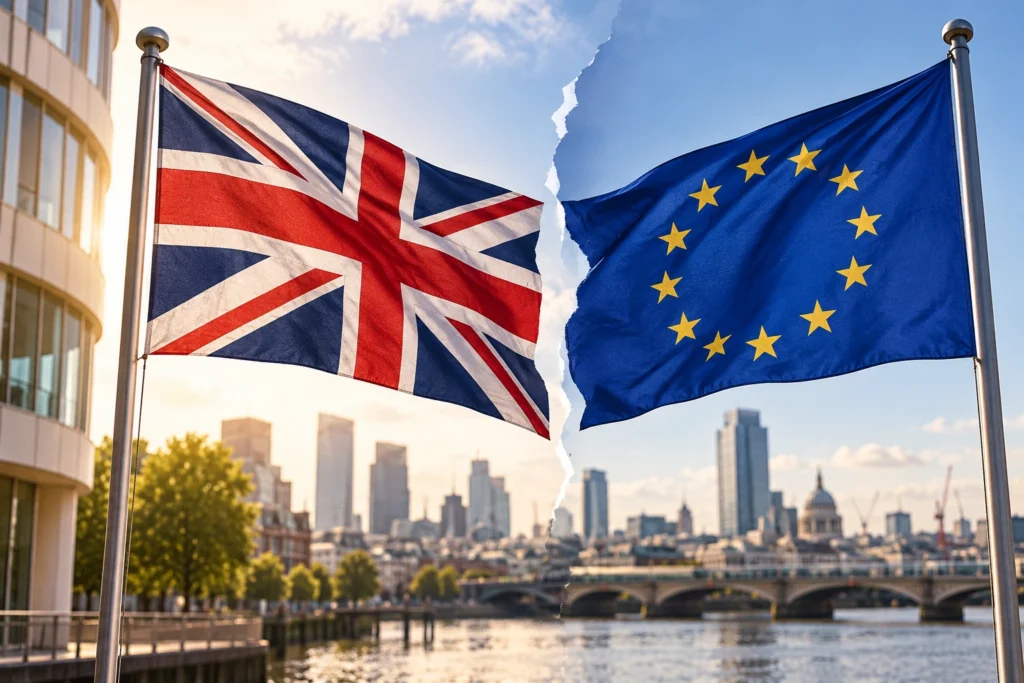
Ten years after the UK voted to leave the European Union, the possibility of rejoining is entering mainstream political discussion.
According to reporting by The Guardian, senior Downing Street officials have been speaking with thinktanks and pollsters to assess public attitudes towards the UK potentially rejoining the EU. Prime Minister Andy Burnham has also said that the options being considered for the UK’s future relationship with Europe could range from maintaining the current position to closer economic integration or going “all the way” and rejoining.
That is a significant political development.
But before asking the public whether Britain should rejoin the EU, there is another question worth asking:
What happened to the promises and expectations surrounding Brexit in the first place?
Brexit and the Promise of Greater Control
Immigration and control over the UK’s borders were central issues in the Brexit debate.
Leaving the EU ended freedom of movement and gave the UK Government greater legal control over who could come to Britain to live and work. That change was real.
However, greater legal control over immigration did not automatically translate into lower overall migration.
The nature of migration changed substantially after Brexit. EU immigration fell while non-EU migration became considerably more important under the UK’s new immigration system.
The Office for National Statistics has said that non-EU nationals drove the substantial increases in immigration between 2020 and 2023. Meanwhile, EU immigration fell, with that decline accelerating after freedom of movement ended.
Net migration subsequently fell sharply. ONS estimates put net migration at 171,000 in the year ending December 2025, down from a peak of 944,000 in the year ending March 2023.
This leaves an important distinction.
Brexit ended freedom of movement for EU nationals, but it also meant the UK no longer shared the same level of border and security cooperation with the EU. While the aim was to take greater control of the UK’s borders, leaving the EU also meant stepping away from security arrangements that had previously supported that control.
As we previously discussed in our article on The Impact of the UK’s Post-Brexit Immigration System on Employment, leaving the EU fundamentally changed how workers enter the UK and how British employers recruit internationally.
What Happened at the Border?
The issue becomes even more complicated when irregular migration is considered.
If taking greater control of Britain’s borders was one of the arguments for leaving the EU, the growth in Channel crossings deserves particular scrutiny.
Home Office figures show that small-boat arrivals were relatively low between 2018 and 2020, with 10,608 recorded arrivals across those three years.
By the year ending June 2025, 43,309 people had arrived by small boat. That was 38% higher than the preceding year, although still 5% below the 2022 peak.
Brexit should not simply be described as the cause of small-boat crossings. Irregular migration is affected by numerous international, legal and geopolitical factors.
But politically, the figures create a difficult question.
If leaving the EU was supposed to give Britain greater control of its borders, why did irregular Channel crossings become a much larger political problem after the referendum?
Legal control and practical control are not necessarily the same thing.
The Economic Question Cannot Be Ignored
Border policy was not the only argument surrounding Brexit.
Supporters and opponents made competing predictions about trade, investment, regulation, public finances and the wider economy. Ten years later, there is considerably more evidence with which to examine those arguments.
The Office for Budget Responsibility’s current Brexit assumptions estimate that the UK’s post-Brexit trading relationship with the EU will reduce long-run productivity by around 4% compared with remaining in the EU. It also assumes UK trade intensity will ultimately be around 15% lower.
Consumers have also experienced some effects through prices.
Research from the London School of Economics’ Centre for Economic Performance concluded that additional trade barriers following Brexit contributed to higher UK food prices. Its earlier analysis estimated that leaving the Single Market and Customs Union had increased food prices by approximately 6%.
Again, Brexit cannot reasonably be blamed for every economic difficulty Britain has experienced. The pandemic, war in Ukraine, global inflation, energy prices and other international pressures have all affected households and businesses. Nevertheless, the evidence makes it legitimate to examine whether some of the economic expectations associated with Brexit were realised.
And Now Britain Is Talking About Rejoining
This is what makes the current discussion particularly striking.
The country held a referendum in 2016. A majority voted to leave. Governments then spent years designing and implementing Britain’s departure from the EU.
Now Downing Street is reportedly gathering evidence about whether the public might support moving in the opposite direction.
That does not necessarily mean the UK will rejoin.
Rejoining would itself be an enormous political and legal undertaking. The terms could not simply be assumed to replicate Britain’s previous EU membership, and any future application would require negotiation with European partners.
There are also several possible positions between today’s arrangements and full EU membership. These could include closer customs arrangements or participation in aspects of the Single Market.
The Government therefore faces more than a simple “Leave or Rejoin” question.
Before Another Decision, Britain Deserves an Honest Assessment
The debate should not become an attempt to rewrite either side of the 2016 referendum.
Instead, it should examine what actually happened.
Did Brexit give the UK greater legal control over immigration? Yes.
Did that automatically result in consistently lower overall migration? No.
Did ending free movement stop irregular migration? The small-boats figures clearly show that it did not.
Have there been economic costs associated with leaving the EU? Evidence from organisations including the OBR and LSE indicates that post-Brexit trade barriers have imposed economic costs.
None of these answers, by themselves, determines whether Britain should rejoin the EU.
But they should form part of the discussion.
If the public is eventually asked to support another fundamental change in Britain’s relationship with Europe, the debate should be based on evidence about what worked, what did not and what any new relationship would actually involve.
Ten years after the referendum, perhaps the most important question is not simply “Should Britain rejoin the EU?”
It is: What has Britain learned from leaving it?
Follow Morgan Smith Immigration for updates on UK immigration law, policy and official developments affecting migrants, employers and families.
With more than 20 years of experience in UK immigration matters, Morgan Smith Immigration is committed to providing professional immigration advice and maintaining high standards of client care.
For advice on how changes to UK immigration policy may affect you, your family or your business, contact Morgan Smith Immigration on 0203 959 3335 or email [email protected].