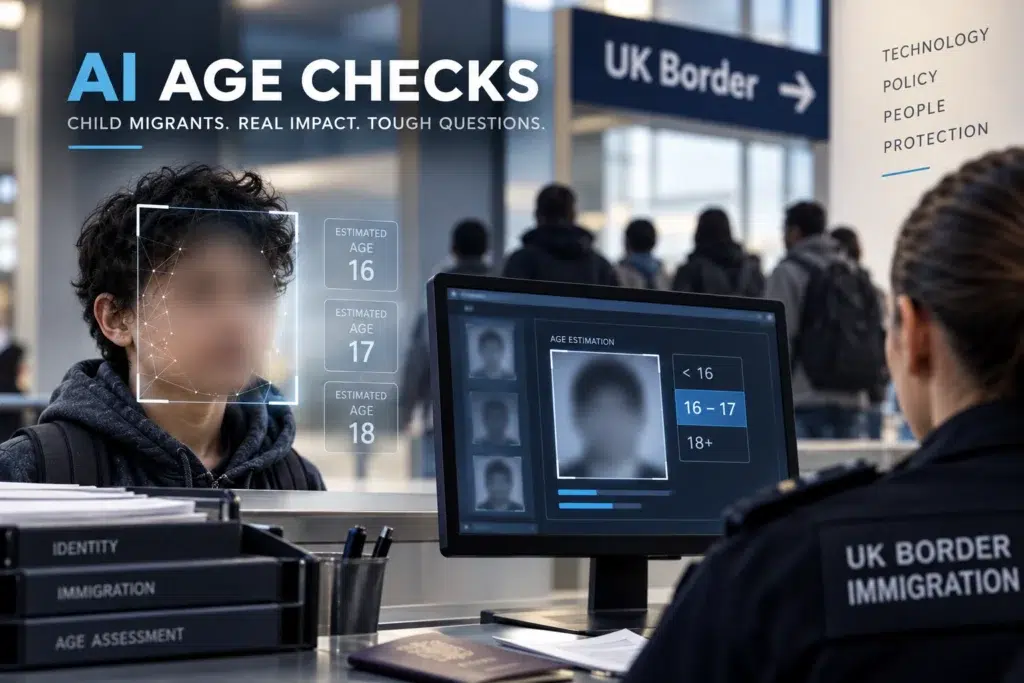


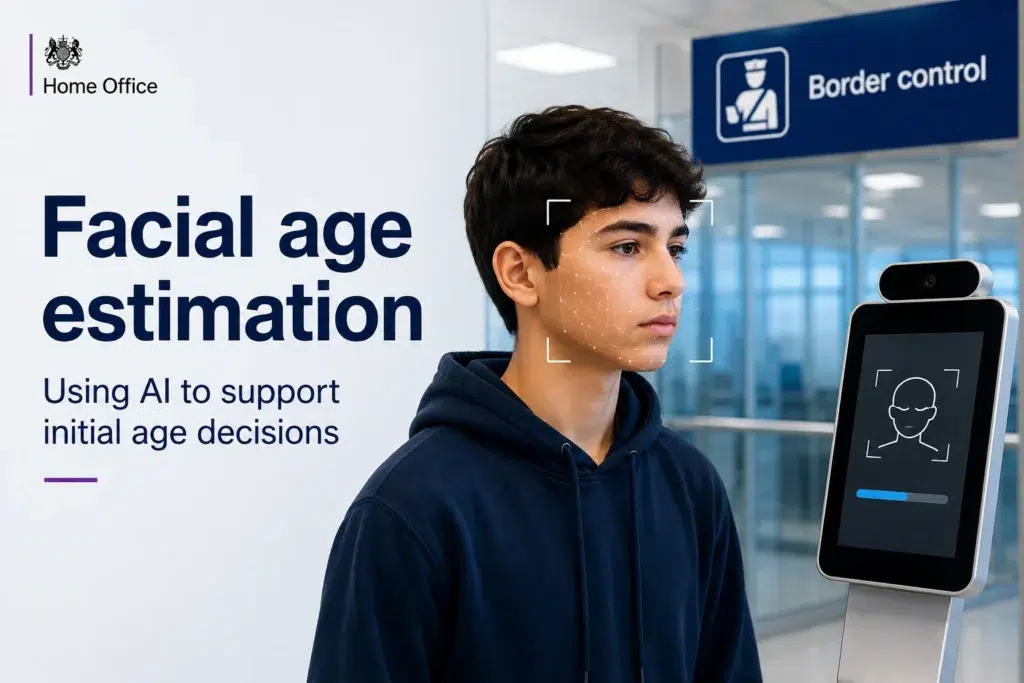
The Home Office has announced plans to explore the use of Facial Age Estimation (FAE) technology as part of the UK’s age assessment process for asylum seekers. Testing of the technology will continue throughout 2026 and it is not expected to become operational until 2027. Even so, its proposed introduction marks a significant development in the handling of age-disputed asylum cases at the UK border.
The initiative supports the Government’s broader efforts to strengthen age assessment procedures. At the same time, it maintains a strong focus on safeguarding vulnerable children.
Why Age Assessment Matters
Some individuals arrive in the United Kingdom seeking asylum without reliable identity documents. In these cases, determining their age can present a considerable challenge. This is particularly important where a person claims to be under 18 but there are doubts regarding their stated age.
The distinction between a child and an adult has significant implications within the asylum system. Children are entitled to specific protections and safeguarding measures. They also have access to accommodation arrangements and educational opportunities that differ substantially from those available to adults.
An incorrect age assessment can have serious consequences. A child may be placed in unsuitable adult accommodation if their age is assessed incorrectly. Conversely, an adult identified as a child could gain access to environments designed for minors, including schools, care settings and local authority support services.
For this reason, immigration officers are required to make an initial assessment of age when there is reason to question an individual’s claimed age.
The Current Approach to Age Disputes
At present, immigration officers make initial age decisions based on the information available at the point of first encounter. This assessment takes into account an individual’s physical appearance, demeanour and any professional observations provided by social workers where appropriate.
The Home Office applies a “benefit of the doubt” principle in disputed cases. Two immigration officers must independently conclude that an individual appears to be significantly over the age of 18. If they do not, the person will generally be treated as a child pending further assessment.
Uncertainty may still remain after the initial assessment. In such cases, a local authority may conduct a more detailed age assessment in accordance with the well-established Merton principles.
This approach reflects the importance of ensuring that potentially vulnerable children receive appropriate care and protection while more comprehensive enquiries are undertaken.
What Is Facial Age Estimation?
Facial Age Estimation is a technology that analyses a photograph of an individual’s face. It then generates an estimate of that person’s age.
Facial recognition systems seek to identify a person by comparing their image against existing records. By contrast, Facial Age Estimation does not establish identity. Instead, it focuses solely on estimating age based on facial characteristics.
Researchers developed the technology using machine learning techniques that analyse large volumes of images from individuals with known ages.
Through this process, the system identifies patterns associated with different age groups and applies those patterns when assessing a new image.
The result is an estimated age or age range generated within seconds.
How the Home Office Intends to Use FAE
A key point emphasised throughout the Home Office guidance is that Facial Age Estimation will not replace human decision-making.
The technology provides an additional source of information to support immigration officers when they make initial age decisions. Responsibility for those decisions will remain with trained officers, who must continue to consider all available evidence and circumstances.
Where an officer is already satisfied that an individual is a child, there would be no requirement to use Facial Age Estimation. Similarly, the technology will not replace detailed local authority age assessments where these are necessary.
Professionals use FAE to supplement their judgement and provide an additional point of reference when individuals dispute their assessed age.
Understanding the Limitations
While Facial Age Estimation offers potential benefits, the Home Office acknowledges that the technology is not capable of determining a person’s exact age.
No age assessment method can provide complete certainty in the absence of reliable documentary evidence. As with human judgement and other scientific approaches, there remains an inherent margin of error.
Research conducted by the US National Institute of Standards and Technology (NIST), which has evaluated Facial Age Estimation systems for more than a decade, demonstrates that performance varies between different algorithms and demographic groups.
Factors such as image quality, age range, gender and geographical background can all influence accuracy.
Importantly, studies indicate that estimating ages around the critical 16-to-18-year-old threshold remains particularly challenging, even for the highest-performing systems.
These limitations explain why the Home Office has consistently stated that FAE will serve as a supplementary tool rather than a decisive factor in age assessments.
Balancing Innovation and Safeguarding
The proposed use of Facial Age Estimation reflects a broader challenge facing immigration authorities: balancing the need for effective border management with the duty to safeguard vulnerable individuals.
Age assessment remains a complex exercise requiring professional judgement, careful consideration of evidence and an awareness of the significant consequences that may follow from an incorrect decision.
The Home Office’s position is that Facial Age Estimation can contribute to this process by providing immigration officers with an additional source of information rather than replacing established assessment methods.
If implemented as planned, the technology could assist decision-makers in reaching more informed initial assessments while maintaining the central role of human judgement and safeguarding principles.
Looking Ahead
Facial Age Estimation is currently undergoing evaluation and is not yet being used operationally within the UK’s asylum system. The Home Office intends to continue testing throughout 2026, with potential implementation at the border from 2027 onwards.
As the technology develops and further evidence becomes available, its role within the age assessment process is likely to remain the subject of considerable scrutiny from policymakers, legal practitioners, safeguarding professionals and human rights organisations.
What remains clear is that any future use of Facial Age Estimation will need to strike an appropriate balance between technological innovation, procedural fairness and the protection of vulnerable children within the immigration system.
Follow us to stay updated on changes to UK immigration law, policy developments and guidance affecting migrants, employers and families.
With over 20 years of experience and a commitment to excellence, Morgan Smith Immigration is your trusted partner for all your immigration needs. Contact us today to learn more about how we can assist you with UK visa applications. For enquiries or assistance, call us at 0203 959 3335 or email [email protected].