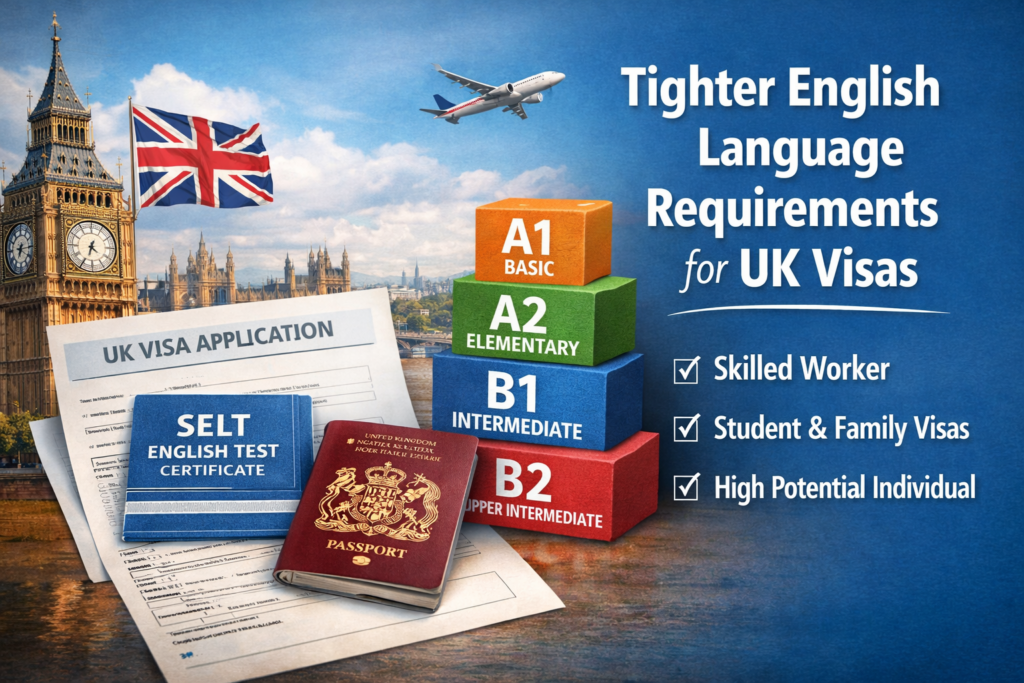


English language ability has long formed part of the UK’s work immigration system but recent changes have raised the standard expected of certain visa applicants.
From 8 January 2026, individuals applying under several key work routes must demonstrate a higher level of English than was previously required. While the change may appear technical, it has practical consequences for overseas workers, international graduates already in the UK and employers relying on overseas recruitment.
Understanding the new requirements at an early stage can help avoid delays, unexpected refusals and disruption to recruitment plans.
Why Does English Language Ability Matter?
The Home Office requires many work visa applicants to prove that they can communicate effectively in English. The requirement is intended to ensure that migrants can participate fully in professional life, understand workplace responsibilities and engage with day-to-day life in the UK.
English language ability is assessed according to the Common European Framework of Reference for Languages (CEFR), an internationally recognised scale used to measure language proficiency.
Until recently, many work visa applicants were required to meet CEFR level B1. New rules now require a higher standard for certain routes.
Which UK Work Visas Require English at B2 Level?
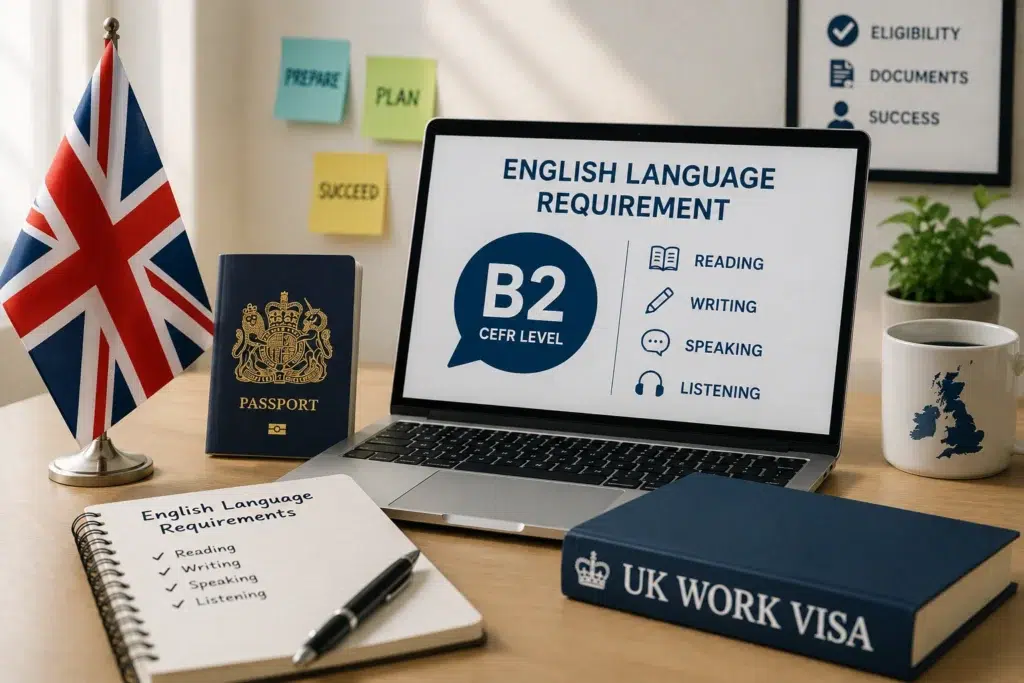
Applicants making new applications from 8 January 2026 must generally demonstrate English language ability at CEFR level B2 if applying under:
- The Skilled Worker route;
- The Scale-up route; or
- The High Potential Individual (HPI) route.
The requirement applies whether the applicant is applying from overseas or switching into one of these routes from another immigration category within the UK.
For example, a Student visa holder moving into Skilled Worker status after graduation will now be expected to satisfy the higher B2 standard.
How Can You Meet the English Language Requirement?
The Home Office allows applicants to satisfy the English language requirement through several recognised methods. The appropriate option will depend on an individual’s qualifications, nationality and immigration history.
Using UK School Qualifications
Applicants may be able to rely on certain qualifications obtained at a UK school, provided the course of study began before the age of 18.
Accepted qualifications include:
- GCSE English;
- A Level English;
- Scottish National Qualification level 4 or 5 in English; and
- Scottish Higher or Advanced Higher in English.
Using a UK Degree Qualification
Applicants can meet the requirement if they hold a degree-level qualification that was:
- Taught in English; and
- Awarded by a recognised UK institution.
This includes qualifications awarded by UK institutions where studies were completed outside the United Kingdom.
Using an Overseas Degree Taught in English
Applicants with a degree awarded outside the UK may also be able to rely on their qualification if it was taught in English.
In most cases, Ecctis confirmation will be required to verify that the qualification is equivalent to a UK bachelor’s degree or higher and that it was taught in English.
Passing an Approved English Language Test
Applicants who cannot rely on a recognised qualification will generally need to pass a Secure English Language Test (SELT) from an approved provider.
For new applications submitted from 8 January 2026 under the Skilled Worker, Scale-up and High Potential Individual routes, applicants must demonstrate English language ability at CEFR level B2 in:
- Speaking;
- Listening;
- Reading; and
- Writing.
Previously Accepted English Language Evidence
If an applicant has already demonstrated their English language ability in a previous successful immigration application, they may not need to provide evidence again, depending on the relevant Immigration Rules.
Who Is Exempt from the English Language Requirement?
Certain applicants do not need to provide separate evidence of English language ability.
Nationals of Majority English-Speaking Countries
The Home Office recognises nationals of the following countries and territories as meeting the English language requirement:
- Antigua and Barbuda;
- Australia;
- The Bahamas;
- Barbados;
- Belize;
- British Overseas Territories;
- Canada;
- Dominica;
- Grenada;
- Guyana;
- Jamaica;
- Malta;
- New Zealand;
- St Kitts and Nevis;
- St Lucia;
- St Vincent and the Grenadines;
- Trinidad and Tobago; and
- The United States of America.
Existing Skilled Workers and Transitional Arrangements
Applicants who held Skilled Worker permission before 8 January 2026 and are applying to extend or update their permission can generally continue to rely on the previous B1 English language requirement.
Similarly, applicants switching from the Health and Care Worker route will usually not need to provide fresh evidence where the requirement has already been satisfied.
Looking Ahead
The increase to B2 forms part of a broader shift towards stricter English language requirements within the UK’s immigration system.
For prospective applicants, early preparation is likely to be more important than ever. Assessing eligibility, identifying the appropriate evidence and addressing any language requirements before an application is submitted can significantly reduce the risk of delays or refusals.
For employers, understanding these changes will be essential when planning future recruitment and sponsorship strategies.
Follow us to stay updated on changes to UK immigration law, policy developments and guidance affecting migrants, employers and families.
With over 20 years of experience and a commitment to excellence, Morgan Smith Immigration is your trusted partner for all your immigration needs. Contact us today to learn more about how we can assist you with UK visa applications. For enquiries or assistance, call us at 0203 959 3335 or email [email protected].
Frequently Asked Questions