


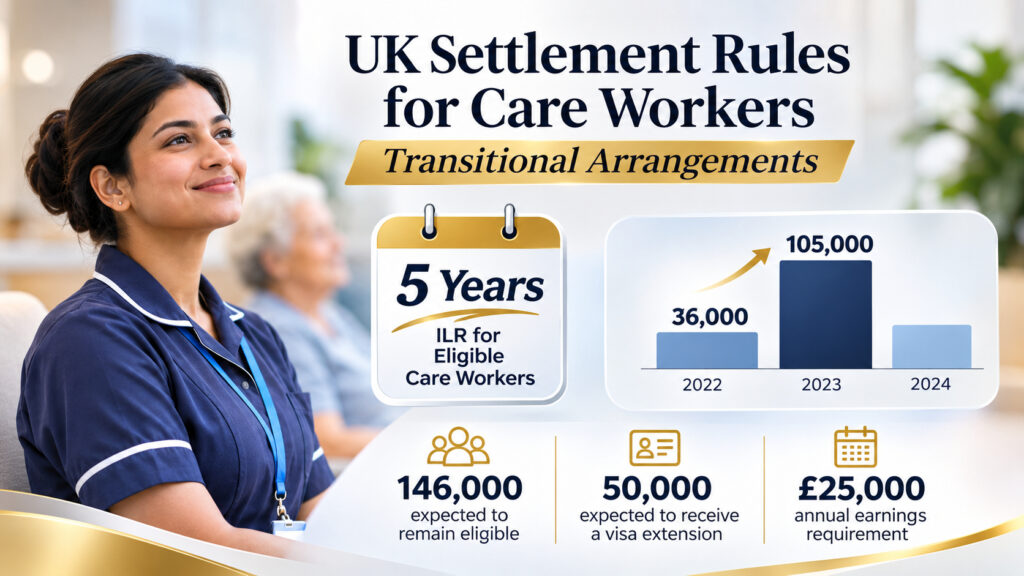
The Government’s earned settlement reforms will increase the standard qualifying period for Indefinite Leave to Remain (ILR) from five to ten years. However, transitional arrangements have been announced to protect the existing five-year settlement pathway for eligible care workers.
A recent House of Commons Library briefing examines these arrangements, the number of care workers expected to benefit and the estimated financial impact of their settlement in the UK.
Which Care Workers Will Retain the Five-Year Route to ILR?
UK Government has recognised care workers as a “unique cohort” and announced transitional arrangements for those who meet certain requirements.
Under the announced arrangements, care workers may retain their five-year pathway to settlement if they:
- Entered the care worker route before 12 May 2025.
- Have remained in sponsored employment.
- Have maintained annual earnings of at least £25,000.
Similar arrangements are expected to apply to workers in certain other lower-paid healthcare occupations, including nursing auxiliaries.
However, the Government has yet to confirm the detailed eligibility requirements, including how periods of unemployment, interruptions in sponsored employment or earnings below £25,000 will be treated.
Further clarification is also required regarding the immigration status applicants must have held before the cut-off date.
What Happens to Care Workers Who Do Not Qualify?
Care workers within the eligible transitional cohort who do not meet the requirements to retain their five-year settlement pathway will be offered a special five-year visa extension.
Following this extension, they may apply for ILR, subject to meeting the applicable settlement requirements. Settlement will not be granted automatically.
Those who entered the care worker route after the relevant cut-off date will generally fall under the new standard ten-year settlement pathway.
How Many Care Workers Could Benefit?
According to Government estimates, approximately 196,000 care workers and 186,000 dependants could potentially benefit from the transitional arrangements.
The Government estimates that:
| Category | Care workers | Dependants |
|---|---|---|
| Expected to retain the five-year settlement route | 146,000 | 136,000 |
| Expected to receive a special five-year extension | 50,000 | 50,000 |
| Expected to follow the standard ten-year route due to entering after the cut-off | 6,000 | 5,000 |
These figures remain estimates and may change once the final eligibility requirements are published.
How Has Care Worker Immigration Changed in the UK?
Overseas recruitment in the social care sector increased considerably after care workers and home carers became eligible for Skilled Worker visa sponsorship in February 2022.
Home Office statistics show that:
- At least 152,000 Skilled Worker visas have been granted to overseas care workers since January 2021.
- Approximately 36,000 visas were granted in 2022.
- Visa grants increased to around 105,000 in 2023.
- Approximately 250,000 care workers and their dependants arrived in the UK or switched into the route between 2022 and 2025.
However, subsequent immigration restrictions significantly changed recruitment within the sector.
In March 2024, restrictions were introduced preventing newly sponsored care workers from bringing dependants, subject to transitional provisions. From July 2025, the Government closed overseas recruitment for care workers and senior care workers.
Understanding the £10 Billion Estimated Fiscal Cost
Home Office research published in March 2026 estimated the lifetime net fiscal cost of care workers and their adult dependants expected to settle between 2026 and 2030.
The estimated costs were:
- Care workers: £4.2 billion.
- Adult dependants: £5.3 billion.
- Combined estimated lifetime cost: £9.5 billion, rounded to £10 billion.
These calculations consider expected tax contributions alongside expenditure on public services and benefits over an individual’s lifetime.
Importantly, the £10 billion figure does not represent the direct cost of introducing transitional arrangements. Extending the settlement qualifying period would delay access to certain public funds rather than necessarily prevent these costs from arising in the future.
The analysis also does not account for certain wider economic and social benefits provided by care workers, including their contribution to the delivery of essential healthcare and social care services.
What Should Care Workers Do Now?
Until the detailed Immigration Rules are published, care workers should review their immigration and employment history, maintain records of their earnings and sponsorship and ensure they continue to comply with their visa conditions.
Those who have experienced employment gaps, salary reductions or changes in sponsorship should seek professional advice regarding their individual circumstances.
The Government has confirmed that a full impact assessment will be published before the reforms are implemented.
How Morgan Smith Immigration Can Help
At Morgan Smith Immigration, we provide tailored immigration advice and assistance to individuals and businesses based on their circumstances.
If you require guidance regarding your eligibility for UK settlement or your current immigration status, contact our team on 0203 959 3335 or email [email protected].
Follow Morgan Smith Immigration to stay updated on the latest UK immigration rules and settlement reforms.