


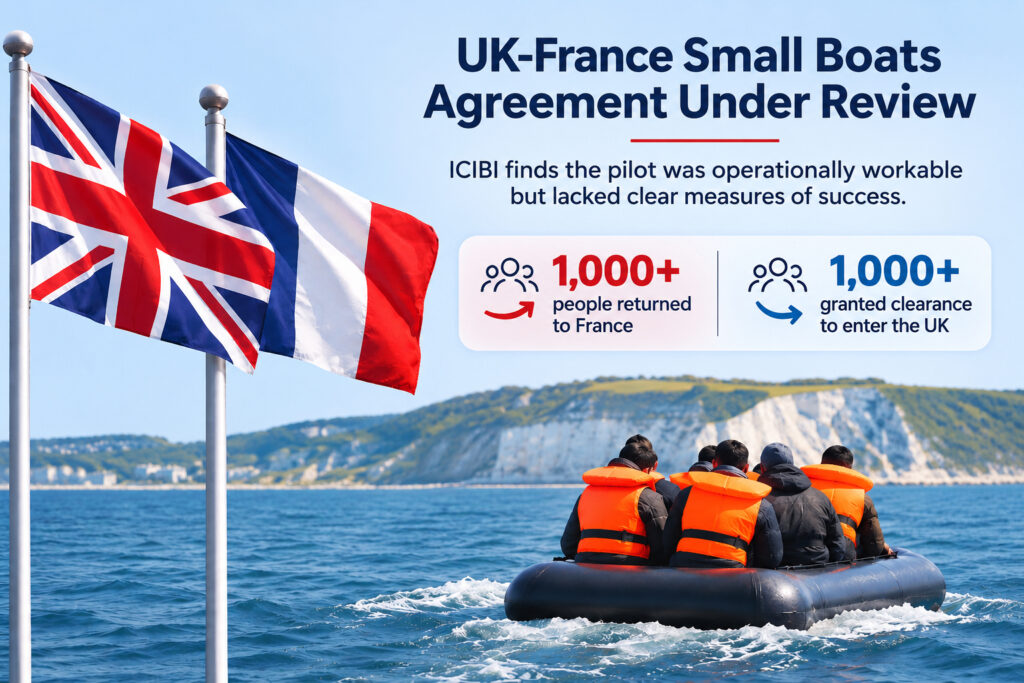
The UK’s agreement with France to return asylum seekers who arrive by small boats has demonstrated that a joint returns system can operate in practice. However, an independent inspection has raised questions about its effectiveness, costs and ability to deter dangerous Channel crossings.
The Independent Chief Inspector of Borders and Immigration (ICIBI) published its findings following an inspection of the scheme, known within the Home Office as Operation Hillmore.
While inspectors recognised progress in establishing the arrangement, they found that the Home Office had not set sufficiently clear criteria to determine whether the pilot had achieved its wider objectives.
How Does the UK-France Agreement Work?
The agreement, commonly referred to as the ‘one in, one out’ scheme, allows the UK to return certain asylum seekers who arrive through irregular Channel crossings to France.
In exchange, an equivalent number of eligible individuals can be admitted to the UK through an authorised process.
The pilot was initially scheduled to conclude on 11 June 2026 but was subsequently extended until 1 October 2026.
By mid-June, more than 1,000 individuals had been returned to France, while a similar number had received clearance to enter the UK.
The arrangement was intended to discourage dangerous Channel crossings while establishing a controlled system for returns and admissions between the two countries.
Inspectors Question How Success Was Measured
One of the inspection’s main findings was the absence of clearly defined measures for evaluating the pilot’s overall success.
Although the Home Office monitored operational performance, inspectors found uncertainty over whether the programme’s primary objective was to reduce irregular crossings or demonstrate that a functioning returns system could be established.
The report acknowledged that the agreement had shown the practical feasibility of cooperation between the UK and France using existing legal procedures.
However, it remained difficult to establish whether the scheme had directly contributed to any reduction in small boat arrivals.
Inspectors noted that several external factors influence Channel crossings, making it challenging to isolate the agreement’s impact.
Without measurable objectives, the Home Office could not adequately demonstrate whether the pilot had achieved its intended deterrent effect.
Concerns Over Costs and Return Refusals
The inspection also identified concerns regarding the programme’s financial implications and operational demands.
Inspectors found that a comprehensive value-for-money assessment had not been completed, leaving questions about whether the resources committed to the pilot were proportionate to its outcomes.
The scheme also placed additional pressure on immigration detention capacity, potentially affecting other enforcement activities.
Another challenge involved referrals rejected by French authorities.
According to the report, refusal rates reached 50% among certain groups of cases. Limited information about the reasons for these refusals made it difficult for Home Office officials to identify problems and improve the referral process.
Despite these difficulties, inspectors credited strong leadership, central coordination and dedicated resources for the programme’s operational progress.
Safeguarding and Access to Legal Advice
The inspection examined how individuals were treated throughout the returns process, including their access to legal advice and welfare support.
Inspectors recognised efforts by Home Office staff to maintain appropriate safeguarding standards, improve reception arrangements and provide practical assistance to individuals in detention.
However, concerns remained about the circumstances of people returned to France.
Non-governmental organisations raised questions about whether individuals had sufficient opportunities to obtain legal advice or disclose experiences of trafficking, torture or other vulnerabilities before removal.
Inspectors also highlighted the difficult circumstances faced by some individuals arriving in Paris following detention in the UK.
These findings underline the importance of ensuring that immigration enforcement arrangements include effective safeguards and meaningful access to legal advice.
Home Office Accepts All Three Recommendations
Following the inspection, the ICIBI made three recommendations aimed at improving future immigration arrangements.
These included conducting a comprehensive review of lessons learned, establishing measurable objectives before introducing similar schemes, and assessing whether alternative approaches could achieve comparable outcomes more efficiently.
In its official response, the Home Office welcomed the report, acknowledged the operational strengths identified by inspectors and accepted all three recommendations.
The findings suggest that although the UK-France agreement has established a workable returns mechanism, further evaluation is necessary to determine its wider effectiveness and financial sustainability.
What Does This Mean for UK Immigration Policy?
The inspection highlights an important distinction between establishing an operational immigration arrangement and demonstrating that it achieves its intended policy objectives.
For future agreements, the Home Office will need to consider not only the number of individuals returned or admitted but also the impact on irregular migration, public expenditure and the protection of vulnerable individuals.
The report also reinforces the importance of clear legal procedures and safeguards when implementing immigration enforcement measures.
At Morgan Smith Immigration, we continue to monitor developments in UK immigration policy and their implications for individuals and families.
For professional advice on UK immigration, contact our team on 0203 959 3335 or email [email protected]. Follow Morgan Smith Immigration for the latest UK immigration news and policy updates.