


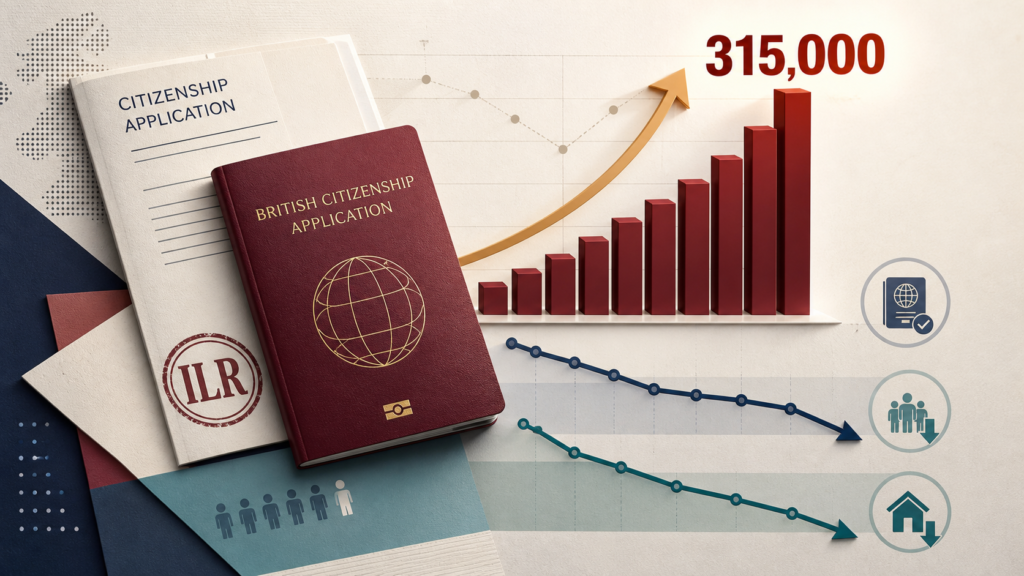
UK citizenship applications hit record high in 2026, as the number of people applying for British citizenship reached its highest level on record, according to new Home Office figures analysed by the Migration Observatory at the University of Oxford.
Just over 315,000 citizenship applications were submitted in the year ending June 2026, an increase of 17% compared with the previous year. The rise came during an intense political debate over permanent settlement, access to benefits and the future rights of non-citizens living in the UK.
At the same time, the latest data show declines in UK visa grants, asylum applications, small boat arrivals and the number of asylum seekers housed in hotels. Returns of unauthorised migrants, meanwhile, continued to increase.
Citizenship applications rise to record levels
Both EU and non-EU citizens contributed to the record number of British citizenship applications.
Non-EU nationals accounted for the clear majority, with approximately 234,000 applications, representing 74% of the total. This continues a gradual upward trend seen over the past five years as more non-EU migrants who entered the UK before 2020 have become eligible to apply.
The Migration Observatory also identified a gradual increase since 2021 in the proportion of eligible non-EU migrants choosing to become British citizens.
Applications from EU citizens followed a different pattern. They began rising sharply in October 2025 and increased by around 40% over the following year, reaching more than 81,000 in the year ending June 2026. Unlike the rise among non-EU nationals, this increase did not coincide with a notable expansion in the number of people becoming eligible.
Researchers said the available data cannot establish precisely why more EU citizens are applying. However, political discussions about restricting the rights of non-citizens or removing some people who do not hold citizenship may have encouraged eligible residents to secure their position by becoming British citizens.
Uncertainty over immigration status can influence such decisions, particularly when migrants believe the conditions attached to permanent residence may change.
Settlement debate may be influencing applications
The government is consulting on proposals that could lengthen the route to permanent settlement and limit access to benefits for some non-citizens with settled status.
The Conservative Party and Reform have also indicated that they would remove Indefinite Leave to Remain from certain existing holders.
Most migrants with ILR can currently apply for British citizenship after holding settled status for 12 months. Against this political backdrop, citizenship may increasingly be viewed as offering greater long-term security than permanent residence alone.
Grants of Indefinite Leave to Remain increase
The number of people granted settlement also known as Indefinite Leave to Remain rose substantially during the first half of 2026.
Approximately 127,000 settlement grants were issued, an increase of 73% compared with the same period in 2025. The rise was driven primarily by Hong Kong British National (Overseas) status holders and people who had previously held work visas.
The timing is significant because 2026 marks five years since the first migrants entered under the UK’s post-Brexit immigration system.
However, many people who arrived through that system have not yet lived in the country long enough to qualify for permanent settlement. This includes large numbers of care workers who came to the UK in 2022 and 2023.
UK Home Office is expected to announce during 2026 whether these migrants will face a longer route to settlement.
UK visa grants fall by 15%
The year ending June 2026 also marked the second full year of immigration data since Labour took office and the first full year since work visa restrictions were introduced in July 2025.
Overall, the UK granted approximately 723,000 entry visas during the government’s second year in office. This represented a decrease of 124,000 or 15% from the preceding year.
Much of the decline occurred in immigration categories directly affected by more restrictive policies.
Student and skilled worker visas decline
Visa grants to international students fell by 45,100, equivalent to an 11% reduction.
Skilled worker visas including health and care visas issued to workers and their dependants declined by 49,400, or 34%.
The most pronounced fall was among care worker main applicants. Only around 7,000 visas were granted in this category, a reduction of 95% following the closure of the overseas care worker route in July 2025.
Refugee family reunion visas also decreased. Grants fell by approximately 7,750, representing a 38% decline after the government restricted this route in September 2025.
Migration Observatory researchers noted that policy changes have played an important role in reducing visa numbers. However, wider conditions may also have contributed, including rising unemployment, weaker demand for workers and reduced recruitment of doctors and nurses by the NHS.
Asylum applications fall to a four-year low
The number of people claiming asylum in the UK fell by 21% in the year ending June 2026.
Approximately 86,000 people submitted asylum applications during the period. This was the lowest annual figure recorded in four years, although it remained high when compared with historical levels.
More than half of applicants 52% had arrived through unauthorised routes, including small boats and lorries. A further 41% had originally entered the country on visas or with another form of immigration permission.
The decline in applications was not limited to people arriving by small boat. Numbers fell across all major entry routes, including visa arrivals and other forms of unauthorised entry.
Applications from Syrian nationals recorded the largest decrease, followed by applications from Pakistani and Vietnamese citizens. By contrast, the number of Somali citizens claiming asylum increased notably.
The fall in Syrian applications followed the change of regime in Syria and a steep reduction in the proportion of Syrian claims approved in the UK.
Researchers suggested that several factors may have contributed to the broader decline. These include restrictions affecting universities whose students later claim asylum, fewer unauthorised arrivals into the European Union and lower numbers of Syrians travelling to the UK.
Asylum approval rates continue to fall
The proportion of initial asylum decisions resulting in a grant of protection fell to 38% in the year ending June 2026. This was substantially below the recent peak of 77% in the year ending September 2022.
Approval rates for Syrian nationals experienced the most dramatic change, dropping from 98% to 10% within a year.
The grant rate for Pakistani applicants also declined, falling from 46% to 25%.
These figures indicate that the reduction in asylum applications has been accompanied by a significant shift in the outcomes of initial decisions.
Use of asylum hotels falls by half
The number of asylum seekers accommodated in hotels decreased by 50% over the year. Just over 16,000 people remained in hotel accommodation in June 2026.
This reduction was largely connected to the government processing initial asylum decisions more quickly.
The initial asylum backlog fell from approximately 90,800 cases to just under 41,200, a reduction of 56% in one year. It has now returned to a level comparable with 2019, before the backlog became a major policy concern.
However, pressure has increasingly shifted from the Home Office to the courts. The asylum appeals backlog reached 87,450 cases in March 2026.
There was also a small rise in the number of asylum seekers living in other forms of accommodation, including houses in multiple occupation and large sites such as former military barracks.
In total, just under 93,300 people were receiving asylum support at the end of June.
Although faster initial decisions have helped reduce hotel use, the growing appeals backlog remains a major challenge. The government has proposed changes to the asylum appeals system and is currently legislating to reform it.
Returns rise by 8%
Returns of unauthorised migrants, covering people who were deported or otherwise departed from the UK, continued to increase in 2026.
A total of 40,600 returns were recorded in the year ending June, up 8% from the year ending June 2025.
More than half involved citizens of just three countries:
- India accounted for 27% of returns.
- Brazil represented 14%.
- Albania accounted for 10%.
Foreign national offenders made up approximately one in seven of all returns.
What the latest UK immigration figures show
UK Home Office data present a complex picture of UK immigration in 2026.
Citizenship applications have reached an unprecedented level, with especially sharp growth among EU citizens. Political uncertainty surrounding settlement rights may be contributing to a greater desire among eligible residents to secure British citizenship.
Meanwhile, more restrictive immigration policies have coincided with falling numbers of international student, skilled worker, care worker and refugee family reunion visas.
The asylum system has also experienced significant change. Applications and hotel use have declined, while the initial decision backlog has been reduced substantially. Yet the rapid growth of the appeals backlog suggests that pressure has not disappeared, it has moved to another part of the system.
Together, these trends show an immigration landscape being reshaped by policy restrictions, political debate and changing decisions among migrants about how best to secure their future in the UK.
Get Professional UK Immigration Advice
With citizenship applications at record levels and further changes to settlement and visa routes under consideration, understanding how the latest developments may affect you is increasingly important.
Morgan Smith Immigration has more than 20 years of experience providing clear, practical guidance across UK immigration matters. Whether you are considering British citizenship, applying for Indefinite Leave to Remain or exploring a UK visa route, our team can explain the requirements and guide you through each stage of the application process.
Follow Morgan Smith Immigration on social media for the latest immigration news, policy developments and practical guidance.
To discuss your circumstances, call us on 0203 959 3335 or email us at [email protected].