


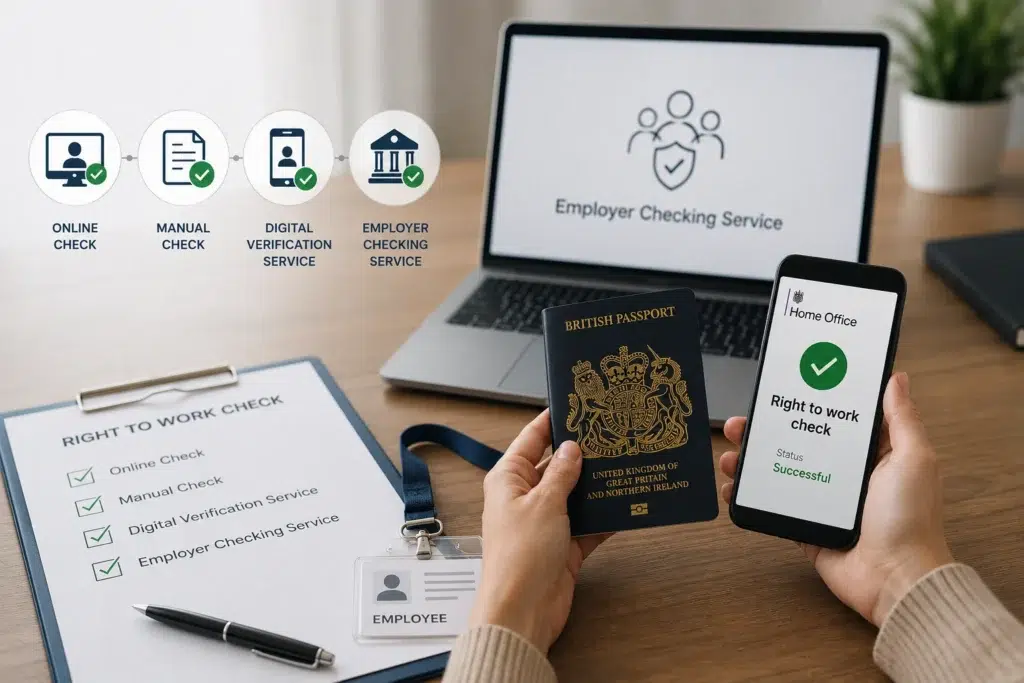
Completing a compliant Right to Work check is a legal requirement for every UK employer. In most cases, this is straightforward. Employers can verify an individual’s Right to Work by carrying out an online Right to Work check using a share code, a manual Right to Work check or, where appropriate, a Right to Work Digital Verification Service Provider (RtW DVSP) check.
However, there are situations where none of these prescribed methods can be used. This is where the Employer Checking Service (ECS) becomes relevant.
Understanding when to use the Employer Checking Service, and when not to, is essential. Using ECS appropriately can help employers establish a statutory excuse against a civil penalty, while relying on it unnecessarily may expose weaknesses in an organisation’s Right to Work procedures.
What is the Employer Checking Service?
The Employer Checking Service is a Home Office service that allows employers to verify an individual’s Right to Work directly with UK Visas and Immigration (UKVI) where the usual checking methods cannot be completed.
If UKVI confirms that the individual has permission to work in the UK, it will issue a Positive Verification Notice (PVN). This provides the employer with a statutory excuse against a civil penalty for six months from the date of the notice, provided all other Right to Work requirements have been met.
A PVN may also confirm any conditions attached to the individual’s permission, such as restrictions on working hours or the type of work they are permitted to undertake.
When should employers use the Employer Checking Service?
Before submitting an ECS request, employers should always establish whether a compliant online, manual or digital Right to Work check can be completed. ECS should only be used where one of the prescribed circumstances applies.
Common situations include the following.
- The individual has an outstanding immigration application
- The individual has a pending appeal or administrative review
- The individual holds documents that require Home Office verification
- Technical issues prevent an online Right to Work check
- Long-term UK residents with limited evidence
When should employers not use the Employer Checking Service?
The Employer Checking Service is not intended to replace the standard Right to Work checking methods.
Employers should not use ECS where an individual can:
- provide a valid share code for an online Right to Work check;
- produce acceptable original documents for a manual Right to Work check; or
- use a Right to Work Digital Verification Service Provider (RtW DVSP), where applicable.
Similarly, ECS should not be used simply because an individual has forgotten to bring their documents or is unable to provide the required evidence. Employment should not begin until a prescribed Right to Work check has been completed successfully.
What happens after an ECS request?
The Home Office aims to respond to valid Employer Checking Service requests within five working days.
If the individual has permission to work, UKVI will issue a Positive Verification Notice. Employers should retain the PVN with their Right to Work records and ensure a follow-up check is carried out before the six-month statutory excuse expires.
If UKVI cannot confirm that the individual has permission to work, it will usually issue a Negative Verification Notice or advise that it is unable to confirm the person’s Right to Work.
For prospective employees, work should not commence until a valid Right to Work check has been completed. Where the individual is an existing employee, employers should review the circumstances carefully, verify that the information submitted was accurate and seek appropriate legal or HR advice before making any employment decisions.
Why is it important to use the correct checking method?
The Home Office expects employers to use the prescribed Right to Work checking method that applies to each individual.
Using the Employer Checking Service where another prescribed method should have been used may indicate weaknesses in an employer’s compliance procedures. Likewise, failing to carry out a follow-up check after a Positive Verification Notice expires could result in the loss of the statutory excuse.
Employers should therefore ensure that HR teams understand when ECS is appropriate, retain clear records of every check completed and maintain systems for monitoring visa expiry dates and follow-up checks.
Conclusion
The Employer Checking Service is an important part of the UK’s Right to Work framework, but it is only intended for specific circumstances where the usual checking methods cannot be used.
Before submitting an ECS request, employers should first determine whether an online, manual or digital Right to Work check is available. Where ECS is the correct route, employers should keep accurate records, monitor Positive Verification Notice expiry dates and complete any required follow-up checks on time.
Understanding when to use the Employer Checking Service helps employers remain compliant with Home Office requirements, establish a statutory excuse where available and reduce the risk of costly immigration compliance issues.
Follow us to stay updated on changes to UK immigration law, policy developments and guidance affecting migrants, employers and families.
With over 20 years of experience and a commitment to excellence, Morgan Smith Immigration is your trusted partner for all your immigration needs. Contact us today to learn more about how we can assist you with UK visa applications. For enquiries or assistance, call us at 0203 959 3335 or email [email protected].