


Carrying out a Right to Work check is one of the most important legal responsibilities for UK employers. A correctly completed check helps establish a statutory excuse against a civil penalty if it later emerges that an individual did not have the right to work in the UK. Conversely, failing to carry out the prescribed check, or using the wrong checking method, may expose an employer to significant penalties and potential criminal liability where illegal working is knowingly facilitated.
The Home Office has also published updated draft guidance ahead of changes due to come into force on 1 October 2026. While the core principles remain the same, employers should ensure they understand when to use an Online Right to Work Check, a Manual Right to Work Check, or a Right to Work Digital Verification Service Provider (RtW DVSP).
This guide explains each method, when it can be used and the key differences employers should be aware of.
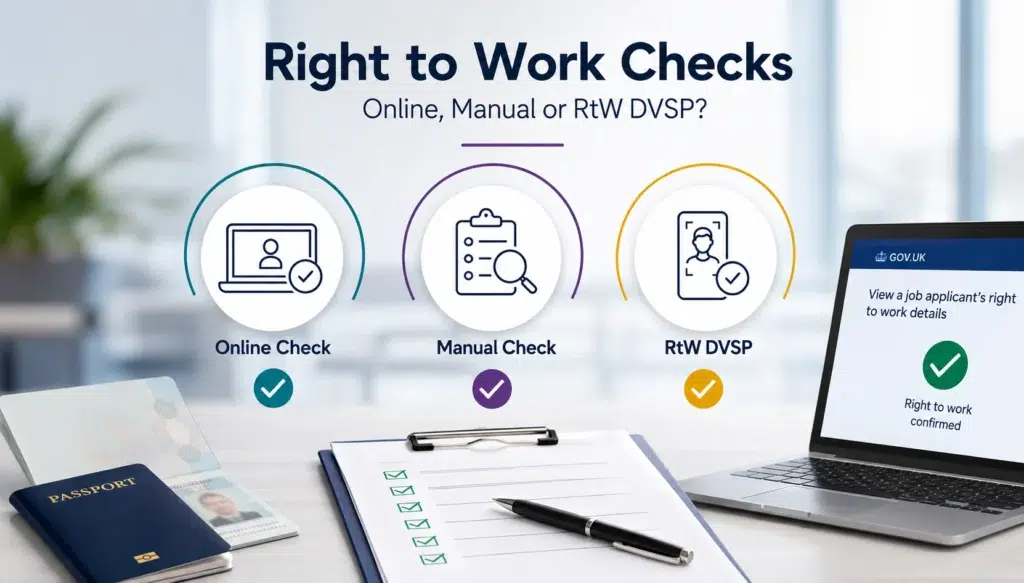
The three types of Right to Work checks
The Home Office recognises three prescribed methods of carrying out a Right to Work check:
- Online Right to Work Check using a share code
- Manual Right to Work Check
- Right to Work Digital Verification Service Provider (RtW DVSP)
1. Online Right to Work Check
An Online Right to Work Check is completed using the Home Office’s online checking service.
The prospective worker generates a share code through their UKVI account and provides it to the employer. The employer then enters the share code together with the individual’s date of birth on the Home Office website to access their Right to Work record.
The online result confirms:
- whether the individual has the right to work;
- any restrictions on the work they may undertake; and
- the period for which they have permission to work, where applicable.
The employer must ensure that:
- the photograph displayed matches the individual presenting for work;
- the details relate to the correct person; and
- any conditions attached to their permission are understood before employment begins.
Where an online check has been successfully completed, there is no requirement to carry out an additional manual document check. The employer should retain evidence of the online check in accordance with Home Office requirements.
2. Manual Right to Work Check
Although digital checks have become increasingly common, manual document checks continue to play an important role.
A manual check follows a four-stage process.
Step 1 – Obtain
The employer must obtain the original documents specified in List A or List B of the Home Office guidance. In certain cases, specified government-issued digital evidence of a person’s name and National Insurance number may also form part of an acceptable document combination.
Step 2 – Check
The employer must carefully examine each document.
This includes confirming that:
- the documents appear genuine;
- the photographs and dates of birth are consistent with the individual presenting them;
- the documents belong to that individual;
- permission to work has not expired; and
- any work restrictions are compatible with the role being offered.
Step 3 – Copy
A clear copy of each document must be taken in a format that cannot be altered. The employer must also record the date on which the Right to Work check was completed.
Step 4 – Store
Copies of the documents must be kept securely for the duration of employment and for two years after employment ends, after which they should be securely destroyed.
3. Right to Work Digital Verification Service Provider (RtW DVSP)
An RtW DVSP is a registered digital identity service that enables employers to complete prescribed digital Right to Work checks for certain individuals.
Under the updated Home Office guidance, employers may use a registered RtW DVSP to verify the identity of eligible British and Irish citizens who present a valid passport, Irish passport card or a passport that expired no more than six months previously. RtW DVSPs may also verify specified acceptable digital documents and use facial recognition technology as part of the verification process.
The process broadly involves four stages:
- selecting a registered RtW DVSP;
- completing the digital identity verification;
- retaining a copy of the verification output in a clear, unalterable format; and
- securely storing the record for the duration of employment and two years afterwards.
Importantly, using an RtW DVSP does not remove the employer’s responsibilities under the right to work scheme. The employer remains responsible for ensuring that the prescribed Right to Work check has been correctly completed and that the person presenting for work is the individual whose identity has been verified.
Final thoughts
Whether an employer conducts an Online Right to Work Check, a Manual Right to Work Check or uses a registered RtW DVSP, the objective remains the same: to confirm that an individual has permission to work in the UK and to establish a statutory excuse under the Right to Work Scheme.
With the updated Home Office guidance and the wider reforms due to take effect from 1 October 2026, employers should review their existing Right to Work procedures. They should also use the correct checking method for each worker and maintain accurate records throughout employment. As a result, they can reduce compliance risks and establish a statutory excuse in line with Home Office requirements.
Follow us to stay updated on changes to UK immigration law, policy developments and guidance affecting migrants, employers and families.
With over 20 years of experience and a commitment to excellence, Morgan Smith Immigration is your trusted partner for all your immigration needs. Contact us today to learn more about how we can assist you with UK visa applications. For enquiries or assistance, call us at 0203 959 3335 or email [email protected].