


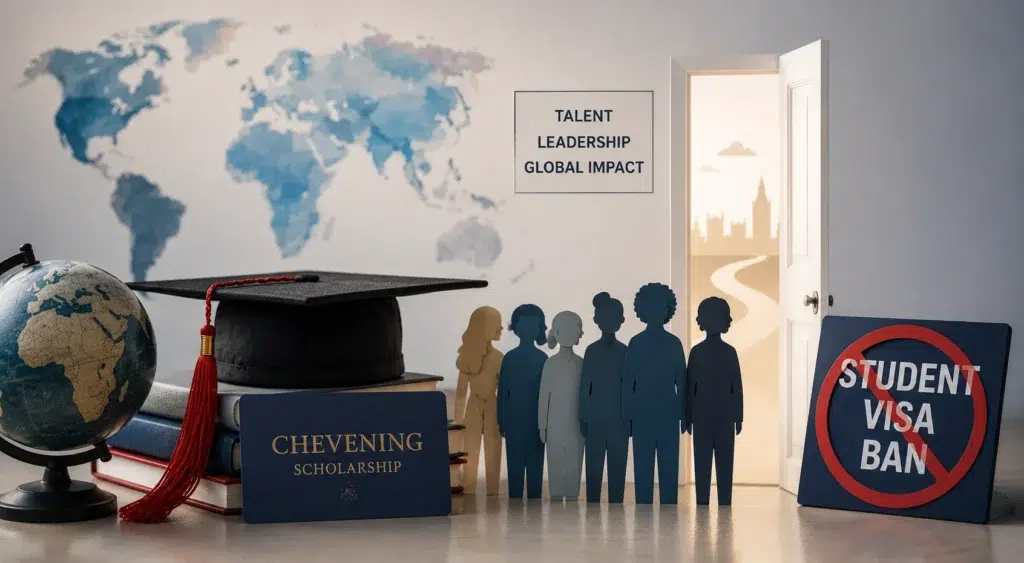
A coalition of leading UK universities has urged Home Secretary Shabana Mahmood to reconsider the government’s decision to prevent students from several conflict-affected countries from obtaining UK study visas.
The appeal focuses specifically on participants in the prestigious Chevening Scholarship programme, a UK government-funded initiative that enables exceptional individuals from around the world to undertake postgraduate study at British universities.
The universities argue that applying the restrictions to Chevening scholars is disproportionate and risks damaging the UK’s international reputation, academic standing, and diplomatic interests.
Background: Visa Restrictions Introduced in March
In March, the Home Office introduced restrictions preventing the issuance of study visas to applicants from Afghanistan, Cameroon, Myanmar and Sudan. The government introduced the measure to address concerns that some individuals were using student visas as a route to seek asylum in the UK.
As a result of these changes, successful Chevening Scholarship recipients from the affected countries are currently unable to travel to the UK to commence their studies.
Universities Seek an Exception for Chevening Scholars
Thirty-four universities, represented by the Russell Group and ResearchPlus, have written jointly to the Home Secretary requesting an exemption for Chevening scholars.
The signatories include some of the UK’s most respected institutions, such as the Universities of Cambridge, Oxford, Manchester, Durham and Imperial College London.
In their letter, the universities emphasised that the government already conducts rigorous assessments of Chevening candidates before awarding scholarships. They argued that treating these scholars in the same way as other applicants affected by the restrictions is neither fair nor proportionate.
The universities also stressed that they fully support measures designed to protect the integrity of the immigration system but warned against policies that could unintentionally penalise genuine students.
Why Chevening Scholars Are Different
Established by the UK government, the Chevening Scholarship programme is one of the world’s most competitive international scholarship schemes.
Each year, more than 1,000 individuals are selected based on:
- Academic achievement
- Leadership potential
- Professional accomplishments
- Commitment to contributing to their home countries after graduation
According to the universities letter, the programme has produced a significant number of global leaders. More than 20 former scholars have become heads of state. In addition, many have progressed into senior government and public sector roles.
University leaders argue that these individuals represent exactly the type of international talent the UK should be seeking to attract.
Concerns Over the Impact on International Relations
University representatives have warned that excluding Chevening scholars could undermine the UK’s long-standing efforts to strengthen international partnerships through education.
Professor Sasha Roseneil, Vice-Chancellor of the University of Sussex and Co-Chair of ResearchPlus, warned that the restrictions could deny opportunities to future leaders. These scholars have already met the government’s own rigorous selection criteria.
The concerns extend beyond higher education. Reports suggest that Foreign Secretary Yvette Cooper also sought an exemption for Chevening scholars. She reportedly raised concerns about the impact of the restrictions on applicants from Afghanistan and Sudan. This included women whose educational opportunities may be severely limited in their home countries.
However, the Home Secretary is understood to have declined the request.
Government Maintains Tough Stance
The Home Office has defended the policy, arguing that some individuals have used study routes as a means of remaining in the UK through the asylum system.
Recent Home Office figures show that 10,835 individuals who entered the UK on student visas went on to claim asylum during the year ending March 2026.
Although this figure represents only a small proportion of overall student visa holders, ministers have maintained that stronger controls are necessary to prevent abuse of the immigration system.
Government representatives have stated that while the UK remains open to talented international students, exceptions to the current policy could create vulnerabilities within the immigration framework.
Student Visa Trends
The latest data also indicates that the number of international students subsequently claiming asylum has begun to decline.
This reduction follows broader changes to the student visa system, including restrictions on dependants accompanying international students.
Despite these trends, international students continue to make a substantial contribution to the UK’s higher education sector, economy and research environment.
What Happens Next?
The universities intervention highlights growing concern within the higher education sector about the broader implications of the government’s approach to international student recruitment.
For now, students from Afghanistan, Cameroon, Myanmar and Sudan who have secured Chevening Scholarships remain unable to obtain study visas under the current rules.
Whether the government will reconsider its position remains uncertain. However, universities continue to argue that exceptional scholars who have already passed rigorous government scrutiny should not be prevented from accessing educational opportunities in the UK.
Conclusion
The dispute over Chevening scholars reflects the wider challenge facing policymakers: balancing immigration control with the UK’s ambition to remain a leading destination for global talent.
While the government maintains that firm action is necessary to prevent misuse of visa routes, universities contend that highly vetted scholarship recipients should be treated differently from the broader applicant pool. As pressure mounts from both academic institutions and diplomatic circles, the debate is likely to continue in the months ahead.
Follow us to stay updated on changes to UK immigration law, policy developments and guidance affecting migrants, employers and families.
With over 20 years of experience and a commitment to excellence, Morgan Smith Immigration is your trusted partner for all your immigration needs. Contact us today to learn more about how we can assist you with UK visa applications. For enquiries or assistance, call us at 0203 959 3335 or email [email protected].