

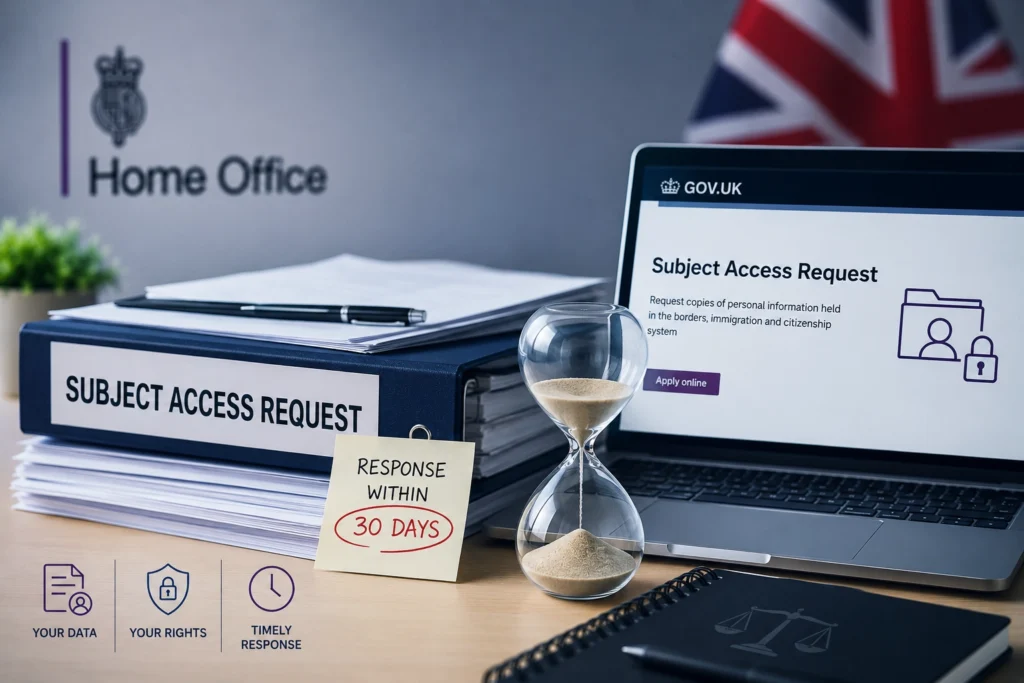
A Subject Access Request (SAR) allows individuals to obtain copies of personal information held by the Home Office under the Data Protection Act 2018. These requests are often essential in immigration matters, particularly where applicants or legal representatives require access to immigration history, application records, decision letters, interview notes, or previous correspondence.
The Home Office states that Subject Access Requests are generally processed within one calendar month once all supporting documents have been received. However, despite these published service standards, many applicants continue to experience significant delays, often waiting several months without receiving the requested information.
What Is a Subject Access Request?
The Subject Access Request Unit (SARU) manages requests relating to information held by:
- UK Visas and Immigration (UKVI)
- Border Force
- Citizenship and Immigration Services
Individuals may request access to records including:
- Immigration history
- Previous visa applications
- Decision letters
- Appeal outcomes
- Interview records
- Landing cards
- Detention records
The Home Office offers three types of requests:
1. Basic Request
This provides digital immigration information recorded since the year 2000, including application history and decisions.
2. Specific Request
Applicants can request up to five specific documents, such as:
- Particular application forms
- Decision letters
- Appeal determinations
- Interview records
3. Detailed Request
This option includes electronic records and may also involve paper files where further information is required.
The Expected Processing Time
According to Home Office guidance, applicants should receive a response within one month once all supporting evidence has been submitted. The guidance specifically states:
“You will receive a response within 1 month once we have all the supporting documents to process your request.”
The Home Office further explains that if additional documents are requested, the one-month timeframe begins only after the outstanding evidence has been received.
While the guidance acknowledges that complex cases may require additional time, applicants are expected to be informed if an extension applies.
Ongoing Delays Affecting Applicants
Despite the official timeframe, many individuals continue to experience substantial delays in receiving Subject Access Request responses.
According to the Home Office guidance, applicants should normally receive a response within one month once all supporting documents have been provided. The guidance also states that, in exceptional circumstances, requests considered complex may take longer to process.
However, applicants continue to report waiting several months for responses, even where the required documentation has already been submitted.
Subject Access Requests are commonly used to obtain information held by the Home Office, including:
- immigration history,
- visa applications submitted from outside the UK,
- copies of application forms,
- decision letters,
- appeal determinations,
- detention progress reports,
- and interview records.
As a result, delays in receiving this information can create uncertainty for individuals seeking access to their personal immigration records.
Lack of Communication and Transparency
One of the major concerns raised by applicants and representatives is the lack of meaningful communication during the waiting period.
Although the Home Office advises applicants not to contact SARU if their request remains within the standard processing period, many individuals report receiving limited updates once delays extend beyond the expected timeframe.
In some situations, applicants are left waiting without:
- estimated completion dates,
- explanations for delays,
- or confirmation regarding the status of their request.
This lack of transparency can add further stress for individuals already dealing with complex immigration matters.
Supporting Documents and Compliance Requirements
The Home Office requires applicants to provide supporting evidence before processing can begin. This typically includes:
- Photo identification
- Letter of authority
- Proof of relationship (where applicable)
The guidance also states that applications may be automatically rejected if supporting documents are not received within seven days.
While these safeguards are intended to protect personal data, applicants who fully comply with these requirements reasonably expect timely responses in return.
What Can Applicants Do?
Where delays become excessive, applicants may consider escalating concerns through formal complaint procedures.
The Home Office guidance confirms that complaints may be raised with:
- the Subject Access Request Unit (SARU),
- the Office of the Data Protection Officer (ODPO),
- or the Information Commissioner’s Office (ICO).
The ICO has authority under the Data Protection Act 2018 to investigate complaints concerning failures to comply with subject access rights.
Conclusion
Subject Access Requests remain an important legal mechanism allowing individuals to access personal information held by the Home Office. However, increasing delays in processing requests are creating serious difficulties for applicants and legal representatives alike.
Whilst the Home Office maintains that responses should generally be issued within one month, the growing number of prolonged waiting periods highlights the need for improved efficiency, clearer communication, and greater transparency within the Subject Access Request process.
For many individuals, these records are not simply administrative documents; they are essential to protecting legal rights and progressing immigration matters fairly and effectively.
Follow us to stay updated on changes to UK immigration law, policy developments and guidance affecting migrants, employers and families.
With over 20 years of experience and a commitment to excellence, Morgan Smith Immigration is your trusted partner for all your immigration needs. Contact us today to learn more about how we can assist you with UK visa applications. For enquiries or assistance, call us at 0203 959 3335 or email [email protected].