

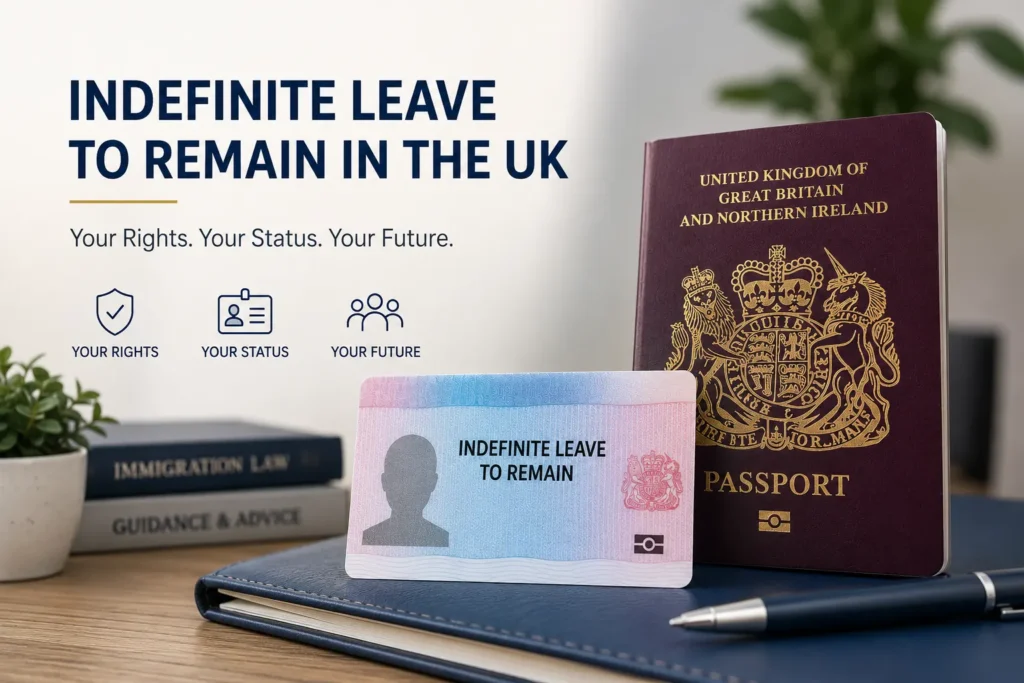
Indefinite Leave to Remain (ILR), often referred to as UK settlement, is one of the most significant milestones in the UK immigration system. It allows individuals to live in the United Kingdom without any immigration time restrictions and provides a pathway towards British citizenship.
Holding ILR means that you have secured permanent residence in the UK and are no longer subject to the conditions attached to temporary visas. However, understanding your rights, responsibilities and the circumstances in which your status may be affected is essential.
This guide explains what Indefinite Leave to Remain means, the rights it provides, how to prove your status, and what you should know about travelling, working and applying for British citizenship.
What Is Indefinite Leave to Remain?
Indefinite Leave to Remain (ILR) and Indefinite Leave to Enter (ILE) are forms of settled status that allow a person to remain in the UK without any time limit on their stay.
If you hold ILR or ILE and the UK is your permanent home, you are regarded as settled in the United Kingdom. This status provides many of the same rights enjoyed by British citizens, although there are still some important differences.
How Can You Prove Your ILR Status?
Many individuals were previously issued physical immigration documents, such as Biometric Residence Permits (BRPs), passport endorsements or vignette stickers.
The Home Office is now replacing physical immigration documents with digital immigration records known as eVisas.
Applying for a No Time Limit (NTL) Confirmation
If you believe you hold ILR or ILE but do not have evidence of your status, you may be eligible to submit a No Time Limit (NTL) application.
An NTL application can be used where:
- Your passport containing evidence of your immigration status has been lost, stolen or has expired.
- You have ILR or ILE but no documentary evidence confirming it.
- You have legally changed your identity and wish your settled status to reflect your new details.
Successful applicants receive confirmation of their immigration status through an eVisa.
The Windrush Scheme and Settlement Status
Individuals who, or whose parents, were settled in the UK on 1 January 1973, or who arrived in the UK before 1988, may be eligible to obtain evidence of their immigration status under the Windrush Scheme.
Settled Status Under the EU Settlement Scheme
If you have been granted settled status under the EU Settlement Scheme (EUSS), you do not need to apply separately for confirmation of your immigration status.
Your status is held digitally and can be viewed and shared through the Home Office online service. This enables you to demonstrate your right to live, work and access services in the UK.
eVisas and Expired Biometric Residence Permits
Individuals with settled status may previously have held a BRP stating:
- “Indefinite Leave to Enter”; or
- “No Time Limit”.
All BRPs have now expired as physical immigration documents. However, certain expired BRPs may continue to be accepted for limited purposes until the applicable Home Office deadline.
If your permission to remain in the UK extends beyond the expiry date shown on your BRP, you should create a UK Visas and Immigration (UKVI) account and access your eVisa.
Important Steps to Take
You should:
- Create a UKVI account if you have not already done so.
- Ensure your current passport or travel document is linked to your eVisa.
- Update your UKVI account whenever your personal details change.
- Keep your expired BRP as it may be useful for future immigration applications.
If your BRP is lost or stolen, it should be reported to the Home Office immediately.
Your Right to Work in the UK
One of the principal benefits of ILR is unrestricted access to the UK labour market.
Individuals with ILR can:
- Work for any employer.
- Change jobs without requiring immigration permission.
- Establish and operate a business.
- Become self-employed.
- Pursue professional careers without sponsorship requirements.
You must continue to comply with all applicable employment laws and professional regulations.
Studying in the UK
Settled persons are free to undertake education and training courses in the UK without immigration restrictions.
Voting Rights in the UK
The right to vote depends on your nationality rather than your immigration status alone.
Eligibility varies depending on the type of election and whether you are a British, Irish, Commonwealth or qualifying foreign national.
Individuals with ILR should check the current electoral registration requirements before voting.
Access to Healthcare
People who are settled in the UK are generally entitled to access National Health Service (NHS) healthcare without paying immigration-related charges.
Access to Benefits and Public Services
Holding ILR often provides access to public funds and welfare benefits, subject to meeting the relevant eligibility criteria.
Depending on your circumstances, you may be eligible for:
- Universal Credit.
- Child Benefit.
- Housing support.
- State Pension.
- Other government assistance programmes.
Eligibility is assessed individually and may depend on factors such as residence, income and National Insurance contributions.
Children Born in the UK to Parents with ILR
If you have a child born in the UK while you are settled here, the child will usually acquire British citizenship automatically at birth.
In some situations, children born in the UK after 1 January 1983 who did not automatically become British citizens may later become eligible for registration as British citizens once a parent obtains settled status.
Bringing Family Members to the UK
Having ILR does not automatically grant immigration status to overseas family members.
However, certain family members may be able to apply to join you in the UK, including:
- Spouses and civil partners.
- Unmarried partners.
- Dependent children.
- Other qualifying relatives in specific circumstances.
The immigration rules governing family migration can be complex, and professional advice may be beneficial before an application is submitted.
Travelling Outside the UK with ILR
Although ILR is permanent immigration status, it can be lost if you spend extended periods outside the UK.
When Does ILR Lapse?
For most individuals, ILR or ILE will automatically lapse if they remain outside:
- The UK;
- Ireland; or
- The Crown Dependencies (Isle of Man, Jersey and Guernsey)
for two continuous years or more.
EU Settlement Scheme Holders
Individuals with settled status under the EU Settlement Scheme generally lose their status after five continuous years outside the UK, Ireland and the Crown Dependencies.
Swiss citizens and their qualifying family members may be permitted longer absences under specific rules.
Before Travelling
Before international travel, you should:
- Check that your eVisa is linked to your current passport.
- Ensure your UKVI account details are accurate.
- Obtain a share code if required to prove your immigration status.
Failure to maintain your status records may result in delays when travelling.
Can Indefinite Leave to Remain Be Revoked?
Although ILR provides permanent settlement rights, it is not completely immune from cancellation.
The Home Office may revoke ILR where:
- The individual is subject to deportation proceedings.
- Immigration status was obtained through deception or fraud.
- Refugee status has ceased and revocation is permitted under immigration law.
- Other legal grounds justify the withdrawal of settlement status.
ILR may also lapse automatically following prolonged absences from the UK.
Applying for British Citizenship After ILR
For many individuals, ILR represents the final step before becoming a British citizen.
In most cases, applicants must hold ILR for at least 12 months before applying for naturalisation.
However, spouses and civil partners of British citizens may be eligible to apply sooner if they meet the relevant requirements.
Applicants must also satisfy additional criteria relating to:
- Residence.
- Absences from the UK.
- English language ability.
- Knowledge of Life in the UK.
- Good character requirements.
Obtaining British citizenship provides full political rights and removes the risk of losing immigration status through lengthy absences abroad.
Conclusion
Indefinite Leave to Remain is a valuable immigration status that provides long-term security and freedom to live, work and build a future in the United Kingdom. It offers extensive rights, including unrestricted employment, access to healthcare, education and a route to British citizenship.
However, maintaining evidence of your status, understanding travel restrictions and ensuring your eVisa records remain up to date are essential to protecting your settlement rights.
If you are uncertain about your immigration status, need assistance obtaining proof of ILR, or wish to explore British citizenship options, seeking professional immigration advice can help ensure your position remains secure.
Follow us to stay updated on changes to UK immigration law, policy developments and guidance affecting migrants, employers and families.
With over 20 years of experience and a commitment to excellence, Morgan Smith Immigration is your trusted partner for all your immigration needs. Contact us today to learn more about how we can assist you with UK visa applications. For enquiries or assistance, call us at 0203 959 3335 or email [email protected].