


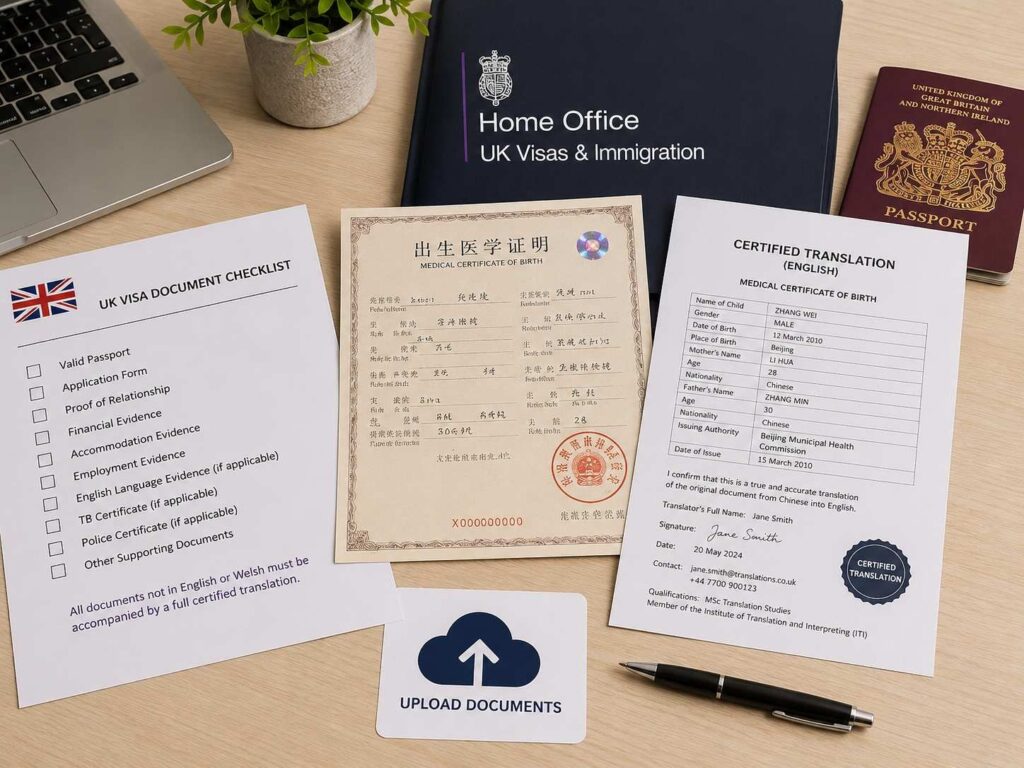
If your UK visa evidence is not in English or Welsh, UKVI will not simply work around it. You should usually provide the original document and a complete certified translation for UK visa applications. If a caseworker cannot read, verify and rely on the document, the evidence may carry little or no weight.
We recommend treating the translation as essential evidence, not admin. In our view, UKVI’s approach is sensible, but badly explained. Too many applicants pay for notarised or apostilled translations when UKVI usually wants something simpler: a complete, independent and verifiable certified translation.
Do UKVI documents need to be translated?
Yes. If a supporting document is not in English or Welsh, we advise submitting the original-language document with a full certified translation for UK visa purposes.
This applies across most UK immigration routes, including spouse and family visas, Skilled Worker visas, student visas, visitor visas, ILR and British citizenship. Our clients often see translation as a small detail. We disagree. If the document proves a core requirement, a poor translation can put the application at risk.
This is the current rule, not a new change
As of 13 May 2026, this is a current Home Office requirement. We have not seen any proposal changing the core UKVI certified translation requirements.
The key rule is Immigration Rules paragraph 39B. It says specified documents not in English or Welsh must be provided in the original language with a full translation that UKVI can independently verify.
What counts as a certified translation for UK visa applications?
A certified translation is a full translation with a statement confirming that it is true and accurate. It must identify the translator and give UKVI enough information to check who prepared it.
For leave to remain and ILR applications, paragraph 39B makes translator credentials especially important. We advise ILR applicants not to take shortcuts. A court document translated by a friend, however fluent, is not the same as a qualified independent translator providing credentials.
In plain English, “certified” does not usually mean notarised, sworn or legalised for UKVI purposes. The Home Office translation requirements focus on accuracy, independence and verifiability.
What must a UKVI certified translation include?
We recommend checking every translation against this list before upload:
- a statement confirming the translation is true and accurate;
- the translator’s full name;
- the translator’s signature, including an electronic signature where accepted in digital submissions;
- the date of translation;
- the translator’s or translation company’s contact details;
- credentials or qualifications, especially for in-country FLR and ILR applications.
A simple certification statement can say: “I confirm that this is a true and accurate translation of the original document from [language] into English.” We also recommend using a professional translator or translation company that regularly prepares UK visa document translation.
Does the whole document need translating?
Yes. The translation should be complete, not a summary. We regularly see avoidable problems where only the “main” text has been translated.
All stamps, seals, handwritten notes, annotations, side remarks, marginal text and endorsements should be translated. For example, a Skilled Worker applicant may upload a criminal record certificate where the typed text is translated, but the official stamp and handwritten note are not. In our view, that is incomplete.
The same applies to mixed-language evidence. If a visitor visa applicant provides bank statements partly in English and partly in another language, we advise translating the non-English parts. Do not assume UKVI will infer the meaning.
Can I translate my own documents for a UK visa?
No. We advise applicants not to translate their own documents, even if they are fluent in both languages.
Family members, sponsors and other interested parties should also avoid translating documents. UKVI expects an independent professional translator or translation company. The practical test is simple: can a caseworker verify the translation and trust that it was prepared without personal interest?
Do I need a notarised translation for a UK visa?
Usually, no. A certified translation is normally enough where UKVI asks for a translation. A notarised translation for UK visa purposes is not a standard requirement.
Certification, notarisation and apostille are different things. Certification confirms the translation’s accuracy. Notarisation verifies a signature or process. Apostille or legalisation is usually for documents needed by officials in another country.
Only consider notarisation if a specific checklist, foreign authority, court process or separate legal requirement asks for it. In our view, paying more does not automatically make evidence stronger for UKVI.
Which UK visa routes most often need translations?
Route matters because different applications rely on different evidence. For spouse and family visas, we often check marriage certificates, divorce certificates, birth certificates and financial evidence.
For Skilled Worker and Health and Care Worker visas, common documents include criminal record certificates, overseas qualifications, bank evidence and family documents. Translation can also matter where a sponsor licence file contains overseas supporting documents.
For Student and Child Student visas, transcripts, qualifications, parental consent and financial evidence may need translation. We also warn students that translation and UK qualification equivalence are separate issues. A translated transcript does not automatically prove equivalence.
For ILR, historic civil status documents, court documents, old passports and overseas records often need careful review. For citizenship applications, foreign birth, marriage, adoption, name-change and nationality documents commonly need official translation if not in English. Visitor visa applicants should check bank statements, employment letters, invitation letters, property documents and medical evidence.
Should I upload the original document and the translation?
Yes. We recommend uploading both the original-language document and the certified translation. Uploading only the English translation can cause delay or refusal because UKVI cannot compare it with the original.
PDF uploads are standard for online UKVI applications. Electronic signatures are generally accepted in digital UKVI submissions, but we still advise making the signature, date and translator details clear.
Use clear file names. Where possible, place the original and translation together in one PDF or next to each other in the upload portal. Scans should be legible, complete, upright and show all pages, seals and stamps.
What happens if UKVI cannot verify the translation?
UKVI may disregard the document if it cannot verify the translation. It may also delay the application by asking for further evidence. However, we would not rely on UKVI giving you a chance to fix the problem.
If the non-translated or poorly translated document is essential, the application may be refused. For example, a spouse visa applicant who uploads an English translation of a foreign marriage certificate but forgets the original certificate creates an obvious verification problem.
Advice depends on the route, document type and facts of the case. That said, our view is firm: translation mistakes are among the easiest UK immigration problems to avoid.
How we recommend preparing translated documents before submission
Before you submit, we recommend taking these steps:
- check every non-English or non-Welsh document;
- use an independent professional translator or translation company;
- ask for the certification statement, signature, date, contact details and credentials;
- translate all stamps, seals, notes and annotations;
- upload the original-language document with the translation.
If you are preparing a certified translation for UK visa evidence for a spouse visa, Skilled Worker visa, ILR, citizenship, visitor visa or student visa, we recommend checking the documents before submission. At Morgan Smith Immigration, we can review whether your translated evidence is likely to meet UKVI and Home Office translation requirements for your specific route.