


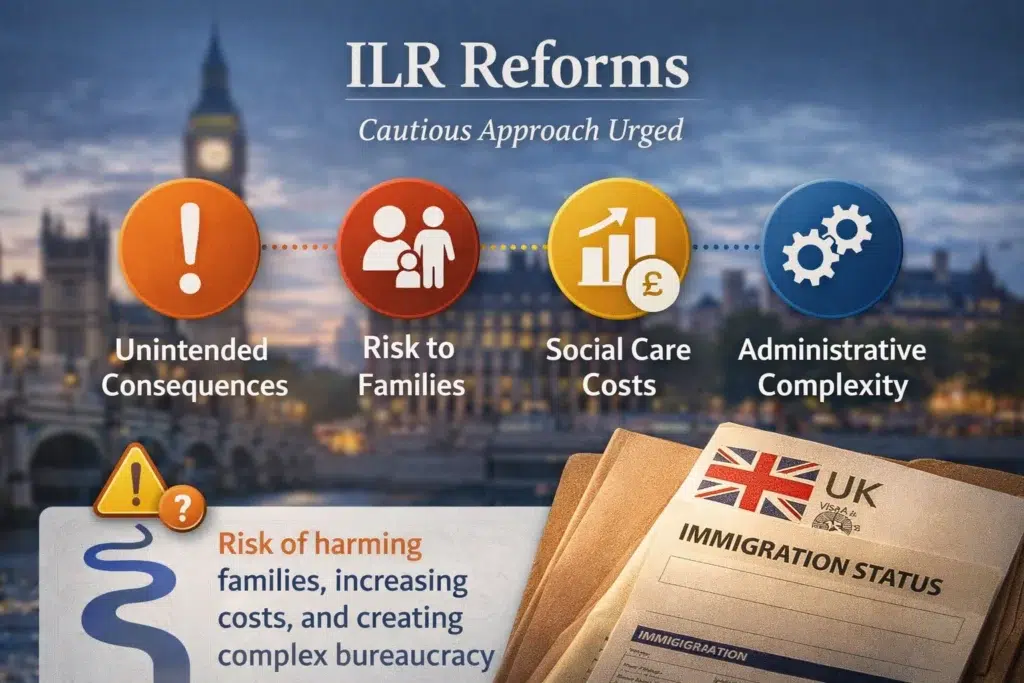
UK Government’s proposed “earned settlement” reforms set to reshape the pathway to Indefinite Leave to Remain (ILR) are facing growing scrutiny. A new report from the Home Affairs Committee raises serious concerns about the timing, design and potential consequences of these changes.
At the centre of the reforms is a significant shift: extending the standard qualifying period for settlement from five years to ten, alongside introducing stricter eligibility criteria linked to income and contribution.
While the Government aims to manage high migration levels and ensure migrants contribute economically, MPs have warned that the proposals, in their current form, risk creating uncertainty, unfairness and unintended harm.
Unclear Timeline Creating Anxiety
One of the Committee’s strongest criticisms relates to the lack of clarity around implementation.
Although the Home Office has indicated that changes will begin from April 2026, it has failed to provide a detailed or realistic timeline. MPs concluded that the department is not yet equipped to implement reforms of this scale and warned that signalling an early start date has already caused unnecessary distress for migrants approaching settlement.
The Committee stressed that getting policy right must take precedence over speed.
Economic Contribution: Fair in Principle, Problematic in Practice
A key pillar of the reforms is the requirement for migrants to meet a minimum income threshold (proposed at £12,570) to qualify for settlement.
While MPs agreed it is reasonable to expect economic contribution, they emphasised that a one-size-fits-all approach would be unjust. Many individuals such as disabled people, carers, students, or those of pension age may be unable to meet these thresholds for legitimate reasons.
The Committee also criticised the Government’s proposal to shorten settlement routes for higher earners based on income tax bands. MPs noted that these thresholds appear to be “convenient” rather than evidence-based, raising concerns about fairness and administrative complexity.
Risk of Arbitrary Outcomes for Workers
The report strongly challenges the proposal to place certain workers particularly those classified as “medium-skilled” on extended routes of up to 15 years.
MPs described the use of occupational skill levels (RQF classifications) as a proxy for income as “odd and unnecessary”. This could lead to inconsistent outcomes, where higher earners in some roles face longer settlement routes than lower earners in others.
Additionally, prolonged reliance on employer-sponsored visas could increase the risk of worker exploitation, as migrants remain tied to a single employer for extended periods.
Social Care Sector: A Policy Dilemma
The reforms pose a particularly complex challenge for the adult social care sector.
Following the rapid expansion of the care worker visa route in 2022, large numbers of care workers are expected to become eligible for settlement soon. The Government now faces a difficult choice:
- Allow settlement under current rules, increasing access to public funds, or
- Extend settlement routes, potentially exposing workers to prolonged poverty and exploitation
The Committee found no evidence that the Home Office has aligned these reforms with broader social care strategy, warning of potential knock-on effects for both the care sector and the NHS.
Impact on Children and Young People
The report highlights significant risks for children growing up in the UK under these proposals.
Longer settlement routes could mean that many children spend most or all of their childhood on temporary status. Some may even reach adulthood before their parents are eligible for settlement.
MPs were clear: children who grow up in the UK should not be required to “earn” their right to remain. Without proper safeguards, the system risks producing deeply unfair outcomes beyond the control of those affected.
There are also concerns about reduced access to higher education, as more young people may be ineligible for home fee status.
Increased Risk of Child Poverty
Extending settlement routes for lower-income families is likely to increase child poverty, particularly among groups such as care workers.
The Committee warned that this could place additional pressure on local authorities and lead to higher long-term social costs. Restrictions linked to “No Recourse to Public Funds” (NRPF) may further exacerbate hardship.
Concerns Over Retrospective Application
Another major issue is whether the reforms will apply to migrants already in the UK.
MPs questioned the fairness of retrospective changes, particularly for those who arrived before 2021 and are already progressing under existing rules. The Committee urged the Government to introduce clear transitional protections and avoid disrupting established settlement pathways.
A System at Risk of Becoming Overly Complex
Across all areas, a consistent theme emerges: the proposed system risks becoming overly complex, difficult to administer and prone to unintended consequences.
From income thresholds to visa classifications and family routes, the reforms introduce multiple layers of rules that could increase administrative burden and reduce transparency.
Key Recommendations from the Home Affairs Committee
The Committee sets out a comprehensive set of recommendations to improve the proposed reforms:
Implementation and Planning
- Provide a clear and realistic implementation timeline
- Avoid rushing reforms; prioritise thorough impact assessment before rollout
- Ensure the Home Office has the capacity and systems to deliver changes effectively
Economic Requirements
- Introduce clear and reasonable exemptions to income thresholds (e.g. for disabled people, carers, students)
- Establish evidence-based criteria for income-related reductions
- Seek advice from the Migration Advisory Committee on appropriate thresholds
Assessing Contribution
- Apply income-based assessments at a household level, not just individual level
Workers and Exploitation
- Base settlement routes on income rather than job classification (RQF level)
- Introduce more flexible visa arrangements to reduce reliance on single employers
- Strengthen protections against worker exploitation, including a role for the Fair Work Agency
Social Care Sector
- Conduct a full impact assessment on social care workforce implications
- Ensure parity between NHS and social care workers in settlement policies
- Take action to improve pay and conditions in the care sector
Children and Young People
- Grant settled status by age 18 to children who grow up in the UK
- Ensure young people are not subject to adult economic requirements
- Allow children to settle with the first parent who qualifies
Education Access
- Review home fee status rules to prevent barriers to university
- Consider eligibility based on years of UK residence (e.g. five years)
Child Poverty and Welfare
- Publish a full assessment of child poverty impacts
- Ease access to support for families under NRPF conditions
- Ensure local authorities are adequately funded
Family and Private Life Routes
- Avoid creating excessively long routes (e.g. 30-year pathways)
- Extend visa duration to 5 years instead of 2.5 years
- Reduce fees to administrative cost levels
Public Funds
- Do not penalise migrants retrospectively for accessing public funds
- Allow reasonable exemptions in cases of hardship
Transitional Protections
- Introduce clear transitional arrangements
- Exempt migrants who arrived before 2021 and are already on a 10-year route
Citizenship
- Remove barriers to child citizenship registration
- Reduce fees and improve awareness of rights
Final Thoughts
The Home Affairs Committee does not reject the principle of earned settlement but it makes clear that the current proposals are not yet fit for implementation.
Without careful design, the reforms risk increasing inequality, undermining integration, and placing unnecessary strain on migrants, families, and key sectors such as social care.
The message from MPs is clear: reform must be fair, evidence-based and properly implemented or it risks doing more harm than good.
Follow us to stay updated on changes to UK immigration law, policy developments and guidance affecting migrants, employers and families.
With over 20 years of experience and a commitment to excellence, Morgan Smith Immigration is your trusted partner for all your immigration needs. Contact us today to learn more about how we can assist you with UK visa applications. For enquiries or assistance, call us at 0203 959 3335 or email [email protected].