

UK Immigration Rules establish a structured framework under the suitability requirements, which must be satisfied in all applications for entry clearance, permission to enter, or permission to stay.
The Home Office guidance “Suitability: grounds for refusal / cancellation – criminality” sets out how criminality is assessed and when an application must or may be refused.
This article outlines the general grounds for refusal, including mandatory and discretionary refusal and the specific provisions applicable to visitors and short-term entrants.
Suitability Requirements: Overview
All applicants must meet the suitability requirements in addition to the relevant eligibility criteria. These requirements relate to an individual’s conduct, character and criminality.
The guidance distinguishes between:
- Mandatory refusal, where refusal is required under the Immigration Rules; and
- Discretionary refusal, where refusal may be appropriate depending on the circumstances.
Where a mandatory ground applies, decision-makers must refuse the application. Where a discretionary ground applies, decision-makers must consider the individual facts of the case before reaching a decision.
General Grounds for Refusal – Criminality
Criminality is a key component of the general grounds for refusal. The Rules require caseworkers to assess whether an applicant’s presence in the UK would be undesirable in light of their conduct or offending history.
Relevant considerations include:
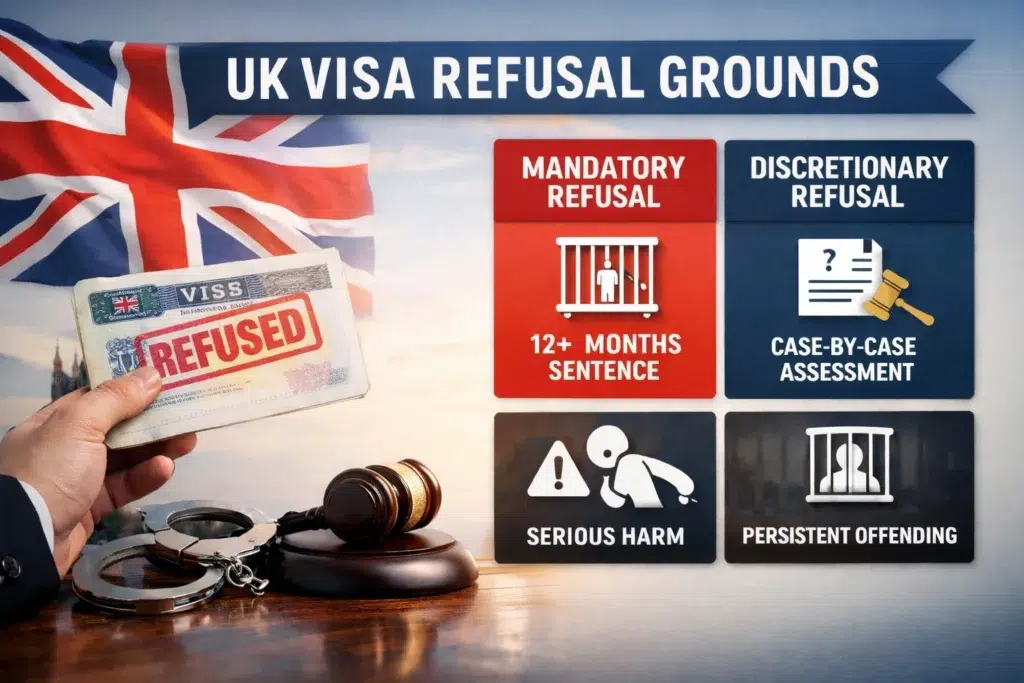
- The seriousness of the offence;
- Whether the person is a persistent offender;
- Whether the offence has caused serious harm;
- The type and length of sentence imposed.
These factors determine whether refusal falls within mandatory or discretionary provisions.
Mandatory Refusal of Entry Clearance or Permission
An application must be refused where the applicant meets specified criminality thresholds.
Mandatory refusal applies where:
- The applicant has been sentenced to a period of imprisonment of 12 months or more;
- The applicant is a persistent offender who shows a particular disregard for the law;
- The applicant has committed an offence which has caused serious harm.
Discretionary Refusal of Entry Clearance or Permission
Discretionary refusal applies where the criminality threshold for mandatory refusal is not met, but concerns remain.
An application may be refused where:
- The applicant has received a custodial sentence of less than 12 months;
- The applicant has received a non-custodial sentence;
- The applicant has received an out-of-court disposal which forms part of their criminal record.
In discretionary cases, decision-makers must consider the individual circumstances of the application, including the applicant’s conduct, character, and criminality and assess whether refusal is appropriate.
Visitors and Those Seeking Entry for Less Than 6 Months
Specific provisions apply to individuals seeking entry as visitors or for a period of less than six months.
Entry clearance or permission to enter must be refused where:
- The applicant has received a custodial sentence of less than 12 months, and
- Less than 12 months have passed since the end of that sentence;
Additionally, refusal must apply where:
- The applicant has received a non-custodial sentence or out-of-court disposal, and
- Less than 12 months have passed since the date of conviction or disposal.
Where more than 12 months have elapsed, refusal may still be considered under discretionary grounds, depending on the circumstances.
Mandatory and Discretionary Grounds: Key Distinction
The Immigration Rules draw a clear distinction between:
Mandatory Grounds
- Refusal is required;
- No discretion is available;
- Typically applies to serious criminality or repeated offending.
Discretionary Grounds
- Refusal is not automatic;
- Decision-makers must assess individual facts and proportionality;
- Applies to less serious offences or historic conduct.
This distinction ensures that the Rules operate both as a protective mechanism for the public interest and as a framework allowing individual assessment where appropriate.
Conclusion
The suitability framework under the UK Immigration Rules provides a structured and stringent approach to criminality-based refusals.
The March 2026 update reinforces this approach, particularly by confirming that suspended sentences of 12 months or more fall within mandatory refusal provisions.
Applicants must therefore ensure that their immigration applications fully address any criminal history, as failure to meet the suitability requirements can result in refusal or cancellation of permission, regardless of whether other eligibility criteria are satisfied.
UK visa refusals on suitability and criminality grounds are often complex and highly fact-specific. Even where a refusal is not mandatory, the outcome of an application can depend on how an individual’s circumstances are presented and assessed under the Immigration Rules.
A failure to properly address issues such as criminal history or previous conduct can result in refusal, cancellation of permission and potential long-term immigration consequences.
Follow us to stay updated on changes to UK immigration law, policy developments and guidance affecting migrants, employers and families.
With over 20 years of experience and a commitment to excellence, Morgan Smith Immigration is your trusted partner for all your immigration needs. Contact us today to learn more about how we can assist you with UK visa applications. For enquiries or assistance, call us at 0203 959 3335 or email [email protected].