


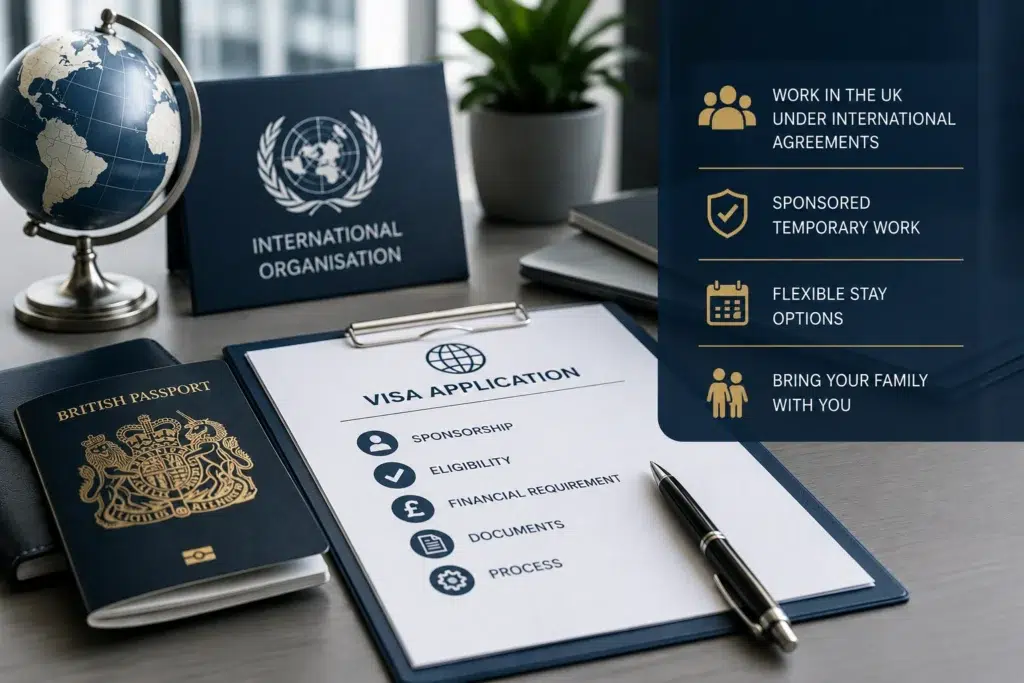
The International Agreement Worker Visa is an immigration route for individuals undertaking work covered by international law or treaty obligations. Despite its relatively narrow scope, applicants often encounter uncertainty regarding sponsorship requirements, financial thresholds, visa costs and the length of permission available under this category.
Unlike many other UK work routes, the International Agreement Worker Visa is specifically designed for overseas government employees, recognised international organisation workers and certain private servants employed within diplomatic households. Understanding the requirements of this route is essential, as errors relating to sponsorship, supporting documentation or eligibility can result in delays or refusals.
This guide explains the key requirements of the International Agreement Worker Visa, including eligibility criteria, application costs, processing times, dependant provisions and extension options.
What Is the International Agreement Worker Visa?
The Temporary Work – International Agreement Visa allows eligible individuals to come to the UK to undertake work covered by international law or treaty obligations.
This route is available to those working:
- For an overseas government
- For a recognised international organisation
- As a private servant in a diplomatic household
- As a private servant in the household of someone employed by a recognised international organisation
The visa replaced the former Temporary Worker – International Agreement Worker (T5) Visa and remains a specialist route within the UK’s Temporary Work immigration system.
Who Is Eligible for an International Agreement Worker Visa?
To qualify for an International Agreement Worker Visa, applicants must meet several Home Office requirements.
Applicants must:
- Be aged 18 or over
- Hold a valid Certificate of Sponsorship from a licensed sponsor
- Be coming to the UK to undertake eligible work covered by international law
- Meet the relevant financial requirements
- Provide supporting documentation confirming eligibility
The sponsoring organisation must also ensure that the employment complies with UK employment laws, including minimum wage requirements and working time regulations.
Failure to satisfy these requirements may result in a visa refusal.
Do You Need Sponsorship for an International Agreement Worker Visa?
Yes. Sponsorship is a mandatory requirement under this immigration route.
Before submitting an application, applicants must receive a Certificate of Sponsorship (CoS) from an organisation licensed by the Home Office.
A Certificate of Sponsorship is not a physical document. Instead, it is a unique reference number containing information about the worker, the role and the sponsoring organisation.
The work undertaken in the UK must directly relate to the activities of the sponsoring organisation.
Applicants should also note that a Certificate of Sponsorship remains valid for only three months from the date it is assigned.
How Much Money Do You Need for an International Agreement Worker Visa?
Most applicants must demonstrate that they can support themselves financially after arriving in the UK.
In most cases, applicants must have at least £1,270 available in their bank account for a continuous period of 28 days.
The final day of this period must fall within 31 days of the visa application date.
You may not need to provide evidence of maintenance funds if:
- You have been lawfully present in the UK for at least 12 months; or
- Your sponsor agrees to cover your costs during your first month in the UK.
Where sponsorship maintenance is being provided, the sponsor must confirm this within the Certificate of Sponsorship.
Do Private Servants Need to Meet an English Language Requirement?
Unlike many UK immigration routes, English language requirements only apply to certain applicants under this visa category.
Private servants applying from outside the UK may need to demonstrate English language ability at CEFR Level B1.
This requirement can usually be satisfied through:
- A recognised UK school qualification
- A degree awarded by a UK institution
- An overseas degree taught in English and verified by Ecctis
- A Secure English Language Test (SELT)
Nationals of designated majority English-speaking countries are generally exempt from this requirement.
Private servants extending their permission in the UK do not normally need to prove their English language ability again.
How Much Does an International Agreement Worker Visa Cost?
The application fee for an International Agreement Worker Visa is currently £340 per person.
Applicants must also pay the Immigration Health Surcharge, which is generally £1,035 per year.
These costs apply separately to each applicant, including partners and dependent children.
When calculating overall immigration costs, applicants should also consider expenses associated with obtaining supporting documents and attending biometric appointments where required.
How Long Does It Take to Get a Decision?
Applications can be submitted up to three months before the employment start date shown on the Certificate of Sponsorship.
After completing the application process and identity verification requirements, applicants typically receive a decision within:
- Three weeks when applying from outside the UK
- Eight weeks when applying from inside the UK
Priority processing services may be available in some circumstances.
Applicants should ensure that all supporting evidence is provided correctly, as requests for additional information can increase processing times.
How Long Can You Stay in the UK on an International Agreement Worker Visa?
The length of stay depends on the type of work being undertaken.
Overseas Government and International Organisation Workers
Applicants can usually stay for up to two years, or for the period stated on their Certificate of Sponsorship plus 14 days, whichever is shorter.
Private Servants in Diplomatic Households
Private servants may remain in the UK for up to five years in total.
Permission is generally granted for up to two years at a time, subject to continued eligibility.
If employment ends earlier than expected, visa holders may be required to leave the UK within 60 days.
Can You Bring Your Partner and Children to the UK?
Yes. Eligible partners and dependent children can usually apply to accompany or join the main applicant.
Dependants must submit separate applications and satisfy the relevant immigration requirements.
Applicants will normally need additional maintenance funds of:
- £285 for a partner
- £315 for the first child
- £200 for each additional child
Evidence of the family relationship must also be provided as part of the application process.
Can You Extend an International Agreement Worker Visa?
In certain circumstances, visa holders may apply to extend their permission from within the UK.
Applicants must continue to satisfy the eligibility requirements and submit their extension application before their existing permission expires.
The maximum period of stay remains:
- Two years for overseas government and international organisation workers
- Five years for eligible private servants
Applicants should not travel outside the UK, Ireland, the Channel Islands or the Isle of Man while an extension application is pending, as this can result in the application being withdrawn.
Does the International Agreement Worker Visa Lead to Settlement?
One of the most common misconceptions about this immigration route concerns long-term residence rights.
The International Agreement Worker Visa is a temporary immigration category and does not generally provide a direct pathway to Indefinite Leave to Remain (ILR).
Individuals seeking permanent residence in the UK may need to explore alternative immigration routes depending on their circumstances and long-term objectives.
Common Reasons International Agreement Worker Visa Applications Are Refused
While many applications are approved without difficulty, refusals can occur where key requirements have not been met.
Common reasons include:
- An invalid or expired Certificate of Sponsorship
- Insufficient financial evidence
- Applying under the wrong immigration route
- Missing supporting documentation
- Failure to satisfy English language requirements where applicable
- Inconsistencies between the application and sponsorship information
Careful preparation and thorough document checks can significantly reduce the likelihood of delays or refusals.
Final Thoughts
The International Agreement Worker Visa provides an important route for overseas government employees, recognised international organisation workers and diplomatic household staff who need to work in the UK temporarily.
Although the route is relatively straightforward for eligible applicants, sponsorship obligations, financial requirements and supporting evidence must all be carefully addressed before an application is submitted.
Seeking professional immigration advice can help applicants understand their eligibility, avoid common pitfalls and ensure that their application meets current Home Office requirements.
Follow us to stay updated on changes to UK immigration law, policy developments and guidance affecting migrants, employers and families.
With over 20 years of experience and a commitment to excellence, Morgan Smith Immigration is your trusted partner for all your immigration needs. Contact us today to learn more about how we can assist you with UK visa applications. For enquiries or assistance, call us at 0203 959 3335 or email [email protected].
