


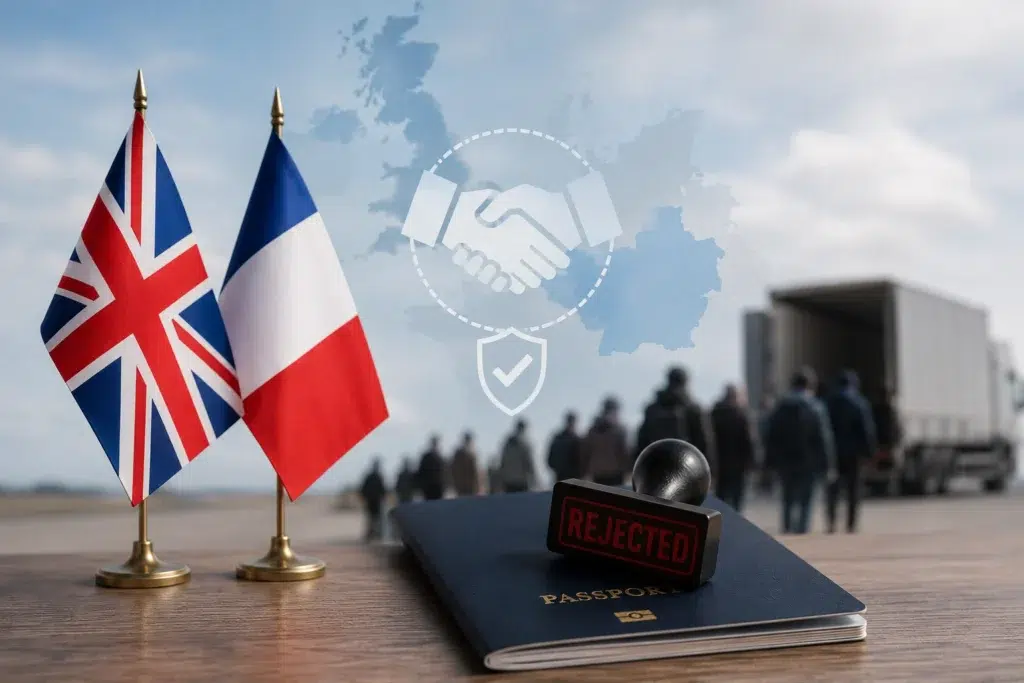
The United Kingdom and France have agreed to revise the One In One Out migration agreement. The move follows concerns that some migrants returned from the UK were later brought back into the country through alternative illegal routes.
The amendment aims to close a loophole that allowed individuals who had been returned to France under the bilateral agreement to re-enter the UK unlawfully, often with the assistance of organised smuggling networks.
Why the Agreement Needed Updating
Under the original “one in one out” arrangement, migrants arriving in the UK via small boats could be transferred back to France. In exchange, the UK would accept an equivalent number of asylum seekers from France through legal channels.
However, authorities identified instances where migrants who had already been removed under the scheme later returned to Britain hidden in lorries. This development raised concerns about the effectiveness of the agreement and the activities of criminal smuggling groups operating across the Channel.
To address the issue, the UK and French governments have agreed that migrants previously returned under the scheme can be transferred back to France again if they subsequently re-enter the UK illegally, regardless of the method used.
Introduction of a New ‘Returnee Case’ Category
As part of the revised approach, the Home Office has introduced a new classification known as a “returnee case”.
This category applies to individuals who have already been removed to France under the agreement but later return to the UK through unauthorised means. The change is intended to ensure that repeat illegal entries can be managed within the framework of the existing treaty.
Migration Figures Under the Agreement
Since the agreement came into force on 6 August last year:
- 921 migrants who arrived in the UK by small boat have been transferred to France.
- These removals represent approximately 3.5% of all small boat arrivals during the same period.
- UK has accepted 896 asylum seekers from France through the reciprocal element of the arrangement.
The agreement was designed to balance returns with legal pathways, with both countries exchanging equivalent numbers of individuals.
Joint Action Between the UK and France
The amendment was agreed between UK Home Secretary Shabana Mahmood and French Interior Minister Laurent Nuñez.
The revised approach extends the scope of the agreement to cover any migrant who returns to the UK illegally after being transferred to France, irrespective of whether they arrive by small boat, lorry, or another unauthorised route.
The objective is to discourage repeated attempts to enter the UK unlawfully and strengthen cooperation between the two countries in tackling irregular migration.
The Role of Smuggling Networks
Reports from migrants who were previously returned to France suggest that organised smuggling groups have been targeting individuals shortly after their arrival back on the continent.
According to those accounts, smugglers were aware of accommodation locations used by recently returned migrants and facilitated their movement back to the UK through clandestine routes.
These concerns have reinforced the need for both governments to adapt the agreement and respond to evolving smuggling tactics.
Extension of the Pilot Scheme
The migration arrangement, which was introduced by Keir Starmer and French President Emmanuel Macron, was initially established as a pilot programme.
The pilot had been scheduled to conclude on 11 June, but both governments have now agreed to continue the scheme until 1 October while assessing its longer-term effectiveness.
The agreement has been described by both countries as a significant step in managing irregular Channel crossings while maintaining legal asylum pathways.
Channel Crossing Trends
Current figures indicate that the number of people crossing the Channel has decreased by approximately one-third compared with the same period last year.
While authorities view this as a positive development, weather conditions are also believed to have influenced crossing numbers during parts of the year.
In addition, the UK and France confirmed a new £662 million agreement in April aimed at further strengthening efforts to prevent dangerous Channel crossings and disrupt people-smuggling operations.
What This Means Going Forward
The latest amendment to the One In One Out agreement strengthens enforcement measures within the existing migration framework. It allows repeat returnees to be transferred back to France. The change aims to discourage repeated illegal entry attempts and reduce opportunities for criminal smuggling networks to exploit loopholes.
As the pilot scheme continues, both countries are expected to monitor the effectiveness of the revised measures and assess their impact on Channel migration patterns and cross-border cooperation.
Follow us to stay updated on changes to UK immigration law, policy developments and guidance affecting migrants, employers and families.
With over 20 years of experience and a commitment to excellence, Morgan Smith Immigration is your trusted partner for all your immigration needs. Contact us today to learn more about how we can assist you with UK visa applications. For enquiries or assistance, call us on 0203 959 3335 or email [email protected].