

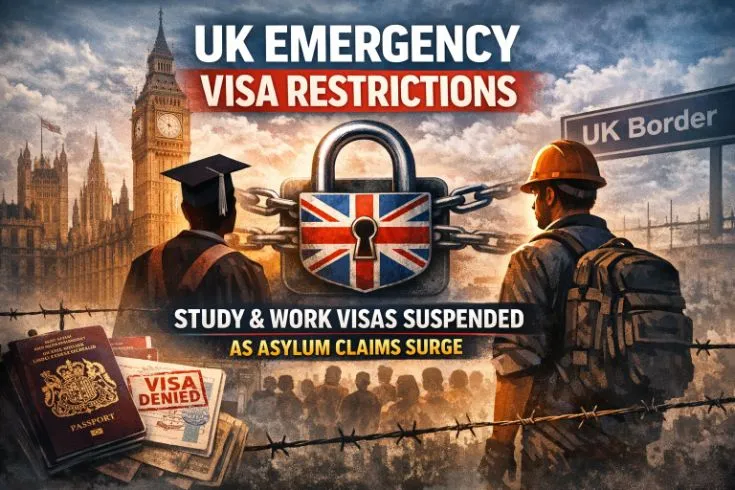
UK government has announced an unprecedented restriction on certain visa routes after a sharp rise in asylum claims made by individuals who initially entered the country legally. The Home Office has confirmed that study visas for nationals of Afghanistan, Cameroon, Myanmar and Sudan will be ended, while skilled worker visas for Afghan nationals will also be stopped.
This intervention, described as an emergency brake on visas, will be implemented through a change to the Immigration Rules on 5 March 2026 and will take effect from 26 March 2026.
Surge in Asylum Claims from Legal Routes
The decision follows a significant increase in asylum applications from individuals who entered the UK on visas intended for study or employment.
According to government figures, asylum claims by students from Afghanistan, Cameroon, Myanmar and Sudan rose by more than 470% between 2021 and 2025. These nationalities are now among the most likely to seek asylum after arriving on a study visa.
In the case of Afghanistan, the number of individuals on work visas who subsequently claimed asylum has exceeded the number of visas issued.
More broadly, asylum claims from individuals who arrived through legal routes have more than tripled since 2021, accounting for 39% of the approximately 100,000 people who applied for asylum last year. Over the past five years, 133,760 individuals have sought asylum after entering the UK legally.
Pressure on the Asylum Support System
The government argues that the increase in such claims has placed significant strain on the asylum support system.
Many applicants are provided with accommodation and financial support while their claims are processed. Officials state that individuals from the four countries in question show higher-than-average levels of destitution claims, resulting in increased reliance on state support.
At present, nearly 16,000 nationals from these four countries are receiving asylum support, including more than 6,000 people housed in hotels. Overall expenditure on asylum support currently exceeds £4 billion per year.
The Home Office maintains that action is required to address what it describes as the misuse of visa routes while maintaining the UK’s capacity to assist individuals in genuine need of protection.
Government Position
Home Secretary Shabana Mahmood stated that the UK remains committed to offering protection to those fleeing conflict or persecution, but emphasised that visa routes must not be used improperly.
She said the decision to refuse visas to nationals from these countries in certain categories was taken to prevent the exploitation of the UK’s immigration system and to restore control over the border.
The Home Secretary is expected to set out further details of the government’s approach in a speech at the IPPR think tank on Thursday, where she will outline how the reforms align with the government’s view of British values.
Trends Behind the Policy Change
Government statistics highlight several notable developments between 2021 and the year ending September 2025:
- The ratio of Afghan asylum claims to study visas issued reached 95%.
- Applications by students from Myanmar increased sixteen-fold during the same period.
- Asylum claims from Cameroonian and Sudanese students rose by more than 330%.
Although the government reports that student asylum claims fell by 20% during 2025, individuals arriving on study visas still represent 13% of all asylum claims currently within the system.
Wider Immigration Measures
The visa restrictions form part of a broader package of immigration and asylum measures.
Earlier announcements include a change to the duration of refugee protection, which was reduced to 30 months from 2 March in an effort to limit factors believed to encourage irregular migration, including small boat crossings.
The government has also adopted a more assertive diplomatic approach in relation to returns agreements. In November, the Home Secretary warned that visas for Angola, Namibia and the Democratic Republic of Congo could be suspended unless their governments agreed to accept the return of their nationals who had entered or remained in the UK unlawfully.
Four months later, cooperation agreements have reportedly been secured with all three countries, allowing for the return of illegal migrants and foreign national offenders.
Humanitarian Commitments
Despite the tighter controls, ministers emphasise that the UK continues to operate humanitarian and resettlement programmes.
Since 2021, more than 37,000 Afghans have been granted sanctuary in the UK through two dedicated resettlement schemes. In 2025 alone, approximately 190,000 visas were issued under humanitarian routes.
Between 2010 and 2025, the UK also ranked sixth globally for the number of refugees resettled following referral by the UNHCR.
The government has further stated that once stability is restored to the asylum system, it intends to introduce new capped safe and legal routes as alternatives to irregular migration.
Conclusion
The government’s decision to introduce a visa emergency brake reflects its intention to address the growing number of asylum claims from individuals who entered the UK through legal routes. By restricting certain study and work visas for specific nationalities, the Home Office aims to protect the integrity of the immigration system while continuing to provide refuge to those in genuine need.
Follow us to stay updated on changes to UK immigration law, policy developments and guidance affecting migrants, employers and families.
With over 20 years of experience and a commitment to excellence, Morgan Smith Immigration is your trusted partner for all your immigration needs. Contact us today to learn more about how we can assist you with UK visa applications. For enquiries or assistance, call us at 0203 959 3335 or email [email protected].