


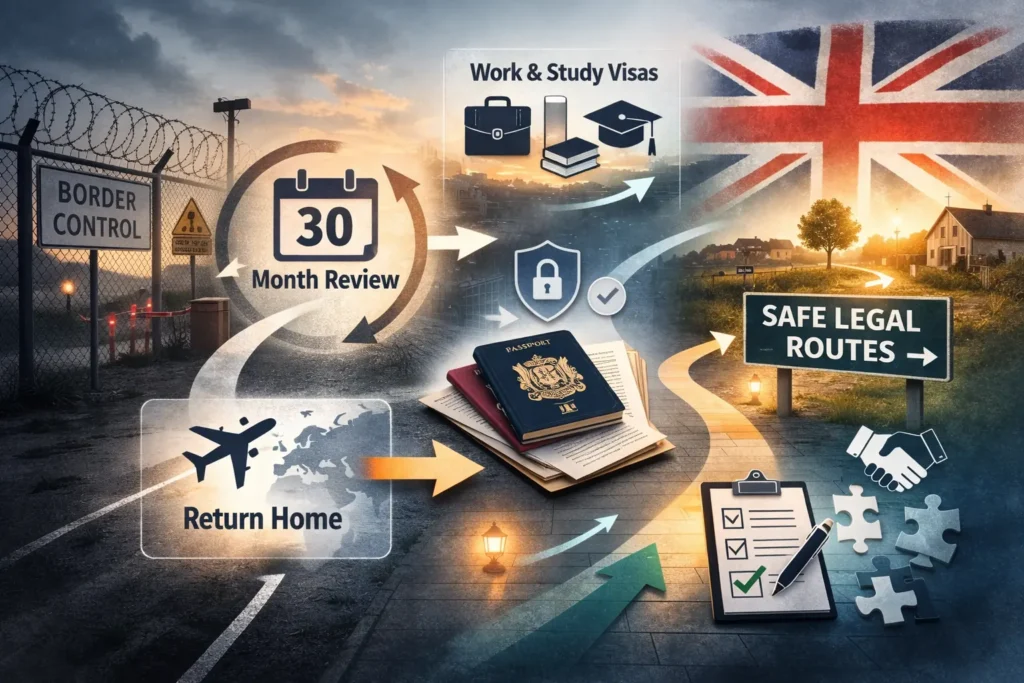
UK Government has announced a significant change to the United Kingdom’s asylum framework, confirming that refugee protection will move from a largely permanent model to a temporary system subject to regular review. The reforms, described as part of a broader reset of the asylum system, will apply to adults and accompanied children who claim asylum from today.
A Shift to 30-Month Protection Periods
Under the new approach, individuals granted refugee status will receive 30 months leave. At the end of that period, their protection will be reviewed. Those who continue to face danger in their country of origin will have their status renewed. However, where conditions are deemed to have improved to the extent that protection is no longer required, individuals will be expected to return home.
This replaces the previous framework under which refugees were granted five years protection, followed by near-automatic, fee-free settlement with ongoing access to housing and benefits. The earlier system also allowed for family reunion during the initial protection period.
The Home Secretary has stated that the former arrangements were among the most generous in Western Europe and have acted as a pull factor, contributing to rising asylum claims in the UK, including a substantial number considered to lack legitimate grounds.
Influenced by the Danish Model
The reforms follow the Home Secretary’s recent visit to Denmark, which has implemented similar measures. Since 2015, Denmark has made refugee status temporary, subject to review every two years, tightened family reunion rules and extended the route to permanent settlement to eight years, contingent on strict integration and employment requirements.
Over the past decade, Denmark has reduced asylum applications by more than 90 per cent, reaching a 40-year low. By contrast, the UK experienced a 13% increase in asylum claims in the year to September 2025, while applications across the European Union fell by 22% over the same period.
The ‘Core Protection’ Model
The new British framework will introduce what has been described as a ‘core protection’ system. Refugees will be required either to renew their permission to stay every 30 months or to apply under a separate legal visa route if they wish to remain in the country long term.
Under reforms announced last autumn, settlement will only be available after 20 years under the core protection route, unless an individual qualifies under an alternative legal migration category.
Family reunion is currently paused while new rules are developed. These will align financial and integration requirements with those expected of British citizens.
The first stage of the core protection system will be implemented through amendments to the Immigration Rules later this week.
Legal Routes and Integration
Alongside these changes, the Government intends to expand safe and legal routes. Community sponsorship will become the principal mechanism for resettlement and new work and study visa pathways will be introduced for refugees who possess relevant skills. These routes are designed to support integration and encourage contribution to society through lawful migration channels. Further detail will be provided in future Immigration Rules updates.
Provisions for Children and Age Assessments
Unaccompanied children will continue to receive five years leave while the Government reviews longer-term policy for this group. Additional announcements are expected in due course.
Existing age assessment procedures remain in place to address false claims of minority. Technology currently being tested is intended to strengthen these measures further.
Government Position
The Home Secretary has emphasised that the United Kingdom will continue to offer sanctuary to those fleeing war and persecution. However, she has also stated that the asylum system must not create incentives for dangerous journeys or facilitate the activities of organised trafficking networks.
Under the revised framework, individuals whose countries of origin are considered safe will be expected to return, while those still in need of protection will continue to receive it.
The Government maintains that these measures will restore control to the asylum system, reduce irregular migration and encourage those seeking to build a life in the UK to do so through safe and lawful routes, while upholding protection for those in genuine need.
Conclusion
These reforms mark a fundamental change to the UK’s asylum system, moving from automatic long-term protection to a temporary model subject to review. The Government maintains that genuine refugees will continue to receive sanctuary, while those no longer in need of protection will be expected to return.
Overall, the changes are intended to reduce irregular migration and encourage lawful routes, while reshaping Britain’s approach to refugee protection.
Follow us to stay updated on changes to UK immigration law, policy developments and guidance affecting migrants, employers and families.
With over 20 years of experience and a commitment to excellence, Morgan Smith Immigration is your trusted partner for all your immigration needs. Contact us today to learn more about how we can assist you with UK visa applications. For enquiries or assistance, call us at 0203 959 3335 or email [email protected].