


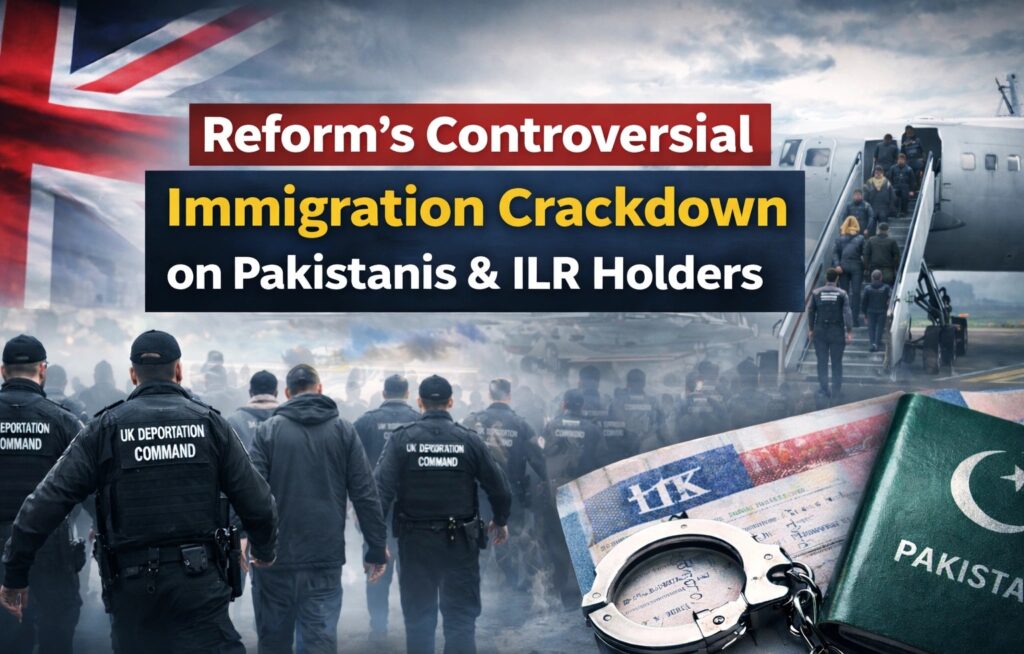
Nigel Farage’s Reform UK has set out one of the most far-reaching immigration agendas seen in modern British politics. The party’s new home affairs spokesperson, Zia Yusuf, is expected to outline proposals that would fundamentally reshape the United Kingdom’s approach to migration, human rights law, policing and national identity.
At the centre of Reform’s programme is a pledge to leave the European Convention on Human Rights (ECHR), repeal the Human Rights Act and replace it with a British bill of rights. The party argues that this constitutional shift is necessary to prevent courts from blocking removals and to reassert parliamentary sovereignty. Under its proposals, the Home Secretary would be placed under a statutory duty to deport individuals in the UK unlawfully, with judges prevented from intervening in such decisions.
A New Deportation Infrastructure
The most striking operational proposal is the creation of a new UK Deportation Command, described as an ICE-style agency, dedicated to detaining and removing those without legal status. Reform says the body would have the capacity to hold 24,000 individuals at any one time and would aim to deport up to 288,000 people annually, operating five charter flights per day.
For context, detention capacity stood at approximately 2,500 spaces as of April 2024. A tenfold expansion would represent not merely a policy adjustment but the construction of an entirely new enforcement architecture. The scale raises immediate logistical and financial questions, particularly given that Labour reports having removed 60,000 illegal migrants over an 18-month period. Reform’s target would therefore mark a dramatic escalation in both ambition and cost.
Ending Indefinite Leave to Remain
Reform also proposes to abolish indefinite leave to remain (ILR) and replace it with a renewable five-year work visa, alongside a dedicated spouse visa route.
This change could affect tens of thousands of people currently regarded as permanently settled. The party argues that ILR grants lifetime access to public funds, though available figures indicate that ILR holders account for a small proportion of universal credit claimants and that a significant share of them are in employment.
Labour has separately proposed reforms to ILR by extending the qualifying period from five to ten years, but Reform’s approach would go considerably further by eliminating the concept of permanent settlement altogether.
Visa Sanctions and Targeted Bans
A further plank of Reform’s policy is the introduction of blanket visa bans on countries that refuse to accept the return of their nationals. Pakistan, Somalia, Eritrea, Syria, Afghanistan and Sudan would face restrictions covering diplomats, students, workers, tourists and VIPs.
Pakistan is currently one of the largest recipients of UK visas, with more than 160,000 issued in the past year. Reform contends that the country accepts back only a small fraction of failed asylum seekers and has resisted UK efforts to repatriate certain convicted offenders. The proposed sanctions echo similar measures adopted by the United States under Donald Trump.
In addition, Reform says it would renegotiate aspects of the Brexit withdrawal agreement to prevent EU nationals with settled status from claiming welfare benefits. The party estimates that without such changes, spending on universal credit for foreign nationals could rise significantly by 2028/29. However, altering these arrangements would require reopening treaty commitments that guarantee reciprocal rights for UK nationals living in the EU.
Welfare and Foreign Nationals
Reform’s platform includes the termination of welfare payments to foreign nationals more broadly. The party notes that 1.3 million foreign nationals currently receive universal credit, an increase from around 900,000 in 2022. It argues that without reform, the fiscal burden will intensify over the coming years.
Critics counter that many recipients are legally resident and in work and that access to benefits forms part of established reciprocal or settled rights frameworks. Any attempt to remove these entitlements would likely involve significant legal and diplomatic complexities.
Policing, Prevent and Public Order
Beyond immigration, Reform’s speech is expected to outline a zero-tolerance approach to Islamist extremism. The Prevent counter-radicalisation programme would be reoriented explicitly towards Islamist threats and the Muslim Brotherhood would be restricted.
A new rule would mandate automatic home searches where three separate authorities corroborate a Prevent referral. The party also promises a substantial expansion of stop and search powers, including saturation policing in high-crime areas, alongside the removal of diversity initiatives within police forces.
These proposals signal a marked shift in counter-terrorism and public order policy, prioritising assertive enforcement over community-based engagement models.
Political and Legal Implications
Collectively, these measures amount to a comprehensive restructuring of the UK’s immigration, asylum and human rights framework. Leaving the ECHR and repealing the Human Rights Act would carry profound constitutional consequences, affecting not only migration law but also broader civil liberties jurisprudence. Expanding detention capacity from 2,500 to 24,000 spaces and implementing removals on the scale proposed would demand substantial financial investment and administrative coordination.
Reform positions its agenda as a restoration of sovereignty and border control, arguing that successive governments have failed to uphold the “social contract”. Labour, by contrast, describes the programme as divisive and an attack on settled families who have built lives in the UK.
Whether Reform’s proposals are seen as decisive or disruptive will depend on how voters balance border control with legal and human rights obligations.
Labour has gone further, describing the plan to scrap indefinite leave to remain as an attack on settled families, people who have lived and worked in the UK lawfully for years. The party argues that removing settled status would create uncertainty for those who built their lives here under existing rules.
What is clear is that Reform is not proposing minor adjustments, but a fundamental shift in Britain’s immigration settlement, one that could redraw the line between who belongs and who does not.
Follow us to stay updated on changes to UK immigration law, policy developments and guidance affecting migrants, employers and families.
With over 20 years of experience and a commitment to excellence, Morgan Smith Immigration is your trusted partner for all your immigration needs. Contact us today to learn more about how we can assist you with UK visa applications. For enquiries or assistance, call us at 0203 959 3335 or email [email protected].