


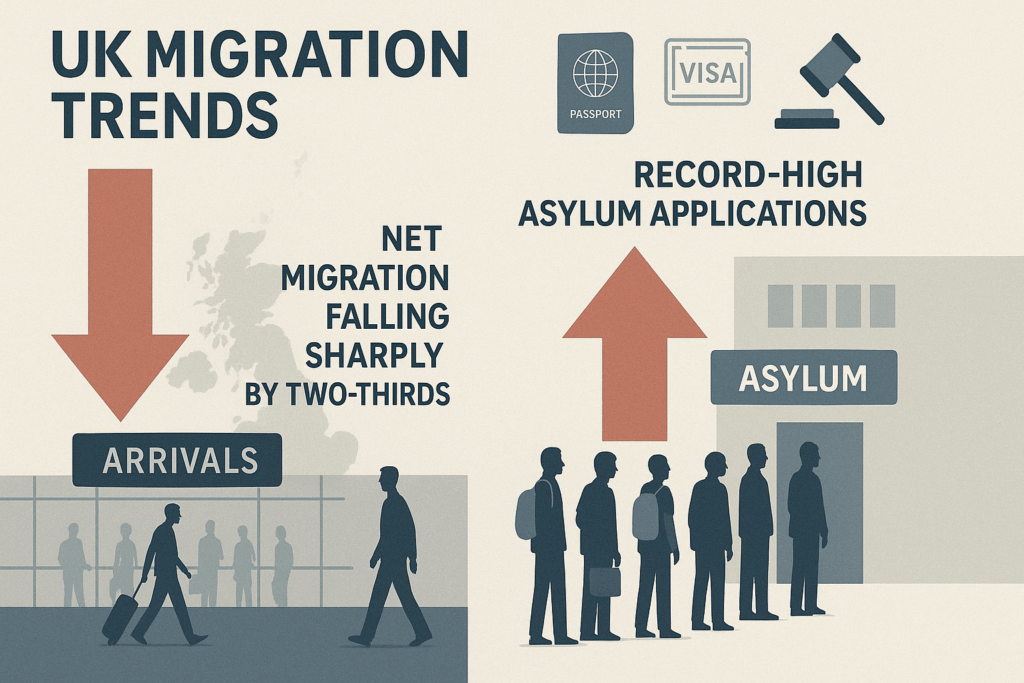
The latest migration releases paint a picture of two UK trends moving in opposite directions. On the one hand, long-term net migration has fallen steeply, easing back towards levels last seen before the post-Brexit immigration system took effect. On the other, the asylum system continues to carry heavy demand, with applications reaching a new high even as grant rates tighten.
Net migration falls back to pre-Brexit levels
The Office for National Statistics provisional long-term international migration estimates show net migration for the year ending June 2025 at +204,000, a dramatic decline from +649,000 in the year ending June 2024. This represents a reduction of roughly two-thirds in a single year.
The fall is driven by a substantial drop in immigration. Total immigration is estimated to have decreased from 1,299,000 to 898,000 over the same period. The profile of arrivals also remains heavily weighted towards non-EU nationals, who account for 75% of all immigrants. EU nationals made up a comparatively small share at 9%.
At the same time, emigration increased. The ONS estimates that 693,000 people left the UK in the year ending June 2025, up by 43,000 compared with the previous year. Most departures were by non-EU nationals (286,000), and around half of those leaving were students.
Commenting on these shifts, Dr Madeleine Sumption of the University of Oxford’s Migration Observatory noted that net migration may now resemble pre-Brexit levels in scale, but not in composition. She highlights three key differences: non-EU net migration remains far higher than before Brexit, EU net migration is much lower, and a larger share of migration is occurring via the asylum system. She also cautions that current trends may not hold long-term, particularly because negative net migration from EU citizens who arrived before Brexit is still pulling the overall numbers down, a factor that will diminish over time.
Home Office visa trends: work down, study steady, family mixed
The Home Office’s quarterly immigration statistics, covering the year ending September 2025, reinforce the picture of cooling inflows through several major routes.
A total of 175,000 work visas were granted to main applicants, representing a 27% fall compared with the previous year. The sharpest decline occurred in the Health and Care route, which dropped to 17,000 visas, an 89% fall from its 2023 peak. Skilled Worker visas also declined substantially to 35,000, down 46% year-on-year.
Notably, while new grants fell, the number of people already in the UK extending their work stay rose by 16%, reflecting earlier arrivals moving into extension phases.
Study visa grants stood at 440,000, broadly unchanged from the previous year, though still 31% below the 2023 peak. Visas for student dependants dropped sharply to 20,000, a 57% decrease following restrictions introduced in 2024.
Family routes
Family visa grants totalled 68,000, down 22%, largely due to fewer Partner visas. In contrast, Refugee Family Reunion reached a record 21,000 grants, up 11%, linked to recent increases in asylum grants. Family-based extensions were also recorded at 61,000, a modest 5% decrease.
Humanitarian safe and legal routes
Protection grants through safe and legal routes rose sharply to 171,000 people, nearly double the previous year’s total. This increase was largely attributed to the Ukraine Permission Extension scheme.
Asylum at record application levels, but grant rates fall
The year ending September 2025 saw the highest asylum application volume ever recorded for the UK. There were 110,000 asylum applications, a 13% increase on the previous year.
Decision-making activity has accelerated at the same time. 134,000 initial decisions were issued, up 31%, but the grant rate fell to 45%, down from 52% the year before.
The main asylum backlog has reduced significantly. People awaiting an initial decision fell to 62,000 cases (81,000 people), a 36% drop year-on-year and far below the June 2023 peak. Meanwhile, around 112,000 people were receiving asylum support, including just over 36,000 in hotel accommodation.
Dr Peter Walsh of the Migration Observatory highlights the tension in these figures: although the main backlog has fallen, high application levels and a growing appeals backlog make sustained pressure on the system difficult to avoid.
UK’s asylum position in Europe
Despite the record number of claims, the UK still received fewer asylum applications than several major European countries in the year ending June 2025. In absolute terms, the UK ranked fifth, behind Germany, France, Spain, and Italy. When measured relative to population size, the UK ranked even lower at 15th, indicating that many European countries receive more asylum seekers per head.
Sharp tightening across nationalities
The latest grant-rate data show a broad tightening across all ten of the most common asylum nationalities, each recording lower positive decision rates than the previous year.
Some of the largest declines were among groups that previously saw very high success rates. For example:
- Afghan grant rates fell from 84% to 36%.
- Vietnamese grant rates dropped from 47% to 19%.
Other nationalities experienced more moderate declines, and several still retain extremely high success rates. In the year to September 2025:
- 96% of Sudanese claims were granted.
- 88% of Eritrean claims were granted.
Conversely, some nationalities continued to see persistently low outcomes, including:
- Bangladesh (18%)
- Turkey (19%)
- India (1%)
What these figures show overall
Taken together, these statistics describe a migration system moving in different directions at once. Net migration has fallen sharply, driven by lower work and family inflows and higher emigration. Yet asylum demand remains at record levels, while grant rates are tightening and varying widely by nationality. Even with a significantly reduced main backlog, the system continues to face sustained pressure as new applications rise and appeals increase.
Follow us to stay updated on the latest UK immigration changes. With over 20 years of experience and a steadfast commitment to excellence, Morgan Smith Immigration is your trusted partner for all your immigration needs. Contact us today to learn more about how we can assist you with UK visa applications and provide tailored advice for your circumstances. For any enquiries or assistance, call us at 0203 959 3335 or email [email protected].