


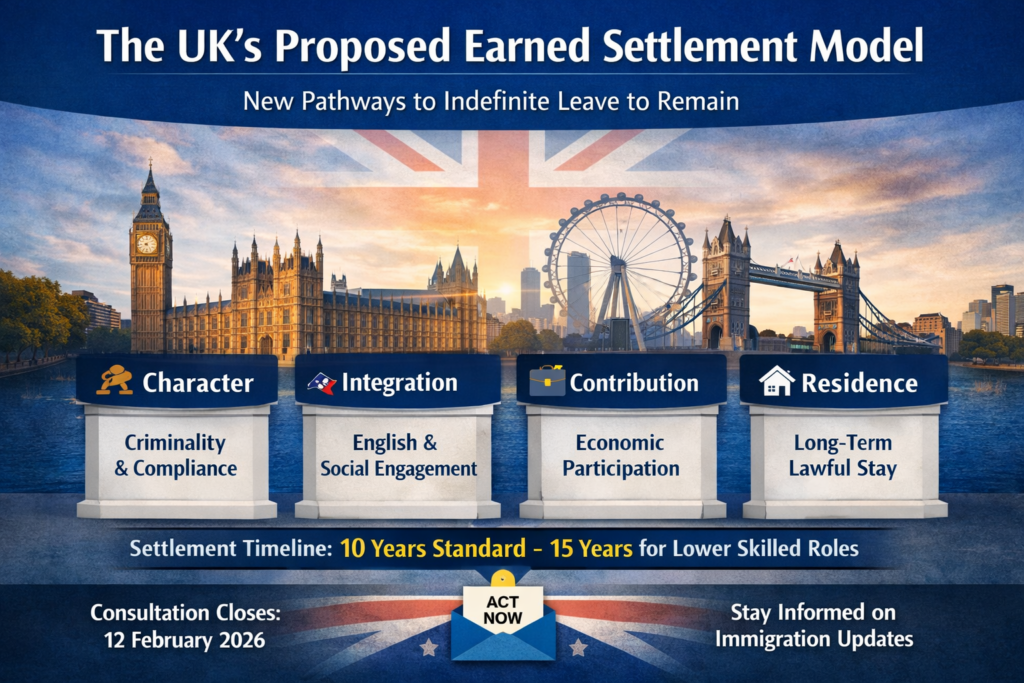
UK Government’s consultation on earned settlement marks one of the most significant proposed shifts in the immigration settlement framework in decades. The consultation, titled A Fairer Pathway to Settlement, proposes replacing much of the current system where most migrant categories can qualify for Indefinite Leave to Remain (ILR) after five years with a model that places greater emphasis on contribution, compliance and integration. Respondents have until 23:59 GMT on 12 February 2026 to share views with the Home Office.
A New Baseline for Settlement
Under the current framework, many routes such as the Skilled Worker route lead to settlement after five years of continuous lawful residence. The earned settlement model proposes a ten-year baseline qualifying period for most applicants, fundamentally changing this tradition. This baseline is designed to be adjustable based on factors including economic contribution, English language proficiency and immigration compliance.
Importantly, these proposals are currently at consultation stage; they do not yet have legal effect and the existing ILR routes remain in force until any future Immigration Rules are formally amended.
How the New Model Would Work
The earned settlement framework centres around four broad principles:
- Character – This remains a mandatory threshold requirement and includes immigration history, criminal record, compliance with UK laws and public interest considerations. These requirements cannot be traded against positive factors and individuals with criminal records are not expected to be eligible for settlement.
- Integration – Applicants will be required to demonstrate meaningful engagement with British society.
- Contribution – Economic contribution will be assessed primarily through sustained and measurable participation in the UK economy. Accelerated settlement would be reserved for those meeting defined contribution thresholds.
- Residence – Lawful, continuous residence in the UK will remain necessary but time spent in the UK alone will not normally be sufficient to qualify for settlement.
Who Could Gain or Lose Out
The Free Movement briefing highlights a spectrum of potential outcomes depending on individual circumstances:
Potential Beneficiaries
- High earners (e.g., those with significant taxable income) could reduce their baseline considerably: in some scenarios settlement after three years becomes possible if earnings thresholds are met consistently.
- Routes with shorter current baselines, such as Global Talent or Innovator Founder visas, may preserve their accelerated settlement timelines under the new model.
- Certain frontline public service roles (e.g., nurses or teachers) may attract reductions equivalent to five-year settlement if they meet occupational criteria and mandatory requirements.
Those Likely to Be Worse Off
- Skilled Workers in “medium skilled” roles (below RQF level 6) and carers could face a 15-year baseline before settlement three times longer than the current five-year route unless positive adjustments apply.
- Dependants (partners and adult children) are anticipated to face separate qualifying requirements rather than automatically inheriting the principal applicant’s status, potentially delaying family settlement.
- People already on a pathway to settlement are facing uncertainty over whether transitional provisions will be introduced, leaving open the possibility of retrospective application of new rules to those mid-route.
What Comes Next
The consultation is part of a broader review of the UK’s immigration system and will inform potential future changes to the Immigration Rules. Any final reforms will require publication of a Statement of Changes and parliamentary scrutiny before they can take legal effect.
For skilled workers, their families and sponsors, earned settlement represents a possible departure from the historical five-year path to permanence in the UK. While the Government frames the reforms as a way to reward genuine contribution, the detail and application of these changes will matter enormously to individuals’ futures and to employers relying on migrant talent.
We will continue to monitor developments closely and will provide updates as further information becomes available. In the meantime, we encourage you to follow us for the latest UK immigration news and policy updates. With over 20 years of experience and a steadfast commitment to excellence, Morgan Smith Immigration is your trusted partner for all your immigration needs. Contact us today to learn more about how we can assist you with UK visa applications and provide tailored advice for your circumstances. For any enquiries or assistance, call us at 0203 959 3335 or email [email protected].