

News

Filter posts by category

Illustration showing UK visa documents, CEFR English language levels and London landmarks representing higher English language requirements for UK visa routes.

UK Tightens English Language Requirements Across Key Visa Routes

UK Visas and Immigration has issued updated guidance clarifying how the English language requirement operates across a number of immigration routes. The guidance applies to both entry clearance applications made outside the UK and applications for permission to stay made from within the UK and confirms the level of English applicants must demonstrate at each stage.

UK Tightens English Language Requirements Across Key Visa Routes Read More »

Care Worker Visa reforms impacting UK social care, with symbolic healthcare elements highlighting staff shortages and growing pressure on the NHS.

Care Worker Visa Reforms: A Looming Crisis for Social Care and the NHS

UK’s social care sector is once again facing significant uncertainty as proposed changes to immigration rules threaten to deepen an already critical workforce shortage. Industry leaders are warning that tighter visa requirements for care workers could have far-reaching consequences, not only for care providers but also for the National Health Service (NHS) and vulnerable individuals who rely on daily support.

Care Worker Visa Reforms: A Looming Crisis for Social Care and the NHS Read More »

UK immigration rules and Part Suitability represented by official documents, a British passport and legal symbols on a desk.

The Introduction of Part Suitability: A Fundamental Shift in UK Immigration Decision-Making

On 14 October 2025, the Home Office published its Autumn Statement of Changes to the Immigration Rules, confirming the introduction of a new and far-reaching framework known as Part Suitability. Coming into force on 11 November 2025, this reform replaces the long-standing Part 9: Grounds for Refusal and consolidates all suitability-related refusal and cancellation provisions into a single, unified part of the Rules.

The Introduction of Part Suitability: A Fundamental Shift in UK Immigration Decision-Making Read More »

Proposed UK ILR reforms for care workers shown with a calendar, pathway timeline and visa-style documents, highlighting a longer route to settlement.

ILR for Care Workers: Proposal to Extend the Qualifying Period to 15 Years

In February 2022, the inclusion of Care Workers and Senior Care Workers on the Shortage Occupation List marked a pivotal change in UK immigration policy. For the first time, overseas nationals could be sponsored into these roles at a reduced salary threshold, opening the door to large-scale international recruitment within the care sector.

ILR for Care Workers: Proposal to Extend the Qualifying Period to 15 Years Read More »

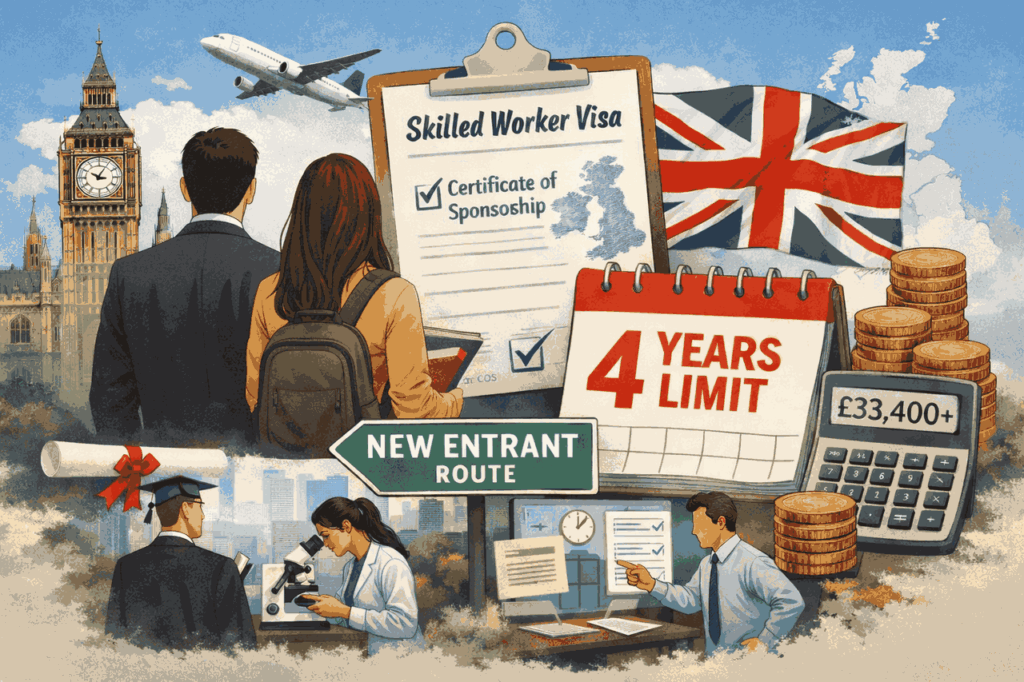
Landscape illustration of UK work visa policy changes, showing “MAC recommends” Skilled Worker salary thresholds (£41,700 general threshold, 25th percentile going rates, £33,400 new entrant rate) with London/Parliament backdrop, graduate, NHS worker and employers.

MAC recommends keeping Skilled Worker salary threshold at £41,700

The Migration Advisory Committee (MAC) has published its latest review of salary thresholds and discounts across the UK’s sponsored work routes. Although the report does not change the Immigration Rules by itself, it is a clear sign of where policy may move next, particularly after the sharp rise in Skilled Worker salary requirements.

MAC recommends keeping Skilled Worker salary threshold at £41,700 Read More »

Right to Work Checks: The Risks of Physical Documents and the Role of Mock Audits

Right to work checks remain a fundamental compliance obligation for UK employers. While digital and online verification methods have significantly reduced the risk of fraud, manual right to work checks using physical documents continue to present heightened vulnerability, particularly where documents lack photographic or security features.

Right to Work Checks: The Risks of Physical Documents and the Role of Mock Audits Read More »

Illustrated cityscape of London’s financial district with office workers in business attire walking toward the skyline, overlaid with an upward-trending economic graph and a pound (£) symbol. A sign reads “UK Skilled Migration Route,” and a document in the foreground references a MAC report showing a £47bn fiscal benefit. The image visually represents post-Brexit skilled migration, economic contribution, rising earnings, and long-term fiscal impact on the UK economy.

Skilled work migrants set to add £47bn to UK public finances, MAC reports

Since Brexit, the UK’s immigration system has undergone significant reform, with a stronger emphasis on skills, salary thresholds and economic contribution. A new report from the Migration Advisory Committee (MAC) adds important evidence to this debate, concluding that skilled migrants arriving in the UK after Brexit are likely to deliver a substantial long-term fiscal benefit to the country.

Skilled work migrants set to add £47bn to UK public finances, MAC reports Read More »

Hyperrealistic desk scene at a British university showing “Approved CAS” and “Paused Recruitment” folders beside a laptop warning of BCA refusal rates below 5%, illustrating the gaps in Home Office oversight pushing universities to manage visa risk.

Protecting the Route or Breaking It: the gaps in Home Office oversight are being tackled from another point of view?

British universities are again being asked to do the Home Office’s risk-management for it. Over the past few weeks, a growing number of institutions have paused or curtailed recruitment from Pakistan and Bangladesh two of the UK’s largest student markets citing concern that high visa refusal rates could put their sponsorship licences at risk.  

Protecting the Route or Breaking It: the gaps in Home Office oversight are being tackled from another point of view? Read More »

Office desk with UK flag and sponsorship paperwork showing ‘UK Immigration Skills Charge update 2025’ and a 16 December 2025 date, illustrating the Immigration Skills Charge increase for sponsors.

Immigration Skills Charge Rises on 16 December 2025: What Sponsors Need to Know

UK employers who sponsor overseas workers will face a notable rise in the Immigration Skills Charge (ISC) from 16 December 2025. This is the first increase since the ISC was introduced in 2017 and represents a substantial uplift in the overall cost of sponsorship.

Immigration Skills Charge Rises on 16 December 2025: What Sponsors Need to Know Read More »

EU Settlement Scheme blog header image showing a diverse group of travellers in a UK airport, holding passports and checking a UKVI account on a smartphone, reflecting account updates for travel and the route from pre-settled to settled status.

EU Settlement Scheme Updates: Updating Your Details and Securing Settled Status

The Home Office has set out a series of changes affecting people who hold status under the EU Settlement Scheme (EUSS). The announcement covers two main areas: keeping UKVI account details accurate, particularly identity documents used for travel and a simpler and more flexible route from pre-settled to settled status, alongside plans to expand automatic grants of settled status.

EU Settlement Scheme Updates: Updating Your Details and Securing Settled Status Read More »

Net Migration editorial infographic showing a split UK migration scene: left side with a downward arrow over UK map and airport arrivals, right side with an upward arrow above an asylum queue, plus passport, visa, and gavel icons in muted navy/grey/red policy style.

ONS Reports Net Migration Down by Two-Thirds; Home Office Data Shows Record Asylum Demand

The latest migration releases paint a picture of two UK trends moving in opposite directions. On the one hand, long-term net migration has fallen steeply, easing back towards levels last seen before the post-Brexit immigration system took effect. On the other, the asylum system continues to carry heavy demand, with applications reaching a new high even as grant rates tighten.

ONS Reports Net Migration Down by Two-Thirds; Home Office Data Shows Record Asylum Demand Read More »

UK border scene showing a passport with ‘ETA approved’ stamp and a phone displaying Electronic Travel Authorisation (ETA) confirmation, highlighting digital entry from Feb 2026.

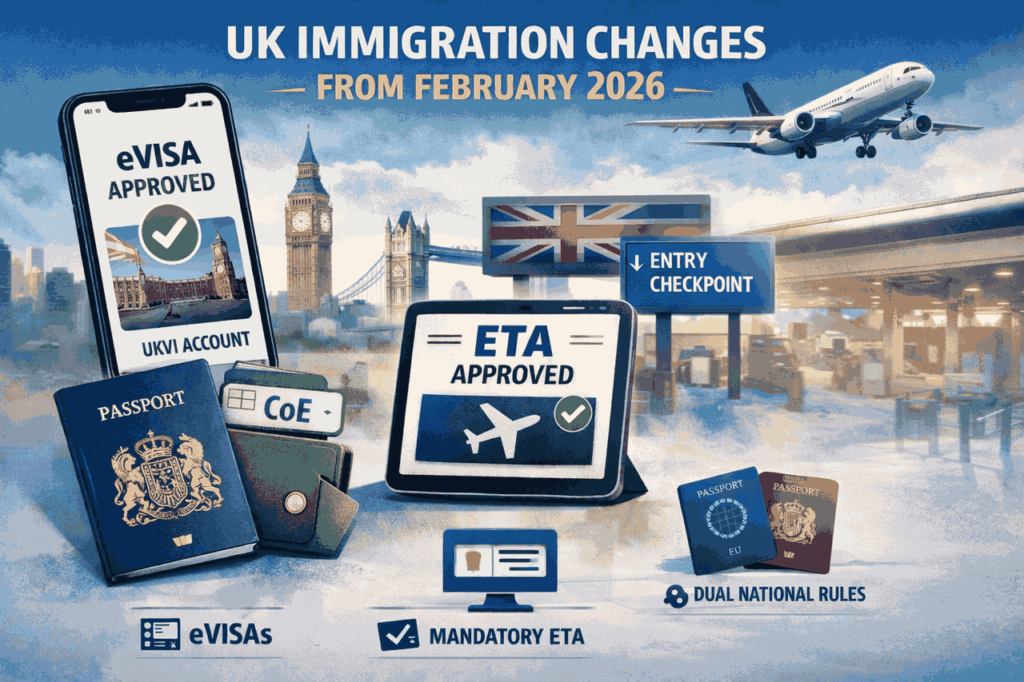
UK to begin enforcing Electronic Travel Authorisation (ETA) requirement from February 2026

From February 2026, the UK will move to full enforcement of its Electronic Travel Authorisation (ETA) scheme. This means that travellers who previously did not need a visa will no longer be able to travel to the UK without an Electronic Travel Authorisation (ETA).

UK to begin enforcing Electronic Travel Authorisation (ETA) requirement from February 2026 Read More »

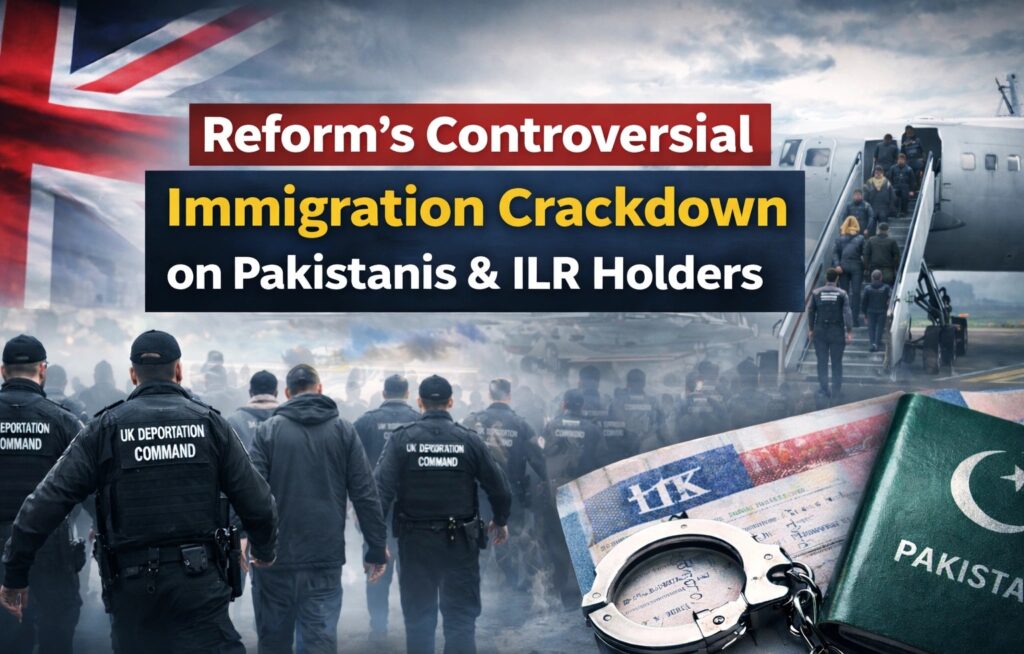
UK Draws the Line: Record Pakistani Asylum Claims, Longer Settlement Route and a Tourist Levy Next 

Pakistan is now the leading source of asylum claims in the UK and the way many applicants are arriving matters as much as the headline total. At the same time, the Home Office is reshaping settlement rules to make permanent residence harder to secure without sustained lawful contribution, while ministers and city leaders are exploring new ways of funding public services through a potential London visitor levy. Taken together, these strands point to a broader shift: tighter control of status-switching, a longer road to indefinite leave to remain and a willingness to ask short-term visitors to contribute more directly to the costs of the system. 

UK Draws the Line: Record Pakistani Asylum Claims, Longer Settlement Route and a Tourist Levy Next  Read More »

A modern illustration showing the UK’s Earned Settlement system, featuring a timeline from 5 to 10 years, icons for contribution, integration, character checks and community involvement, presented in official navy, white and muted red tones.

A New Era for ILR: Shabana Mahmood Introduces the Earned Settlement Framework

The Home Secretary, Shabana Mahmood, has set out detailed plans to overhaul how migrants qualify for settlement (Indefinite Leave to Remain – ILR) in the UK. Instead of settlement following automatically after a fixed period, the new model is built on the idea of earned settlement, permanent status granted only where a person can show long-term contribution, strong integration and a clean record. These proposals are set out in a government policy document and are now the subject of a formal consultation. They are not yet in force but they give a clear indication of the direction of travel.

A New Era for ILR: Shabana Mahmood Introduces the Earned Settlement Framework Read More »

A hyper-realistic image of a printed policy document titled “Restoring Order and Control,” placed on a wooden surface. The visible text outlines key sections of the UK’s Asylum and Returns Policy, highlighting reforms on protection, support and removals, visually reinforcing the article’s analysis of government asylum changes.

Restoring Order and Control: An Analysis of the Government’s Asylum and Returns Policy

The Home Secretary has now formally published the policy paper Restoring Order and Control: A statement on the government’s asylum and returns policy and presented it to Parliament, following several days of extensive briefing to the media. The paper sets out what is described as the most significant reform of the asylum system in a generation, framed around two central aims:

Restoring Order and Control: An Analysis of the Government’s Asylum and Returns Policy Read More »

Understanding Overseas Criminal Record Certificates for UK Visa Applicants

UK immigration system places great importance on safeguarding the public and ensuring that those who enter the country meet suitability requirements. One of the measures supporting this aim is the obligation for certain visa applicants to provide an overseas criminal record certificate. This requirement applies across several immigration categories and helps verify whether an individual has committed offences outside the UK.

Understanding Overseas Criminal Record Certificates for UK Visa Applicants Read More »

Graphic showing UK immigration updates with a Union Jack background, visa documents, and a calendar marked 11 November 2025, representing key policy changes for students, workers, and sponsors.

Major UK Immigration Changes Announced on 11 November 2025

Home Office has announced a series of reforms taking effect on 11 November 2025, bringing notable changes for sponsors, students, seasonal workers and family visa applicants. These updates form part of the Government’s wider approach to strengthening compliance, tightening safeguarding protections and adjusting financial thresholds in line with rising administrative demands.

Major UK Immigration Changes Announced on 11 November 2025 Read More »

Editorial illustration showing a Labour figure standing at a crossroads between ‘Compassion’ and ‘Control’ paths, symbolising Labour’s shift toward Denmark-inspired immigration policies once condemned under the Tories’ Rwanda plan, with Article 8 — Right to Family Life, subtly appearing in the background.

Labour’s Danish Dilemma: Following in the Footsteps of the Policies They Once Condemned

When the Conservative government unveiled its controversial Rwanda deportation scheme, Labour fiercely condemned it as inhumane, unworkable, and contrary to British values. Yet less than a year later, Labour’s Danish Dilemma emerges, with the same party now in power preparing to introduce one of the toughest immigration overhauls in decades, drawing direct inspiration from Denmark’s hardline asylum system. They have also examined Italy’s system, which operated along similar lines to the scheme proposed by the Tories, signalling an effort to explore comparable approaches within Europe.

Labour’s Danish Dilemma: Following in the Footsteps of the Policies They Once Condemned Read More »

HR professionals in a UK office reviewing a laptop showing a “Pending CoS Request” notice, symbolising delays in Certificate of Sponsorship allocations affecting employers.

How Delays in Certificate of Sponsorship Allocations Are Affecting UK Employers 

The consistency and timeliness of Certificate of Sponsorship (CoS) allocations by the Home Office have become a growing source of concern for UK employers and immigration practitioners alike. What was once a relatively straightforward process has become increasingly unpredictable, leaving sponsors and applicants alike struggling to plan effectively. 

How Delays in Certificate of Sponsorship Allocations Are Affecting UK Employers  Read More »

A confident international graduate in professional attire standing outside a modern London office building, holding a diploma folder. The image represents the transition from student life to a professional career under the UK Skilled Worker Visa route.

How to Switch from Student Visa to Skilled Worker Visa in the UK?

As international students near the completion of their studies in the UK, thoughts often turn towards the next step in their professional journey. For many, remaining in the UK to begin a career is an attractive option. However, doing so requires careful planning, particularly when it comes to switching immigration routes before the expiry of your current visa. Applying in good time not only ensures compliance with immigration rules but also helps avoid potential complications such as overstaying or application refusals.

How to Switch from Student Visa to Skilled Worker Visa in the UK? Read More »

Diverse professionals, including a doctor, engineer, and office workers, walking along a London street near St Paul’s Cathedral, symbolising how UK immigration influences Employment and workforce diversity in the post-Brexit economy.

The Impact of the UK’s Post-Brexit Immigration System on Employment

The United Kingdom’s post-Brexit immigration framework, introduced in January 2021, reshaped the composition of its workforce and migration patterns. Designed to end free movement from the European Economic Area (EEA) and replace it with a unified points-based system, the policy aimed to reduce overall migration. However, recent figures tell a different story.

The Impact of the UK’s Post-Brexit Immigration System on Employment Read More »

Two hands holding British passports in front of a vintage map of the UK, symbolising heritage, migration and the UK Ancestry Visa process in 2025.

UK Ancestry Visa: Comprehensive Overview

UK Ancestry Visa allows eligible Commonwealth citizens and others with ancestral links to the United Kingdom to live, work and study in the UK. It recognises a person’s heritage and offers a clear route towards long-term residence and settlement. Applicants must be able to prove that one of their grandparents was born in the UK, the Channel Islands or the Isle of Man.

UK Ancestry Visa: Comprehensive Overview Read More »

Scroll to Top